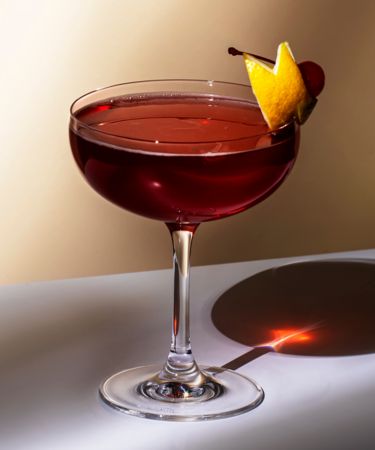
All roads lead to Manhattan. At least, that’s the case when considering the cocktails named after New York City neighborhoods.
While longtime cocktail monikers like the Manhattan and the Old Fashioned make up the global beverage lexicon, New York City — one of the hottest hubs of contemporary mixology — has a set of unique concoctions inspired by its many neighborhoods. Many of these arose from the early aughts cocktail renaissance. Bartenders at Milk & Honey, Death & Co., Please Don’t Tell, and Clover Club — a coalition of bars that elevated NYC’s now-lauded cocktail scene — riffed on the Manhattan rubric (rye, sweet vermouth, and bitters) to make new and exciting drinks inspired by smaller, less popular neighborhoods.
“The best way to create some semblance of originality or risk is on things that already work and that are tried and true, the Manhattan being that case,” says Allen Katz, cocktail historian and co-owner of cocktail bar Jaywalker and the onsite rye and gin distillery Jaywalk. “Within that framework, there are lots of choices and variations.”
Despite owning a rye distillery himself, Katz says part of the early 2000s emergence of NYC-inspired cocktails comes from the relatively recent popularity and accessibility of vermouth. As such, when building any of the drinks below, the quality of the vermouth is equally important as that of the spirit. “There were not nearly as many vermouths available [in the late 19th century] as there are today, so it’s a really exciting time to experiment with a cocktail that’s so seemingly simple as the Manhattan,” Katz says.
With that, here’s a list of the cocktails named after NYC neighborhoods. Unless otherwise noted, these are all takes on the Manhattan, featuring rye, sweet vermouth, and bitters.
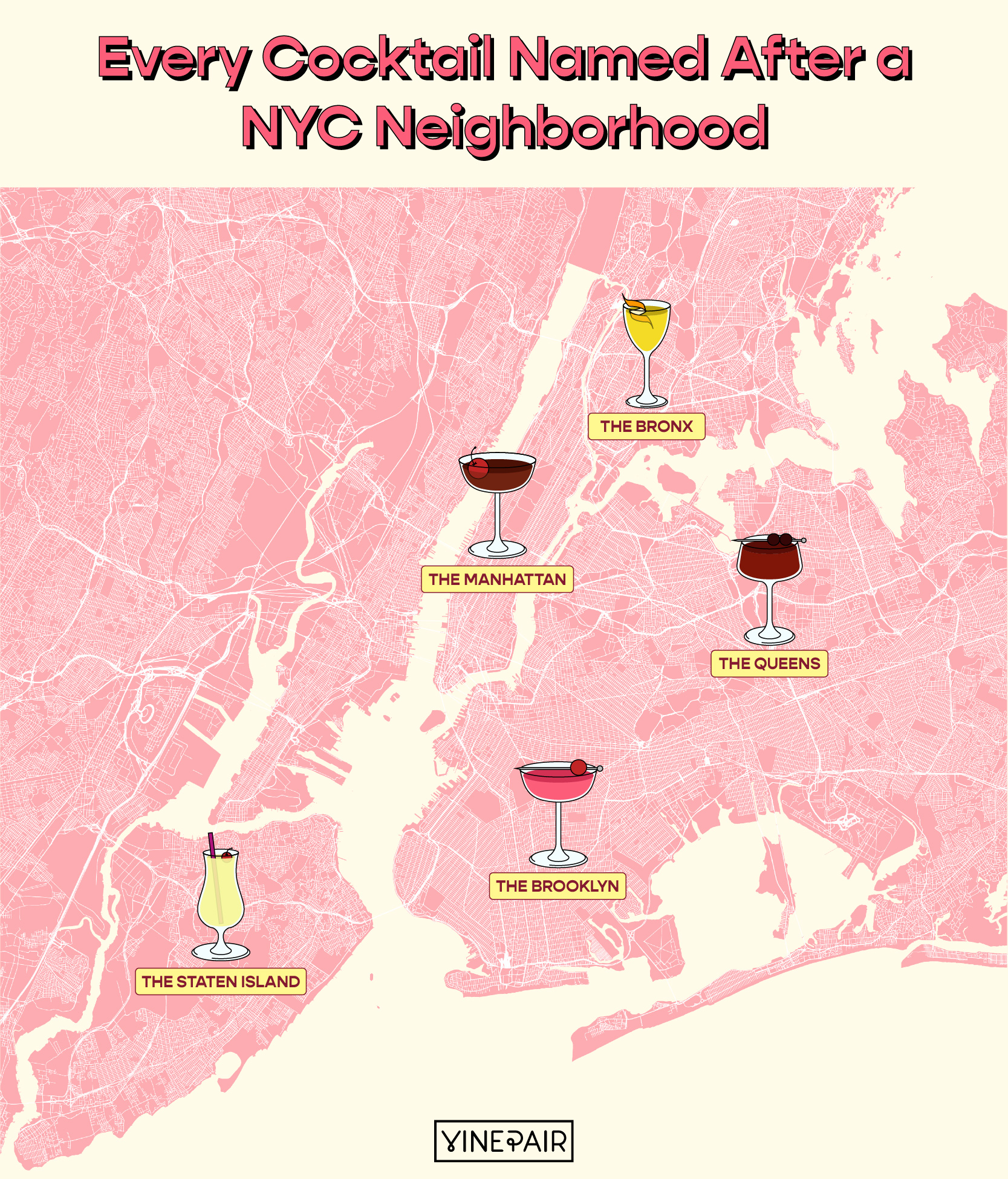
The Five Boroughs
Manhattan
While the origin of the Manhattan isn’t certain, the story goes that it was first concocted in the 1870s as an homage to presidential candidate and Manhattanite Samuel J. Tilden (he lost to Rutherford B. Hayes). In its most classic form, a Manhattan is just rye, sweet vermouth, and Angostura bitters. Some contemporary versions may exchange the rye for bourbon, though purists would raise their eyebrows at that substitution. The canonical cocktail is served up with a cocktail cherry in either a coupe or a rocks glass.
Brooklyn
The Brooklyn emerged in the early 1900s. It matches a Manhattan with the inclusion of rye and vermouth, but it diverges in the use of an inaccessibly esoteric aperitif: Amer Picon. The aperitif hasn’t appeared on American shelves in years, but for those curious about the Brooklyn cocktail, it can be swapped out for a citrus-forward amaro. Beyond Amer Picon, rye, and dry vermouth, the Brooklyn includes maraschino liqueur and is garnished with a cocktail cherry.
Bronx
The Bronx was a popular cocktail in the decades leading into Prohibition. While the drink’s creator is contested, many believe it was first mixed at the Waldorf Astoria hotel in the early 20th century. The Bronx is essentially the love child of the Manhattan and the Gin Martini. It’s a mixture of gin, dry vermouth, sweet vermouth, orange juice, and orange bitters and is served in a Nick & Nora glass with an orange twist.
Queens
One of the earliest appearances of the Queens cocktail is in “The Savoy Cocktail Book” by Harry Craddock, which was released in 1930. Craddock published it as “Queen’s,” which could indicate that the drink originated as an ode to a royal figure, but it has nonetheless stuck within the NYC cocktail canon. The drink is a riff on the Perfect Martini that includes gin, sweet vermouth, dry vermouth, and pineapple juice for a tropical edge.
Staten Island Ferry
Staten Island as a borough may not have an eponymous cocktail, but its famed ferry does. The Staten Island Ferry is reminiscent of a Pina Colada: It’s made up of coconut rum and pineapple juice. How the cocktail came to be and how it got its name are unknown.
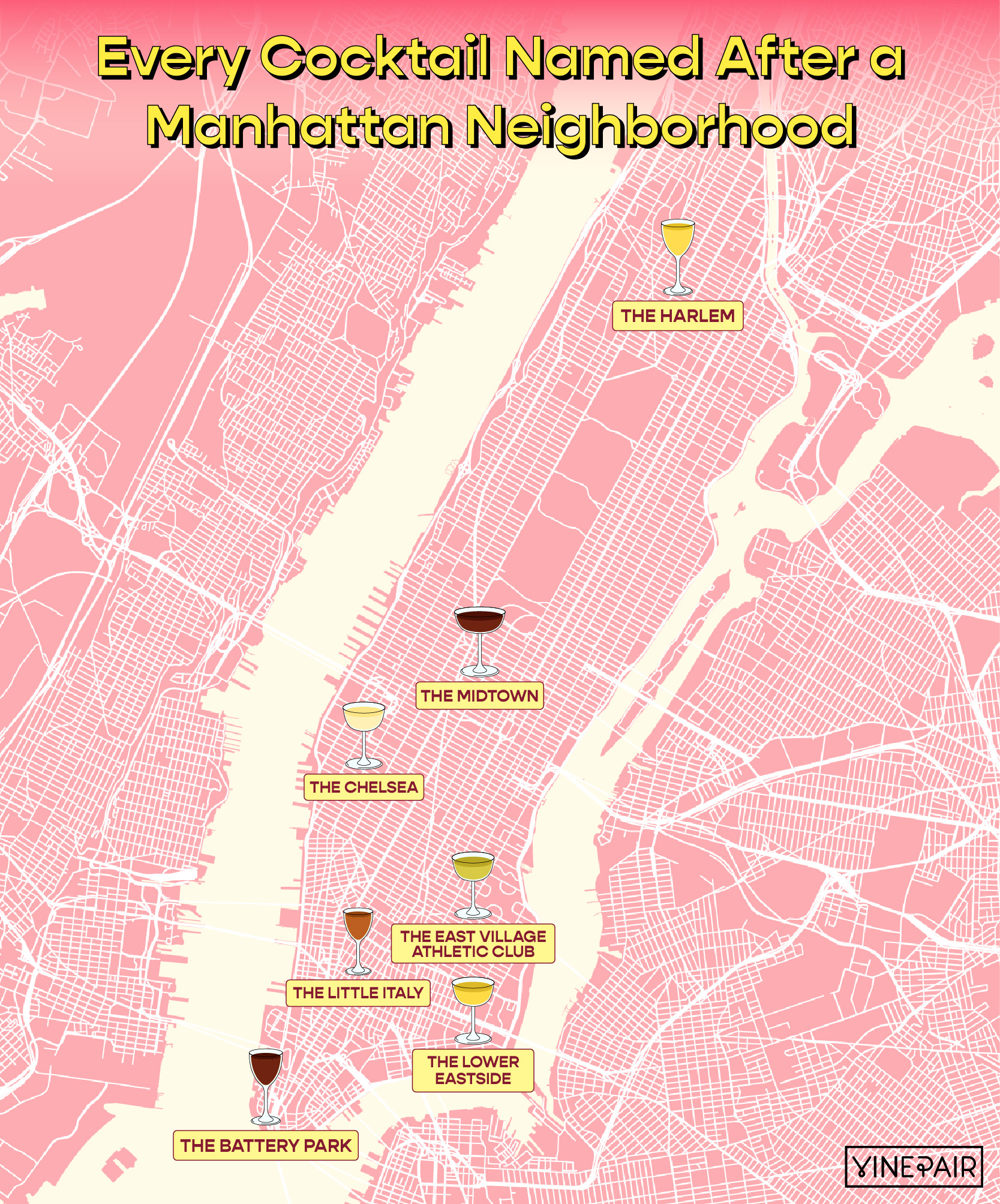
Manhattan Neighborhoods
Battery Park
The Battery Park is one of the most overlooked, unknown cocktails on this list. Those in the know refer to the drink as a combination of an Old Fashioned and a Manhattan. The Battery Park is a blend of bourbon, Drambuie, sweet vermouth, amaro, and chocolate bitters. It’s served in a Nick & Nora glass and adorned with a cherry.
Chelsea
The Chelsea is an iteration of the Sidecar and is alternatively known as the Chelsea Sidecar. While it retains the classic cocktail’s lemon juice and triple sec, it substitutes the original’s brandy for gin. The Chelsea also veers from the first version by incorporating simple syrup and a few drops of saline. It’s served in a coupe and dressed with a swath of lemon peel.
East Village Athletic Club
Jim Meehan, John Deragon, and Don Lee together conceived of the East Village Athletic Club at Please Don’t Tell — located, of course, in the East Village — in 2008, according to the bar’s cocktail recipe book. The East Village Athletic Club consists of blanco tequila, yellow Chartreuse, Grand Marnier, and lemon juice. The mix is served in a coupe glass and decorated with a lime wedge.
Harlem
Most believe the Harlem came onto the map just after Prohibition, when the Cotton Club, a storied cocktail bar in the neighborhood, began serving the concoction. The drink combines gin, maraschino liqueur, pineapple juice, and bitters and is poured into a Nick & Nora glass before being garnished with a cherry.
Little Italy
The now-closed Pegu Club first served the Little Italy in 2005. The drink was christened as such because the mixologists exchanged the Manhattan’s bitters for Cynar, an Italian amaro. The Little Italy is traditionally garnished with a cherry and served in a Nick & Nora glass.
Lower East Side
The Lower East Side cocktail, also known as the Eastside, is credited to either former Libation bartender George Delgado or Chad Soloman of Milk & Honey, one of the most elite outfits in NYC’s burgeoning craft drinks scene of the early aughts. Served in a coupe glass, the drink is a bright, refreshing concoction of gin, lime juice, simple syrup, mint, and cucumber.
Midtown
The Midtown cocktail is a bittersweet concoction. As constructed by Leandro DiMonriva, bartender and content creator behind “The Educated Barfly,” the Midtown adds Zucca Rabarbaro amaro, cherry liqueur, and grapefruit bitters to the Manhattan base. The cocktail often comes in a coupe, garnished with a strip of grapefruit peel.
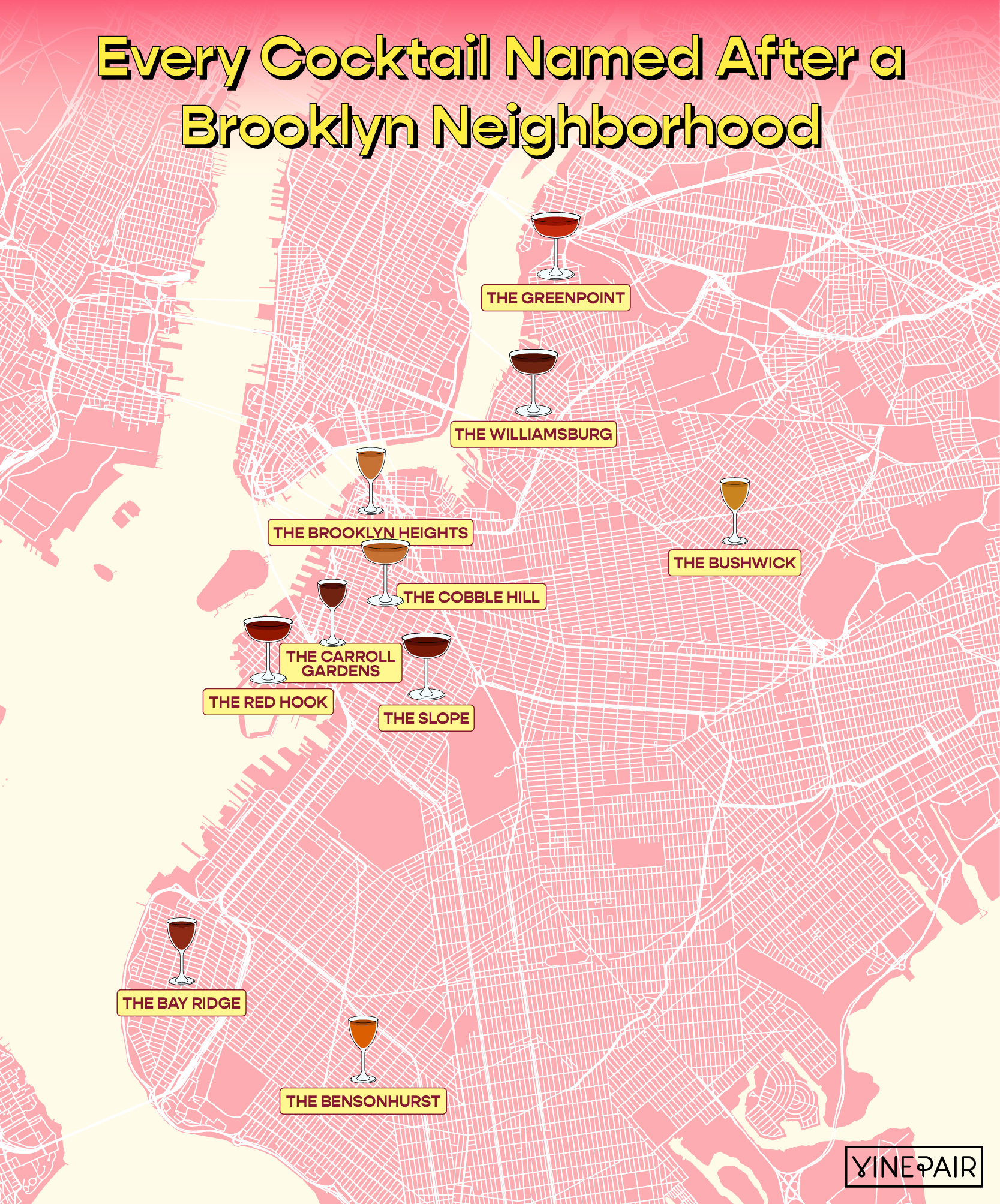
Brooklyn Neighborhoods
Bay Ridge
The Bay Ridge entered cocktail drinkers’ lexicon when Tom Macy invented it at his bar Clover Club in Brooklyn. The drink brings a brighter, more herbaceous flavor profile to the Manhattan-inspired cocktail rubric. The Bay Ridge consists of rye, dry vermouth, Bénédictine, prune brandy, and bitters. The cocktail is served in a Nick & Nora glass and dressed with an orange peel.
Bensonhurst
Chad Solomon first mixed the Bensonhurst in 2006 while splitting his time behind the stick at both Milk & Honey and Pegu Club. As a nod to the namesake neighborhood’s Italian-American roots, and as a way to avoid the hard-to-find French aperitif, the Bensonhurst replaces the Amer Picon in the Brooklyn with Cynar. In addition to the amaro, the cocktail includes rye, dry vermouth, and maraschino liqueur and is served in a Nick & Nora glass.
Brooklyn Heights
Bartender Maxwell Britten invented the Brooklyn Heights at the neighborhood’s former cocktail bar Jack the Horse Tavern. In addition to a rye whiskey base, the cocktail includes an Italian red bitter liqueur like Campari, maraschino liqueur, dry vermouth, amaro, and bitters. Traditionally, the Brooklyn Heights comes in a Nick & Nora glass with a lemon twist as the garnish.
Bushwick
Phil Ward invented the Bushwick in 2009 at his agave spirits-focused bar Mayahuel in Queens. The drink does not include tequila or mezcal and is, instead, a riff on the Brooklyn. It mimics its mother recipe with rye, maraschino liqueur, and Amer Picon but differs in its substitution of sweet vermouth for dry vermouth. The Bushwick comes in a Nick & Nora glass and typically without an adornment.
Carroll Gardens
Acclaimed bartender Joaquín Simó crafted the Carroll Gardens as an offshoot of the Red Hook (see below) while working at Death & Co. in NYC’s East Village. Like the Red Hook , the Carroll Gardens includes rye, Punt e Mes, and maraschino liqueur, then adds amaro and saline as well.
Cobble Hill
Sam Ross invented the Cobble Hill at Milk & Honey in 2009. Like most other NYC-inspired cocktails, this drink starts with rye whiskey but gets enlivened with muddled cucumber, dry vermouth, and amaro. The Cobble Hill is served in a coupe glass and garnished with fresh cucumber slices.
Greenpoint
Michael McIlroy invented the Greenpoint at Milk & Honey with the goal of giving his home neighborhood the named-cocktail treatment. Rye whiskey, sweet vermouth, and bitters set the drink’s foundation, but its incorporation of yellow Chartreuse gives the otherwise boozy cocktail a more palatable lift. (Why McIlroy opted for yellow, not green, Chartreuse in the Greenpoint remains unknown.) It’s garnished with a lemon twist and served in a coupe glass.
Red Hook
The Red Hook cocktail was invented by Italian bartender Vincenzo Errico at Milk & Honey in 2003. The drink combines rye whiskey, maraschino liqueur, and Punt e Mes. It’s served in a coupe and garnished with a cherry.
The Slope
The Slope refers to Park Slope in Brooklyn. The drink, invented by Julie Reiner, was the proprietary Manhattan at Clover Club, which she co-owned. It combines rye, Punt e Mes, apricot liqueur, and bitters. It’s served in a coupe glass and adorned with a dried apricot.
Williamsburg
The Williamsburg is for bourbon lovers. In addition to the whiskey, the cocktail includes Punt e Mes, dry vermouth, and yellow Chartreuse. Most versions are served in a coupe or tulip glass and topped with a lemon twist or cherry.
*Image retrieved from 5ph via stock.adobe.com
