![From ‘Dry’ to ‘Neat’: A Guide to Every Common Bar Call [Infographic]](https://vinepair.com/wp-content/uploads/2026/09/a-guide-to-common-bar-calls-2026-card-375x450.jpg "From ‘Dry’ to ‘Neat’: A Guide to Every Common Bar Call [Infographic]")
Listening to orders while crowding around a busy bar can make it feel like the bar world has its own language. Though there are out-there terms like “make it skate,” even common words like “dry,” “neat,” and “on the rocks,” often carry a different meaning in a cocktail-slinging setting than in everyday life.
Some might recognize this lingo from movies, while seasoned drinkers might know each call by just hanging around the local watering hole. Even though these terms are widely accepted bar vernacular, their meanings aren’t always clear — though some definitions are pretty straightforward, others sound like the exact opposite of what they actually mean.
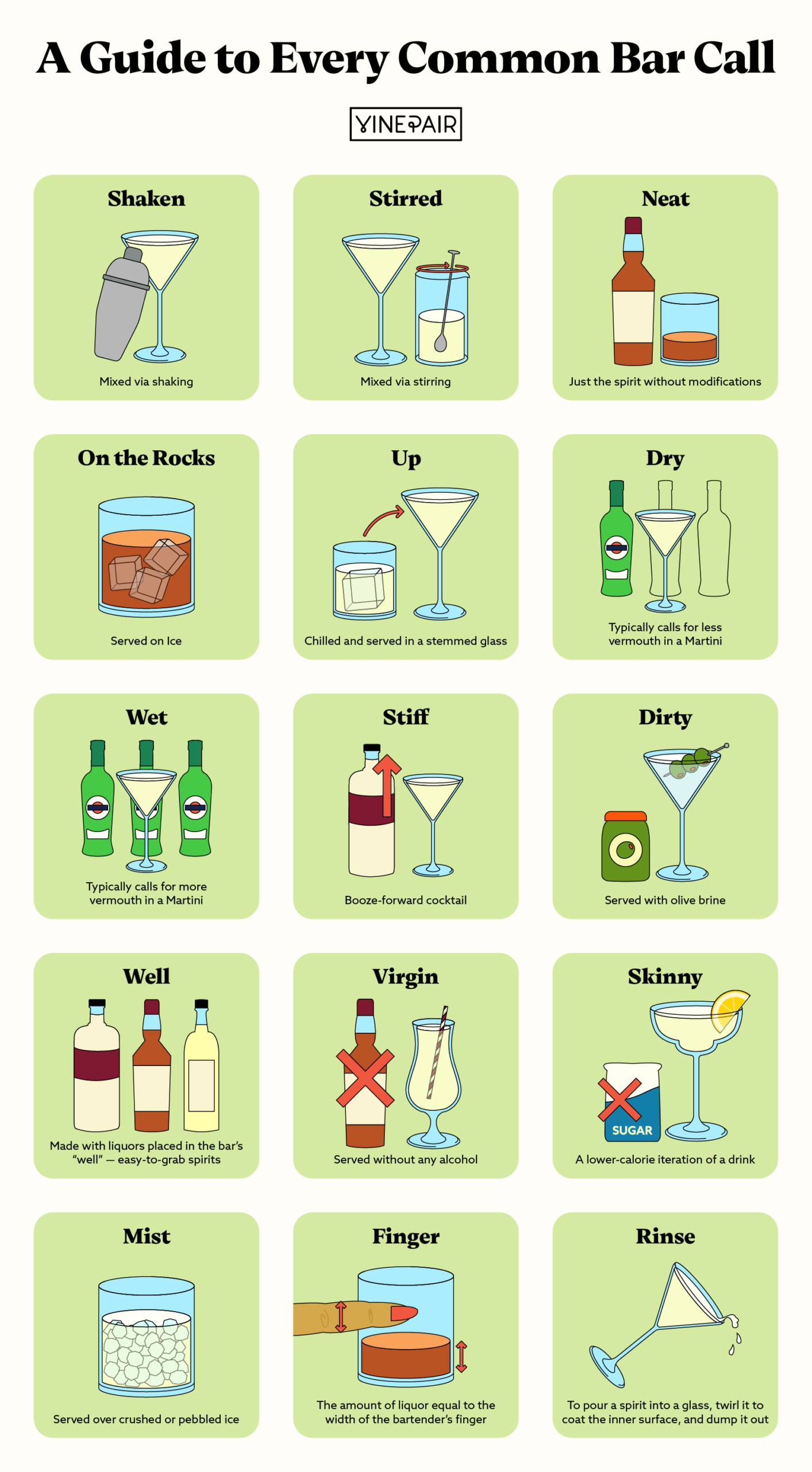
That’s why we compiled a list explaining 15 of the most common bar calls you might encounter on an average night out. Just as bartenders should master the terms to understand what drinkers want, everyday consumers should also familiarize themselves with these terms to better convey to those behind the stick exactly what they want out of their drink. From “dirty” to “wet,” here is the ultimate guide to popular bar calls.
The Most Common Bar Call Terms, Explained
Dirty
Most commonly associated with Martinis, asking for a drink “dirty” means adding olive juice to it. Drinkers might use additional adjectives to describe just how much olive juice they like, such as “a little dirty,” “extra dirty,” or “filthy.”
Dry
While it seems paradoxical to call any beverage “dry,” this term pertains to the sweetness of a drink, where “dry” translates to the opposite of sweet. The call is typically used when ordering a Martini, with “dry” indicating a preference for a boozier Martini that includes less vermouth. Consumers can specify the amount of vermouth with other modifiers like “extra dry” or “bone dry,” meaning very little to no vermouth.
Finger
A “finger” is a rough unit of measurement that equates the amount of liquor poured to the width of the bartender’s finger. Drinkers can ask for a “finger of whiskey,” meaning the bartender pours just enough whiskey in the glass so its volume matches the height of their finger resting horizontally at the bottom of the glass.
Mist
“Mist” means serving a spirit or liqueur poured over crushed or pebbled ice. For example, drinkers can ask for a “vodka mist” or “whiskey on a mist.”
Neat
One of the most commonly used terms when ordering a pour of a spirit, asking for a drink “neat” suggests you would like the spirit on its own without any other modifications — no ice, mixers, or other ingredients. The result is a room-temperature, uncut liquor.
On the Rocks
To ask for a spirit or a cocktail “on the rocks” simply means serving it on ice. Most commonly, the drink would be served in a rocks glass, poured directly over ice cubes. This call ensures a cold beverage that will slowly dilute.
Rinse
A “rinse” is part of a drink’s build. It means to pour a bit of a spirit into a glass, twirl it around so it coats the inner surface, and dump it out. Though this might seem wasteful, rinsing a glass with a potent spirit or liqueur like absinthe or peaty Scotch can add some serious complexity to the final drink. Plus, it makes for a theatrical moment behind the bar.
Shaken
Asking for a drink “shaken” refers to its preparation. Ordering a cocktail shaken entails that the ingredients are added to a cocktail shaker and agitated (by shaking) until well combined. This technique — typically employed in cocktails with citrus juice — leads to an aerated, frothy texture in cocktails like a Whiskey Sour.
Skinny
Ordering a “skinny” version of a drink means asking the bartender for a lower-calorie iteration. In such cases, the bartender may cut back on sweeteners or other sugary ingredients, such as in a Skinny Margarita.
Stiff
Just as your muscles stiffen up when sipping on a strong drink, ordering a drink “stiff” means asking for a more booze-forward cocktail. This might entail upping the proportion of spirit in the drink or using smaller measurements of one or more of the modifiers in the build.
Stirred
“Stirred” is the counterpart to “shaken.” Rather than building ingredients in a shaker tin to combine, the components of a stirred drink are poured into mixing glass — either with or without ice — and mixed together until combined. The result is a silkier, less bubbly texture than a “shaken” cocktail. Drinks that are stirred are usually more booze-forward cocktails like the Negroni and Old Fashioned.
Up
To order a cocktail “up” is a reference to both the preparation and glassware it is presented in. Instead of in a rocks glass, an “up” drink would be served in a stemmed glass. It is shaken or stirred with ice until well-chilled, then poured into a Martini glass, Nick & Nora, or coupe. The term “straight up” can also be used, though the term is a bit more loosely defined.
Virgin
A “virgin” cocktail is one without any booze at all. This call typically refers to drinks with ingredients that can be substituted with soda or other zero-proof ingredients, such as a Mojito, a Moscow Mule, or a Piña Colada.
Well
A “well” drink is one made using liquors placed in the bar’s “well,” the easy-to-grab, go-to spirits. The set of well drinks includes simple two-part quaffs like a Vodka Soda or a Rum and Coke. However, classic and more technical cocktails like an Old Fashioned can also be made with “well” spirits. In those cases, the build is the same but with more budget-friendly ingredients.
Wet
The opposite of “dry,” a “wet” Martini refers to one with a considerable amount of dry vermouth. Cocktail bars have their own Martini specs, but asking for one “wet” informs the bartender that you want more vermouth.
*Image retrieved from Isabella Kara via unsplash.com
