The earliest records of winemaking date back to 6000 BCE, and the oldest known winery — now referred to as Areni-1 — was in operation as far back as 4100 BCE. The oldest wineries that still exist today, however, weren’t established until the Common Era.
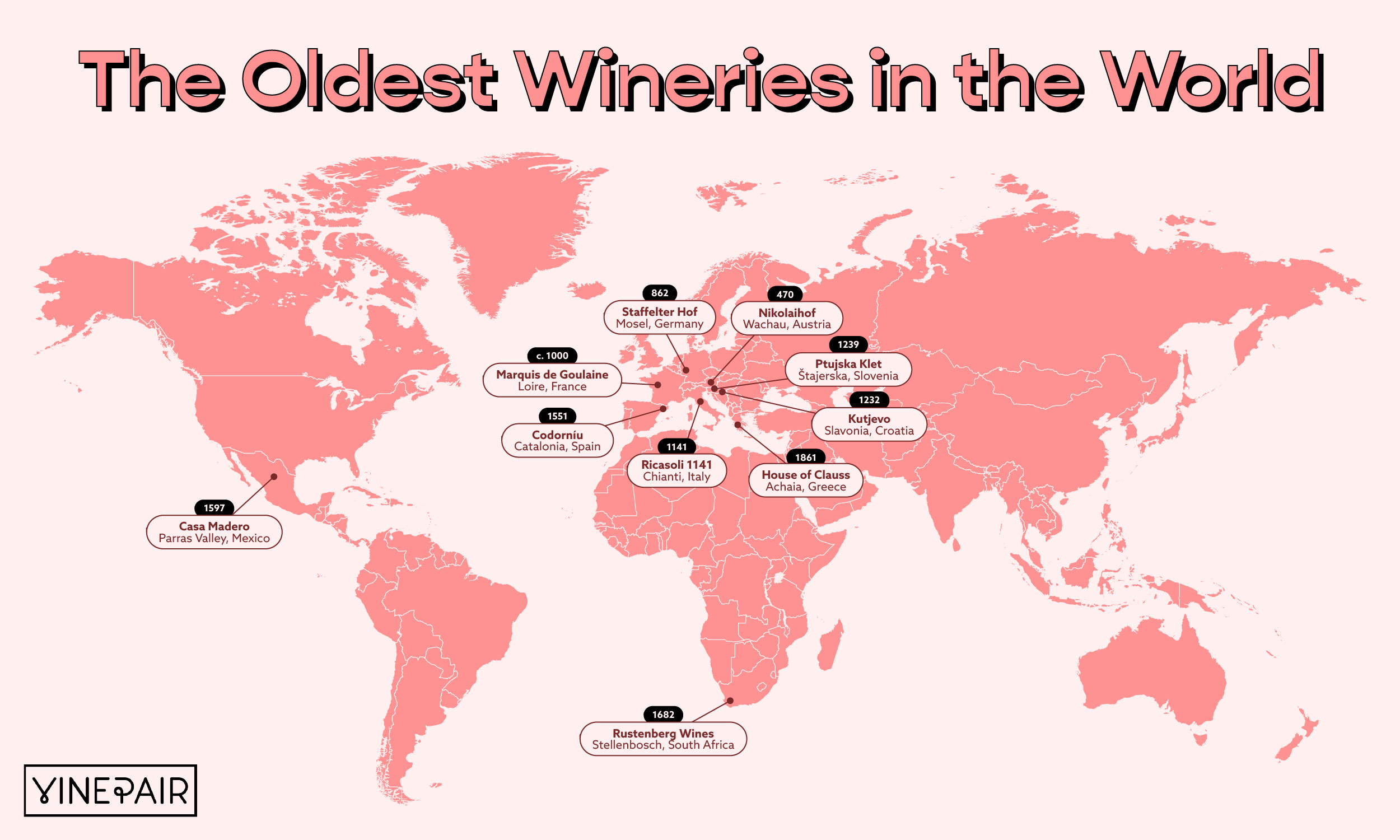
For this roundup of the world’s longest-running wineries, we looked to the oldest winery that still exists today in 10 different countries. Many of the world’s oldest, continuously operating wineries began as monastic cellars vinifying grapes for religious reasons or noble families’ estates making recreational wine. We considered each winery’s earliest record of winemaking as its starting date — not when it began operating as a business.
Below, you’ll learn how evolving sociopolitical tides shaped the early histories of these wineries and how they continue to adapt to shifting consumer habits today.
Nikolaihof, Wachau, Austria
The foundations of Nikolaihof — the oldest existing winery in Austria — were first laid by the Romans as a fortress in 63 CE. The earliest record of winemaking at the estate dates to 470 after monks acquired the estate. In 770, the property was handed to Kremsmünster Abbey and was later taken over by a monastery called Saint Nikola of Passau, which led to its current name. During the Final Recess in 1803, many abbeys and monasteries in the Holy Roman Empire secularized, including Nikolaihof. Ninety-one years later, the Saahs family purchased the estate and remains as its owners today. Under the direction of Nikolaus and Christine Saahs, in 1971 Nikolaihof adopted biodynamic cultivation practices, which are still used at the winery today.
Staffelter Hof, Mosel, Germany
The earliest mention of Staffelter Hof dates back to 862 when the Carolingian dynasty donated the property in Mosel, Germany, to a local monastery. The change in ownership marked the dawn of Staffelter Hof’s winemaking age, albeit for religious purposes. Staffelter Hof secularized under Napoleon in 1803, and the French government owned the property for the next two years until Peter Nikolaus Schneider purchased it. Staffelter Hof has remained in the same family since then, though under the surname Klein. Over the course of its more recent secular history, Staffelter Hof has endured a number of contractions and expansions. The winery’s most recent update was a pivot to producing organic, “natural” wines in the 2010s in response to the growing popularity of the vinification style in the Mosel.
Marquis de Goulaine, Loire, France
Some accounts say the Goulaine family laid the foundations for its estate, Château de Goulaine, as early as 1000 in Nantes, an area of the Loire Valley. Around then, the château began vinifying its estate grapes for casual, domestic consumption, but the bountiful harvests led Château de Goulaine to begin selling its wine. Today, the château continues to produce wine under the Marquis de Goulaine label, making it one of the last châteaus in the Loire still producing wine and the oldest existing winery in France. Marquis de Goulaine is most known for its Lorraine whites, such as Muscadet and Sauvignon Blanc.
Ricasoli 1141, Chianti, Italy
The earliest documentation of the Ricasoli family’s winemaking ventures comes from 1141, which took place at the Brolio Castle in the Chianti area of Tuscany, Italy. The estate has been in the family ever since. Ricasoli 1141 — formerly Barone Ricasoli — began exporting its wine to international markets like England and the Netherlands in the 1600s, and in 1872, Bettino Ricasoli invented and bottled the blend that became Chianti Classico. Bettino’s great-grandson, Francesco Ricasoli, has been at the helm of the family business since 1993 and has made significant strides in scaling the winery to larger yields. Now, it is the largest winery in the Chianti Classico DOCG.
Kutjevo, Slavonia, Croatia
Cistercian monks founded the abbey and wine cellar that would become Kutjevo in 1232. The Jesuits were handed the property and its winemaking operations in 1698, then renovated the abbey and cellar and built a new parish. The Hungarian state owned Kutjevo from 1773 to 1882, until the Turković family took ownership after purchasing it at an auction. Another Croatian company called Božjakovina purchased the winery in 2003, and it is now known as Croatia’s oldest winery.
Ptujska Klet, Štajerska, Slovenia
Most accounts label 1239 as the beginning of Ptujska Klet, when monks built the first cellars beneath the city of Ptuj. The winery, now the oldest in Slovenia, was a state-owned business under Yugoslavian rule. Ptujska Klet became privately owned after Slovenia gained independence in 1991: A large-scale agricultural company acquired it and modernized the winery. Its site still features some relics from its time as a monastery-operated vineyard, including barrels and fermentation tanks.
Codorníu, Catalonia, Spain
Codorníu may be best known for producing the world’s first Cava in 1872, but the winery’s history begins over 300 years earlier. Jaume Codorníu founded the estate in 1551 with the intention of making still wines, making it the oldest existing winery in Spain. The Codorníus united with another popular Spanish winemaking family, the Raventós, when Anna Codorníu and Miquel Raventós married in 1659. Around 200 years later, Josep Raventós bottled the first expression of Cava, which is now the winery’s most produced style.
Casa Madero, Parras Valley, Mexico
Casa Madero was the first winery established in the Western Hemisphere. Spanish conquistadors arrived in Parras Valley, Mexico, in search of gold in the mid-16th century. There, they found land rife with water springs and wild grapevines. After catching wind of this fertile land, Jesuits came to Parras Valley in 1594 and were the first to vinify grapes in the region. In 1595, Don Lorenzo García requested a land grant, along with the rights to cultivate the land and produce wine, from the king of Spain. King Philip II accepted the request in 1597, marking the winery’s official founding. From then, Casa Madero was in the hands of 13 different owners until 1893 when Don Evaristo Madero purchased it, beginning the legacy of the family that still owns the estate. Casa Madero has since experienced a number of milestones, including opening its doors to tourists in 2003 and being named the first organic vineyard in Mexico in 2012.
Rustenberg Wines, Stellenbosch, South Africa
Roelof Pasman from Meurs, Germany, acquired a lot in Stellenbosch, South Africa, in 1682, which he named Rustenberg. Hailing from a town near the Rhine in Germany, Pasman had an eye for land suitable for winemaking. He had planted 5,000 vines by 1691 and began producing the estate’s inaugural wines shortly after. In 1810, owner Jakob Eksteen divided Rustenberg into two separate estates, but they merged again in 1945 under the direction of Peter Barlow. Now, Rustenberg is still held by members of the Barlow family, which has helmed the winery for 80 years and three generations.
House of Clauss, Achaia, Greece
In 1861, German immigrant Gustav Clauss founded Achaia Clauss, later renamed House of Clauss. He first landed in Greece in 1852 while working for a German company that exported raisins. Seven years later, Clauss bought the property for his vineyard. Beginning in 2008, all of House of Clauss’s production — except for its Mavrodaphne grape — was transferred to Germany. House of Clauss returned to Greece in 2025 and is now the oldest, continuously operating winery in the country.
*Image retrieved by Dan Meyers – unsplash.com
