Frozen cocktails have long been a warm-weather staple. But this summer, as we’ve faced the hottest month ever recorded in the U.S. and heat domes dominate the forecast, it’s safe to say Americans are drinking more icy cocktails than ever before.
Frozen Piña Coladas straight from a churning machine and fresh-from-the-blender Daiquiris are often popular picks. But there’s a new, eye-catching method that bartenders are increasingly turning to to make frosty, refreshing cocktails: shaved ice.
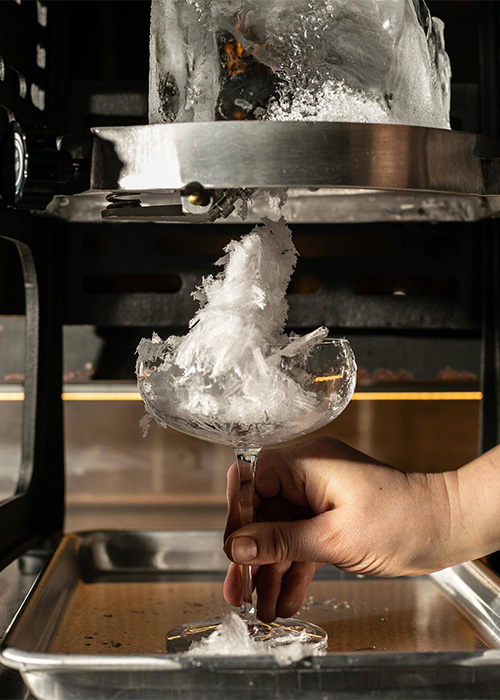
At bars and restaurants across the country, bartenders can be found hand-cranking massive machines, spinning hulking blocks of ice across sharp blades to create a fluffy mountain of freshly shaved ice for each drink. New York City’s Tokyo Record Bar added a Japanese-inspired drink with matcha liqueur and shaved ice to the menu to combat this year’s scorching summer. Meanwhile, Kansas’ Wild Child offers up a Midori Sour that resembles a boozy snow cone and East End Hardware in Houston has a slate of icy cocktails on the menu year round.
While more bars are opting into the growing trend this summer, the idea of cooling off with treats made of thinly cut ice is hardly new. From Sno-Balls in New Orleans and Puerto Rican piragua doused in fruit-flavored syrup to Korean bingsu and Filipino halo-halo, shaved ice is popular in dessert from all around the world. But now, cocktail pros are tapping into these longstanding traditions and bringing them over to the bar — one snow cone Martini and kakigori cocktail at a time.
Perfecting the Method
Translating shaved ice from a dessert eaten with a spoon to a version that’s drinkable and served in a glass is no easy task. To get in on this trendy technique, bartenders are painstakingly researching machines from around the world, fine tuning the size of each individual ice chip, and reworking recipes to achieve perfectly textured frozen drinks that can survive the intense dilution that comes from using small pieces of ice.
When NYC’s Bar Kabawa opened its doors in early 2025, it immediately made a splash with its signature Daiquiri, which pours the classic three-ingredient blend of lime juice, sugar, and rum over a towering pile of shaved ice. This puts on quite a show behind the bar, as guests can look on to see bartenders laboriously spin the arm of a large machine, generating a delicate snowfall of soft, frozen shards that falls into each coupe.
At the time, this wasn’t yet a common scene at a cocktail bar. Creative bartender at Bar Kabawa Kathryn “Pepper” Stashek says the first step was finding the right shaved ice machine for the task. At this high-caliber level of bartending, every detail is important and the team at Bar Kabawa went with a hand-crank version that allows them to manually dial in the size of ice chips created by the machine.
At other bars, the tool of choice that has emerged is the traditional machine designed for making kakigori, a Japanese dessert tradition that dates all the way back to the year 1002. In Japan, kakigori is typically made from natural spring water that is frozen and tempered until it becomes crystal clear, just like the cubes and spheres that bars order from specialized producers for drinks. Once the ice is prepared, it is shaved into a bowl and topped with ingredients like condensed milk, mochi, and fresh fruit.
“The drinks are good from the second sip through the very last sip. They tend not to get overdiluted and watery because they don’t reconstitute in the same way as a drink from a blender or frozen machine.”
Some more common types of shaved ice machines create shards that are thick and crunchy, but kakigori machines press the ice so closely against the blade that the pieces are nearly microscopic. When piled high into a glass, the tiny shards get extremely close to each other without combining, creating a fluffy consistency that bartenders love both for its visual appeal and satisfying texture.
In the U.S., most bars employ professional-grade machines that are manufactured in Japan from the company, Swan, which is one of the only options that is certified for food service by the National Sanitation Foundation. To use it, bartenders hoist a cylindrical block of ice, weighing about seven pounds, on top of the machine and turn on a motor that spins the ice over a stationary blade, quickly cutting off paper-thin slices that float into a glass below at a rate of up to five and a half pounds per minute.
Kevin Beary, the beverage director at Gus’ Sip & Dip, says he was drawn to kakigori-style ice over other models and techniques because the consistency is “dead on.” Classic frozen drinks made in a churning frozen machine can end up with separation that makes the cocktail unappealing when it starts to melt. Using shaved ice instead is a great way to avoid that messy situation. “The drinks are good from the second sip through the very last sip,” he says. “They tend not to get overdiluted and watery because they don’t reconstitute in the same way as a drink from a blender or frozen machine.”
Before landing on the Swan machine, which Beary calls the “Cadillac of shaved ice machines,” the team tried a manual, hand-crank model that leaves the ultra-sharp blade more exposed than professional versions. “We were covered in Band-Aids,” Beary says.
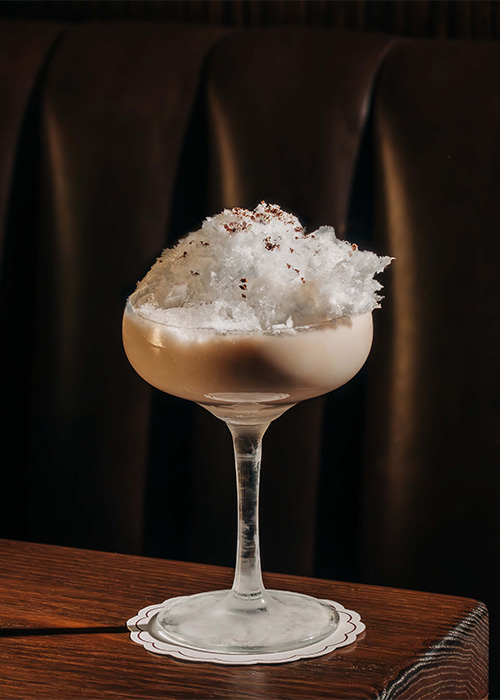
The menu at Gus’s Sip and Dip has three drinks served on shaved ice: a classic Margarita, a Hemingway Daiquiri, and a creamy, dessert-like Grasshopper. The Dirty Martini is also effectively garnished with shaved ice as a tiny pile of shavings is dusted on top before serving. Beary shares this was inspired by guests ordering Martinis and asking to “make it skate” by including unstrained ice chips on top. With four drinks showcasing shaved ice, the team goes through 21 large blocks of ice per shift and a large part of prep time involves making the ice in a Clinebell freezer to prepare for the next day’s service.
Shaved ice melts faster than traditional cubes, so bartenders have to account for dilution differently when developing cocktails that will live on a bed of fine, flaky ice. Shaking or stirring with ice can result in a cocktail that’s final volume is anywhere from 15 to 30 percent water — when ice is broken up into smaller pieces, it melts even faster and will add more water than that to the final drink. With that in mind, many bartenders opt to shake or stir the cocktail’s ingredients without ice, instead allowing the drink to naturally dilute as it sits on the bar. “I also liked that the drinks develop over time,” Beary adds.
All About the Look
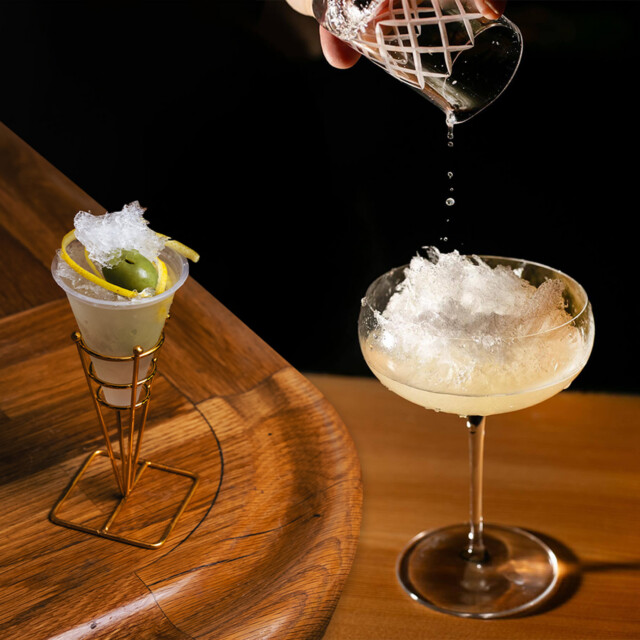
While the texture is no doubt refreshing, Darryl Chan, the bar director of NoHo Hospitality Group, says he wanted to introduce shaved ice at The Dutch to add a playful touch to the restaurant’s dedicated Martini Bar offerings. The menu launched earlier this summer, featuring a drink called the Dirty Snow Cone, a briny vodka Martini with a touch of Chartreuse Élixir Végétal served in a cone of shaved ice. “It’s a fun presentation. There’s an art to it,” says Chan. “In a city full of serious Martini drinkers, I wanted to take the Martini and not make it so precious.”
Chan originally developed the cocktail for Tales of the Cocktail, an annual event when the industry descends upon New Orleans amid its swampiest season. When spiked snow cones were handed over the bar, the sight stopped parched and tipsy bartenders in their tracks at the event — and Chan was certain it would have the same appeal during a toasty NYC summer.
From the avalanche of shaved ice coming off the machine to the ice collapsing on itself in the glass, Chan says the drink provides a show from start to finish. In an era where unconventional garnishes are commonplace and people head to the bar in search of both showmanship and expert-crafted drinks, guests have quickly latched on. “People come in wanting to order it or they see tables getting four of them and end up ordering,” he says. “It definitely turns heads.”
For others, like Stashek at Bar Kabawa, the showmanship that comes with serving shaved ice was simply a “fun side effect” of making an excellent drink that nods to the way Daiquiris were first served in Havana.
”People ooh and aah, and that’s awesome, but that certainly was not the main focus when we were developing it,” she says. “We really lucked out. Videos and social media stuff are an important part of being in the food and beverage scene right now, but it really happened organically for us.”
*Photos retrieved from Bar Kabawa, Gus’ Sip & Dip, and The Dutch
