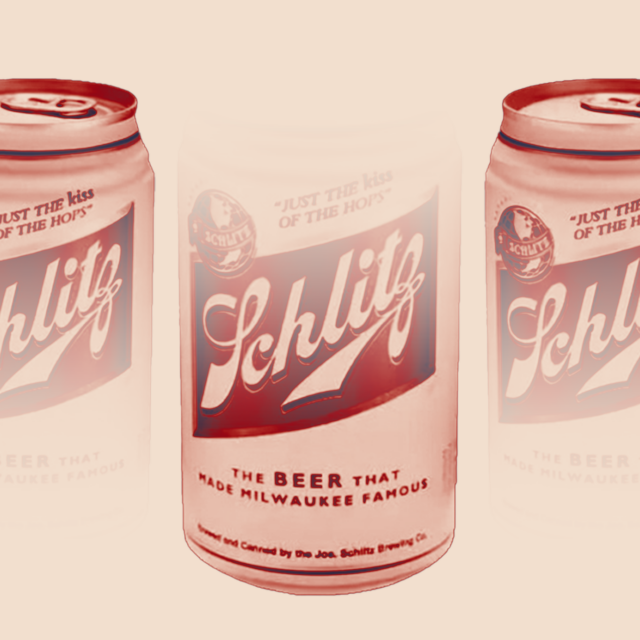
It seemed a Tuesday like any other for Adam Jevne back in mid-February. The 15-year beverage director of Lincoln Hall, Tied House, and Schubas Tavern, contacted his sales rep at Chicago distributor Lakeshore Beverage to place his usual, three-keg order of Schlitz, a.k.a. golden nectar, a.k.a. the best-selling beer on draft at Schubas, one of a few dozen Schlitz Brewery-tied houses still standing citywide. The answer would prove to be a bitter omen.
“He goes, ‘Did you hear — I’m sure you’ve heard — that Pabst is discontinuing Schlitz on draft?’” Jevne recalls. “I was like ‘What? I have not heard. That’s big news for me as a Schlitz-tied house.’”
Around that time, Friends of Friends co-owner Abe Vucekovich heard from a Pabst brand manager that Schlitz production would be limited solely to longneck bottles — suspicious in hindsight given the higher production and shipping costs of glass, he muses. Patrons routinely dispatched three to four half-barrels a week at Vucekovich’s then nine-month-old bar emblazoned with a belted Schlitz globe on its facade. Holding out hope, he switched to bottles, which were soon moving fast enough that Vucekovich bought a dedicated fridge behind the bar.
Murmurs grew louder among bartenders and on online forums as supplies of the beloved American lager dried up citywide. Old Town Ale House is on its last keg. Red Lion pub in Lincoln Park got the rest of the tallboy cans. Kite String in Roscoe Village still has some!
When a planned meeting between Jevne and a Pabst brand manager never materialized, he called his contact at Glunz, a Schlitz distributor since the late 19th century (and the region’s largest), who declared the brand done. Jevne more than doubled his order; his new weekly question for Lakeshore became: “How many kegs of Schlitz are left?”
In mid-April, Vucekovich heard from Pabst directly that it was pulling the plug on the storied, 177-year-old lager. The brewing giant confirmed the news via email on May 15, some three months after the initial rumblings.
“Unfortunately, we have seen continued increases in our costs to store and ship certain products and have had to make the tough choice to place Schlitz Premium on hiatus,” Zac Nadile, head of brand strategy at Pabst, said in a statement. Pabst left the window of hope open just a crack. “Any brand or packaging configuration that is put on hiatus is still a cherished part of our history and hopefully our future. We continually look for opportunities to bring back beloved brands and customer feedback is important in shaping those discussions.”
The move reflects a pattern of Pabst quietly sunsetting production of budget brands with regional cult followings such as Blatz and Old Milwaukee bottles. It comes on the heels of reports that the company laid off 60 to 70 employees in December and put its San Antonio office on the market.
“For a lot of us, there’s that family connection to it, childhood memories of our fathers or grandfathers sitting on a lawn chair with a 6-pack of Old Style or Schlitz.”
Amid a broader correction in the oversaturated beer market, macrobrewers have been culling their bloated portfolios for months, mostly of craft beer brands. Jevne had almost grown used to the abrupt disappearances of cult-favorite craft brews, “but I’ve never seen anything like this on a large national scale,” he says. “This was a shock.”
Could it be a harbinger for other cheap, macrobeer-owned regional beers? (Attention: Hamm’s, Natty Boh, and Rainier fans; it’s gut-check time.)
“If you zoom out and look at national beer, it’s no surprise that a big company like that would kill a little brand like Schlitz to focus on bigger regional ones like Lone Star,” Jevne says. “Is this the beginning of big macrobreweries killing off small regional brands?”
A Storied History With Deep Chicago Roots
Those cusping on drinking age in households stocked with artfully appointed craft beer cans may not feel pangs of nostalgia when they see the scripted Schlitz logo inscribed on a condensation-beaded can. But for Chicagoans of a certain age, adolescence no doubt features a memory of stealing a can of clean, lightly sweet Schlitz from Dad’s basement cooler stash.
“For a lot of us, there’s that family connection to it, childhood memories of our fathers or grandfathers sitting on a lawn chair with a 6-pack of Old Style or Schlitz,” says Chicago-based beer historian Liz Garibay, who is executive director of the Beer Culture Center.
Those a generation or two removed need only gaze upon the handsome, brick structures housing Schubas or Friends of Friends; dotting Armitage Avenue between Damen and Western Avenues; or the few surviving “Schlitz Row” edifices just outside the Pullman neighborhood to understand the historic hold of Milwaukee-born Schlitz on Chicago.
“The Schlitz globes are everywhere, whether the place is still a bar or not,” Vucekovich says. “It gets you thinking about the history and what these places meant as corner bars for different communities. To still see them standing is kinda wonderful like, oh, this is Chicago.”
“The beer that made Milwaukee famous” was born in 1849 when a German immigrant named August Krug started brewing beer in the basement of his restaurant. When Krug died in 1856, his bookkeeper, Joseph Schlitz, took over the brewery and renamed it after himself. The brewery grew in lockstep with the industrial age. In the wake of the 1871 Chicago Fire, Schlitz shipped hundreds of free barrels of beer to thirsty Chicagoans, seeding loyalty that would sustain the brand for decades. By 1902, Schlitz had sold over 1 million barrels of beer, making it the world’s largest brewery.
Owing to intense competition among brewing companies and a rash of new restrictions on public drinking houses amid the budding temperance movement, brewers like Pabst, Miller, and Schlitz adopted the U.K.’s tied house system, buying up saloons and only serving their beers. Brewing companies contracted architects to design these handsome, high-style structures featuring arches and recessed panels heavy on craftsmanship, Garibay says. At its peak in the early 1900s, Chicago had around 70.
Schlitz famously brought disaster upon itself in the second half of the 20th century with a series of poor business decisions, starting with the calamitous “Drink Schlitz or I’ll Kill You” ad campaign followed by cost-cutting changes in ingredients and the brewing process that all but killed its slogan as the “most carefully brewed beer in the world.” Loyal drinkers abandoned the brand in droves, and Schlitz was reduced to a punchline.
In 1982, the Uihleins — owners of the profitable Uline business products company — sold Schlitz to Stroh Brewing. Pabst bought the brand in 1999 and in 2008 relaunched it with a new, allegedly 1960s-era formula to resuscitate its reputation.
Despite its towering history, the brand had lately dwindled in Chicago — clearer in hindsight to its devoted stewards.
“If I look back even a couple years, there have been periods of time where Schlitz was kind of difficult to get,” Jevne says. “There’d be weeks and weeks where supplies would run low and I’d keep asking, ‘Did the kegs drop yet?’ There aren’t, to my knowledge, a ton of places still pouring it on draft so it clearly wasn’t a priority brand for Pabst.”
A few Wednesdays ago, Schubas was still sitting on a few kegs when this writer popped by for a pre-Cubs-game Schlitz. Crisp and clean, its tawny bubbles danced skyward within the confines of their custom-engraved, footed pilsner glass. (Fun fact: When Schlitz stopped making branded glassware, Schubas was granted permission to custom-etch the logo on glasses itself, as long as it didn’t sell them.) Indeed, the beautiful old bar bedecked in old Schlitz cans and related tchotchkes had the air of an unofficial Schlitz museum long before the golden nectar started drying up, not least because bartenders love to wax poetic on its tied-house origins.
“If you zoom out and look at national beer, it’s no surprise that a big company like that would kill a little brand like Schlitz to focus on bigger regional ones like Lone Star. Is this the beginning of big macrobreweries killing off small regional brands?”
Jevne admittedly doesn’t drink the stuff as much as he did in his 20s, but the moment supplies started to dwindle, the staff took to ending shifts with a Schlitz or two. Chalk it up to the scarcity principle, maybe.
“It might be a little cheesy and mushy to say, but Schlitz quite literally built the house where many of us have found careers and met some of our closest friends,” Jevne says. “It’s always going to be a part of Schubas, part of our regulars’ lives and our lives.”
Schlitz is fittingly coming home to Wisconsin for its final run after years as a roving, contract-brewed macrobeer stepchild. Verona-based Wisconsin Brewing Co. will brew the final batch on May 23, which will be available to consumers on June 27.
Friends of Friends, meanwhile, squirreled away four kegs for a Memorial Day bash-slash Schlitz funeral, $5 a pint ’til they’re gone. It’s better than hobbling through the last few kegs until July, “like a relationship where you break up and you’re still roommates,” Vucekovich says.
He still isn’t sure which cheap beer will replace the golden nectar that he dubs “unspectacularly wonderful.” After all, it’s not just any old lager.
“I think more than anything it’s the history and what it means. Everyone’s got a story with Schlitz. It’s gonna be weird.”
