Miles Teller made two big beverage-alcohol moves to kick off 2023. In January, the actor upped his ownership stake in The Finnish Long Drink, the gin-based canned cocktail brave enough to ask “What if High Noon had a personality?” And in February 2023, he appeared in a nationally televised Super Bowl ad for Bud Light, a coveted casting that has often signaled the beginning of a lucrative multi-year campaign with parent company Anheuser-Busch InBev.
Just a couple months after Teller’s forgettable, Muzak-soundtracked turn shilling the country’s best-selling beer on the Big Game broadcast, of course, the brand became mired in a publicity fiasco that would push it into the arms of more MAGA-oriented endorsers like Shane Gillis and Dana White. But if that was a cloud of disappointment on the A-lister’s horizon, the silver lining arrived this past Monday, when White Claw parent company The Mark Anthony Group of Companies (MAG) announced its plan to acquire The Finnish Long Drink (FLD) for an undisclosed sum.
Cue the usual hosannas to the gods of synergy and scale, which you can read in full in the firms’ joint press release if you’re that sort of sicko. They even got FLD’s celebrity co-owner in there. “I first came across Long Drink as a fan — it felt different from anything else out there,” Teller said in a statement. “With The Mark Anthony Group of Companies, we have the right partner to introduce the brand to even more people without losing what made people enjoy it in the first place.” All very standard stuff, but nice enough.
I occasionally hear from readers who complain that I am too negative about the bev-alc industry. This is a category error, of course. I’m a journalist; if you want relentless positivity, hire a publicist, or get yourself glazed/lobotomized by ChatGPT. But contrary to what those guys (they’re always guys, of course) might think, I’m not pathologically incapable of alacrity vis-à-vis the trade. Here, I’ll prove it: I like this deal. I like it a lot more than FLD itself, which tracks as cloyingly sweet to my pedestrian palate. There’s an intuitive thesis and, importantly, that thesis makes sense. MAG’s acquisition of FLD is no sure thing, because there’s no such thing. But with the large caveat that we still don’t know the price tag, yes, this is smart. Congratulations to both parties.
[shudders violently]
Ugh. That’s more than enough of that. Let’s spend the rest of this column more productively by breaking down the angles on this acquisition.
As I wrote in a brief VP Pro Take on Monday, this deal makes too much sense. “This is such an obvious move it almost makes me angry,” I wrote. (Look at me, turning positives into negatives!) More:
On one hand, Mark Anthony Brands’ (MAB) malt- and cane-based fermentables have been at the forefront of the consumer pivot away from ingredient quality and artisanal provenance and towards big-honkin’ commodity flavors. On the other hand, Finnish Long Drink (FLD) has taken advantage of that turn with a higher-price point, spirits-based hard seltzer heir-apparent that has been a bona fide segment-expanding hit in the red-hot ready-to-drink segment.
MAB had dabbled with a vodka-based White Claw extension to respond to the threat from High Noon but began phasing out White Claw Vodka + Soda in summer 2025. It has had more luck with its Clawtails flavored-malt-beverage (FMB) line, which has no doubt helped to blunt attrition in the face of the explosive rise of Cutwater et al. But you don’t bring a knife to a gunfight, and you don’t bring an FMB to a spirits-based RTD fight. Now, MAB won’t have to.
Moreover, FLD isn’t just any spirits-based RTD. Off-premise scan data from NIQ crunched by Bump Williams Consulting (BWC) for Beer Business Daily last month puts the brand at 3.1 percent share of the red-hot segment, racking up $107.2 million in the 52 weeks through March 14 — a 23.2 percent year-over-year dollar gain. In the NIQ-iverse, it is the country’s ninth best-selling spirits-based RTD brand. Shanken Impact Databank, which measures both off- and on-premise, put FLD at 3.3 million 9-liter case equivalents for 2025, which would make it the United States’ sixth best-selling brand.
This is all without the backing of any major “strategic partner” (Teller doesn’t count) to deliver economies of scale on production, command wholesaler attention in the middle tier, and execute the integrated national marketing campaigns that really move the needle with the American drinking public. This is not impossible to pull off: Carbliss, Monaco, and most of all Surfside have managed to muscle their way into this rapidly consolidating goldmine independently. But it’s damn difficult, and demonstrates FLD’s “pull through” — demand, in the jargon — and strong positioning in this increasingly crowded cohort.
Maybe selling makes life easier for FLD’s founders, who will no longer have to deal with the vagaries of contract production once MAG takes over. (Woe to contractors like City Brewery, which are in line to lose a whole lot of volume.) But while the sellers get a better supply chain and, presumably, a bunch of cash, the buyer gets something even more dear: a powerful weapon for the RTD wars.
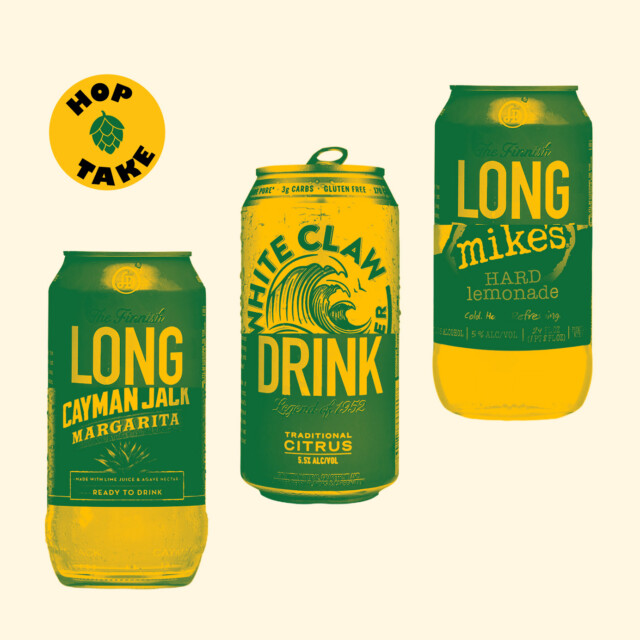
As I noted earlier this week, MAG has been a — if not the — big winner when it comes to capitalizing on John Q. Guzzler’s pivot to alcopops over the course of the past decade thanks to brands like White Claw, Cayman Jack, and Mike’s Hard Lemonade. It is the fourth-largest “beer” maker by volume tracked in the off-premise by market research firm Circana, despite not actually making beer. (The Sazerac Company, no slouch itself in the faux-beer game, could never.) But its rise has slowed as its footprint has swelled and the American palate has gotten a taste of liquor-based drink-a-likes. The company’s formidable FMB portfolio grew 0.0 percent in year-over-year dollars and declined 2.7 percent in volume according to Circana scans for multi-outlet grocery, mass retail, and convenience stores in the 52 weeks through March 22. (It has bounced back a bit in more recent frames.)
MAG has done some in-house “innovation” work to keep the good times rolling on fermentables, with varying degrees of success. White Claw’s ClawTails extension had a promising rookie year, racking up $23.7 million in NIQ-tracked off-premise channels sales for 2025 and landing on BWC’s list of the top 10 best-selling new products across flavored beverage alcohol for the year. It also rolled out Cayman Jacked — that’s 10 percent alcohol-by-volume Cayman Jack in 19.2-ounce stovepipes, for the uninitiated — last year. But after 27 years in the U.S. market, the Mike’s Hard brand family is slowing down a bit, losing 0.9 percent dollars and 3.4 volume year-over-year in Circana scans for the year through mid-March. It’s a double-whammy for MAG: Mike commands a higher price-per-case than Jack, and has almost double the share. The latter can’t backfill the former on its own.
More significantly, the wind is all blowing toward spirits-based RTDs, and like Molson Coors — which acquired Monaco parent Atomic Brands last month despite almost certainly being aware the more upmarket, less scaled FLD was up for sale, for reasons that may become clearer once we can compare prices — MAG had no entree there. It discontinued White Claw Vodka + Soda in the summer of 2025, perhaps deciding that going head-to-head with Gallo’s vodka-based High Noon was best left to ABI’s NÜTRL. But in that failure lies a clue as to FLD’s potential value to the House of Claw.
With its gin base and more substantive backstory — ”The Legend of 1952,” inscribed on each can, refers to real, publicly funded Scandinavian mixology R&D in advance of that year’s Olympics contest in Helsinki — it’s a high-end product that can defend a high-end price point and compete for many of the same occasions as vodka-seltzers without actually being one. FLD is differentiated enough to slip into a plan-o-gram or onto a bar menu that already features High Noon, without being so disparate that drinkers wouldn’t switch from the latter to the former. It also drinks a lot like MAG’s existing products, a competitive advantage for its salesforce that one imagines will inspire envy among the ABI reps and marketers currently getting acquainted with BeatBox’s various and sundry flavors.
None of this guarantees the deal will pan out, of course. MAG still has to figure out how to absorb FLD into its operation, something it has never done before with a brand this size. It will have to decide how to handle the rigmarole of wholesaler realignment. It will have to avoid the urge to tinker with the marketing or formula of its flashy new Finnish-ish toy, or start extending the hell out of it. (Though on that last challenge, it has proven much more disciplined than one-time hard seltzer rival Boston Beer Company has with Truly.) There are plenty of ways this sale can still go south.
But from where I’m sitting, it’s — ugh — a smart move.
🤯 Hop-ocalypse Now
There was much grumbling among industry insiders and enthusiasts last decade about the apparent goal-post moving the Brewers Association did to keep key member (and dues payer) BBC within the trade group’s definition of a “craft brewery” as its “beyond beer” stuff became more important to its bottom line. This decade, rank-and-file brewers are mostly too focused on staying afloat to worry about whether the Samuel Adams maker still belongs under the BA’s big tent. It remains in the fold. But the org’s just-released annual production data for 2025 show that the longtime No. 2 BA-defined craft brewer has finally been demoted from that spot by rival Sierra Nevada Brewing Co., which almost exclusively makes, y’know, craft beer. Imagine that! Anyway, Tilray Brands — maker of such illustrious craft offerings as Pub Cerveza, Shock Top LiiT, and Popsicle Hard — is now the country’s fourth-largest BA-defined craft brewer. So.
📈 Ups…
New Belgium Brewery’s CEO took to LinkedIn (lol) to brag that “$1 out of every $8 spent on craft beer in the US is spent on buying a New Belgium or Bell’s beer”… Tilray’s CEO told the British press that for BrewDog to succeed, it must escape the “stigma” of co-founder/chud James Watt… Reyes Beverage Group hired a vice-president for wine, best of luck to former Republic National Distributing Co. exec Patti Signorile… This is NOT investment advice, but BA economist Matt Gacioch thinks 2026 may be the year for “buying the dip”…
📉 …and downs
Ardagh Metal Packaging won a $175 million judgment against BBC stemming from a 2022 suit over the latter’s alleged failure to make contracted can purchases as the Truly boom went bust… The BA’s latest production data have craft beer at -5.1 percent volume year-over-year for 2025, which is a smidge less than overall beer at -5.7 percent… More middle-tier consolidation leaves the entire state of Vermont with just two beer distributors… Tilray filed to raise up to $180 million in new stock issuance, potentially diluting current bag shareholders… Bigtime beer-seller 7-Eleven is planning to close almost 650 stores in North America this year…
This story is a part of VP Pro, our free platform and newsletter for drinks industry professionals, covering wine, beer, liquor, and beyond. Sign up for VP Pro now!
