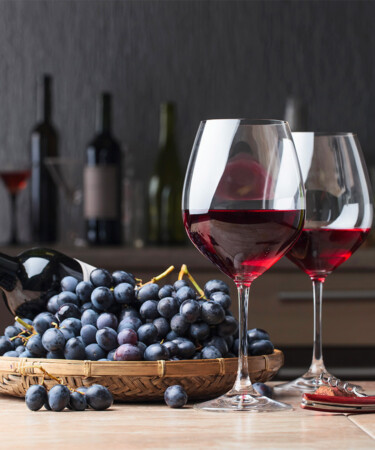
While Merlot originated in Bordeaux, the grape grows well all around the world. Its cultivation now stretches from its homeland in Europe to the Pacific Northwest of the United States and the Southern Hemisphere.
Merlot is often compared to Cabernet Sauvignon: The two go hand in hand because they are the most common varieties in Bordeaux and known for headlining the region’s world-class, luxurious red blends. Where Cabernet is firm in tannins and full in body, Merlot is softer and lighter with fresh, more expressive fruit qualities.
The thin-skinned grape often brings strong notes of dark fruit, such as black cherries, blackberries, and plums, as well as chocolaty and floral elements. Depending on where it’s grown, the grape’s flavor can range from juicy and fruity to well-structured and herbaceous.
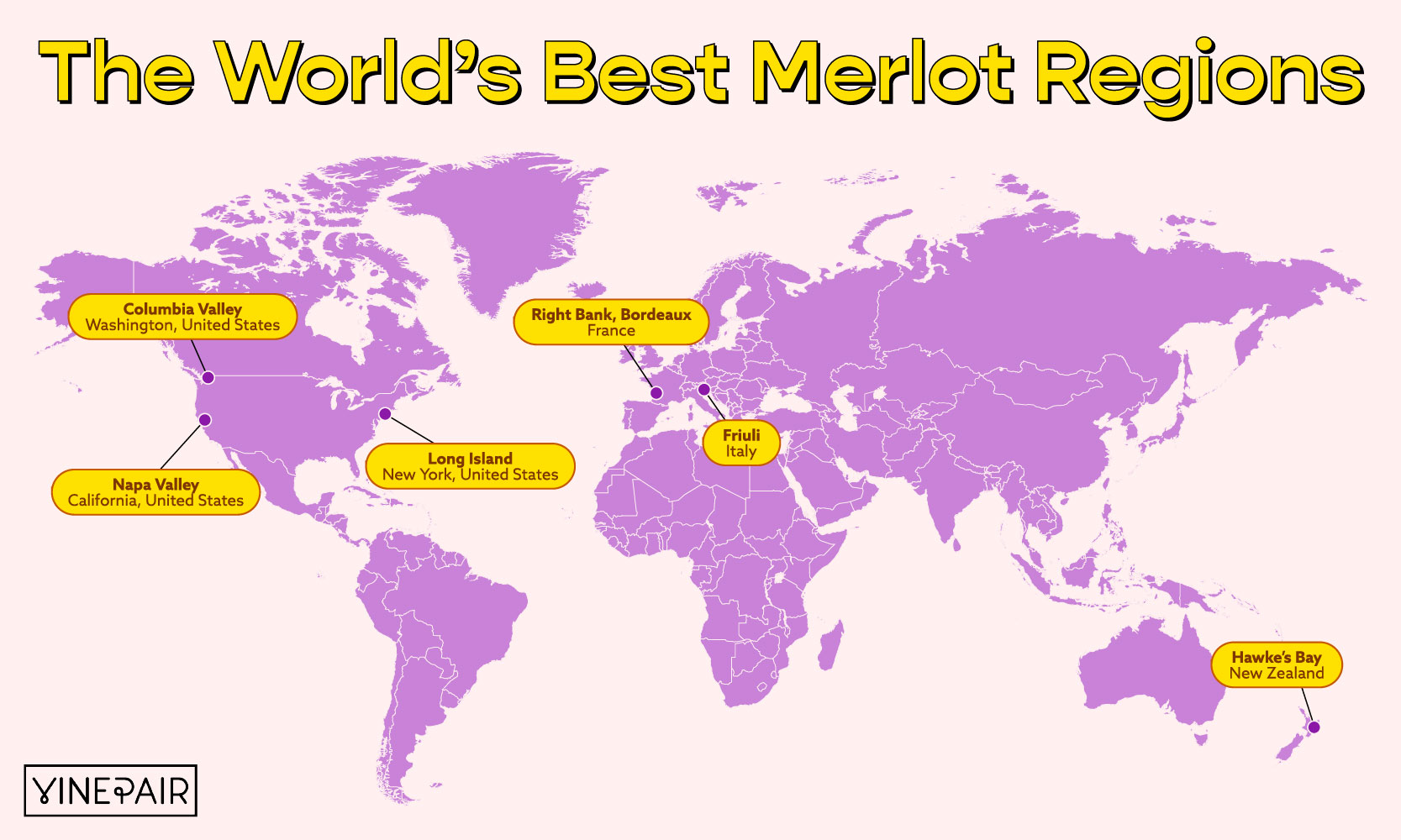
Because Merlot can be found in many different corners of the world, we narrowed down this list to the regions that best express the easy-drinking grape. Here are the world’s six best regions that grow Merlot.
Columbia Valley, Washington, U.S.
Columbia Valley is Washington’s biggest AVA and, along with Cabernet Sauvignon, Chardonnay, and Riesling, Merlot is one of the most commonly grown grapes there. The AVA, which has porous, loess soils, became known for its red wine production in the later decades of the 20th century when winemakers began pivoting their attention to Merlot and Cabernet after first gaining recognition for the region’s stellar Rieslings and Gewürztraminers. Merlot can be found across the region, but it is most popular in certain sub-AVAs like Yakima Valley and Horse Heaven Hills where winemakers are lauded for their fresh, fruit-forward expressions of the grape.
Friuli, Italy
Friuli is located at the northeastern corner of Italy, encompassing the foothills of the Alps and part of the Dolomites. As such, many of the region’s vineyards are planted on high-altitude plots that generate bright and grippy wines. Merlot was first planted in the region in the early 1900s, but it didn’t become popular there until the 1980s. Now, Merlot from Friuli comes in either single-variety wines or blends with indigenous varieties like Schioppettino. The grape grows particularly well in the subregion of Collio, an area that produces some of the most expressive iterations of the grape. Collio’s breezy hills and calcareous soil yield zingy, vibrant takes on Merlot with notes of ripe fruit, spice, and balsamic vinegar.
Hawke’s Bay, New Zealand
Situated on the east coast of New Zealand’s North Island is Hawke’s Bay, the second-largest wine region in the country. Hawke’s Bay’s temperate, maritime climate and alluvial, gravelly soils make for an ideal growing environment for Merlot. Sauvignon Blanc and Chardonnay are the two most popular grapes in the area, but Merlot is its most common red variety. Though it’s grown across New Zealand, Hawke’s Bay boasts the highest concentration of the grape: 1,870 acres of the zone’s land under cultivation are dedicated to Merlot. There, the grape is either utilized as a standalone grape or as the dominant variety in a red blend, which would typically also include Cabernet Sauvignon.
Long Island, New York, U.S.
Long Island, New York, is an up-and-coming winemaking region, and Merlot production has helped it gain its present-day acclaim. The AVA is split into two subregions: the North Fork and the South Fork, which notably includes the Hamptons. While Merlot’s cultivation straddles the two, it is more prominent in the sandy soils of the North Fork. The grape does well in this particular slice of Long Island because of its cool, maritime climate: Controlled temperatures keep the fruit from ripening too quickly and help retain its natural acidity. Merlots from Long Island are marked by their bright fruit flavors, balanced acidity, and mellow body.
Napa Valley, California, U.S.
Merlot was introduced to Napa Valley in the mid-1800s as a blending grape, but it wasn’t praised as a single varietal in the region until the 1990s and 2000s. In 2004, however, a quippy remark in the movie “Sideways,” in which the main character blasphemes the grape, tarnished its reputation in the U.S. In turn, American consumers and California winemakers focused more on Cabernet and Pinot Noir. Merlot currently accounts for roughly 8 percent of Napa’s total vineyard acreage. It is the third most grown grape in the region — behind Cabernet at No. 1 and Chardonnay at No. 2. — of the roughly 60 varieties cultivated in the American Viticultural Area (AVA).
Merlot performs well in Napa because of the region’s clay-heavy and loamy soil. It buds earlier than Cabernet and, in turn, ripens earlier. As such, the grape is most suited to high-altitude, cool-climate plots in the region. Merlot can mostly be found in the Castiloga, Howell Mountain, Oak Knoll, Oakville, Stags Leap District, and Spring Mountain sub-AVAs.
Right Bank, Bordeaux, France
Merlot was created in Bordeaux in the 1700s as a cross-pollination between Cabernet Franc and a less-popular grape called Magdeleine Noire des Charentes. Now, it is the principal grape of Bordeaux’s Right Bank, figuring into the region’s lauded blends. Merlot is especially common in the Saint-Emilion, Pomerol, and Fronsac appellations. The grape’s versatility is what makes it well suited for blending: Its light style can soften and smooth out other powerful red grapes such as Cabernet Franc, Cabernet Sauvignon, Malbec, and Petit Verdot.
The grape, which comprises around 60 percent of Bordeaux’s plantings, grows well in the region because of its clay- and limestone-rich soil, which retain moisture and facilitate controlled fruit production. A steady ripening cycle means the grapes can develop their fruity qualities without becoming overwrought, so they can remain light, fresh, and easy-drinking. These soils also impart a minerality into the wines that helps to develop an earthy complexity in an otherwise fruit-forward grape.
*Image retrieved from Igor Normann via stock.adobe.com
