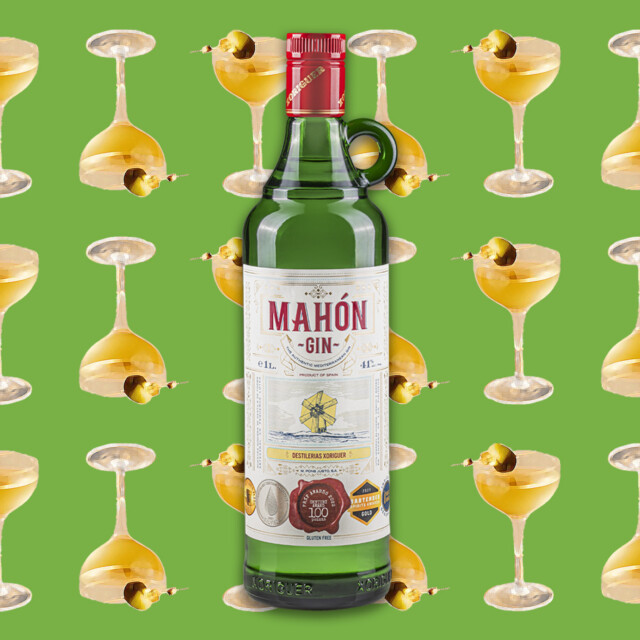
By now most people know there are geographically-protected wines — that whole “Actually, it’s only Champagne if it comes from” meme. Less discussed, however, are Europe’s geographically-protected spirits. There are the obvious ones, always capitalized, like Scotch, Cognac, Armagnac, and Calvados. But there is also a geographically-protected gin that is a bit more obscure.
Spain’s Gin de Mahón.
Produced since 1750 on the tiny island of Menorca, one of the Balearic Islands located in the Mediterranean Sea, roughly 130 due east of the mainlaid, it is said that the occupying British Royal Navy was what initially spurred locals to produce it. But Menorca was a grape-growing island — specifically Parellada grapes used for Cava — making for an atypical base distillate for gin.
The family Destilerías Xoriguer has been distilling what is now known as Mahón gin since 1945, supposedly based on the original 18th century recipe. (While most cocktail menus in the U.S. will simply list the Xoriguer product as “Mahón Gin” or “Gin de Mahón,” it should be noted there is a smaller craft distiller, Licores Biniarbolla, also producing gins on the island.) Xoriguer distills on wood-fired pot stills over 250 years old using juniper sourced from the Pyrenees — then aged near the Mahón harbor for two years — along with other undisclosed botanicals before being matured in American oak then bottled in its unique emerald green, handled caneca jug.
While long a source of pride on the island, Mahón Gin has remained mostly obscure in the United States until recently, where a trend of Spanish-style cocktails has led to its rise in New York and beyond.
Simple and Complex
At Mirador, an Andalucían-inspired tapas café in Kingston, the Martini Mirador has been served with Mahón since the spot first opened in early 2024. The gin is paired with an extra dry sherry-based vermouth, fino sherry, olive brine, and a garnish of a fino sherry gelatin cubito served as a pintxo with a Gordal olive placed next to it.
“We chose Mahón gin for three reasons: first and foremost because of its purity; second because it’s grape-based which aligns with our love of Spanish wine; and third because the roundness and purity pair very nicely with a slightly more robust fino sherry,” says Mirador’s owner Nick Africano. “Everything in the Martini is grape-based (apart from the olive).”
Africano considers Mahón a gin that is somehow both simple and complex, one that can star in a gin- and juniper-forward Martini yet can also allow sherry and vermouth to have their own voices as there are not a slew of botanicals in the gin fighting for dominance. In fact, it seems many bars love the interplay between Mahón and sherry. There is a clear minerality, but a warmth and woodiness from the slight barrel-aging that you just don’t see in more standard London dry gins.
(For these reasons and more, it recently tied for 1st as our top overall scoring gin on VinePair’s Best Gins for 2026.)
This unique and distinct flavor profile almost demands a sort of Martini template: Mahón + sherry + vermouth + salty garnish.
At Deux Chats, “Le bar préféré de Williamsburg: Martinis & Oysters” according to their motto, the house Deux Chats Martini is served with Mahón Gin alongside manzanilla sherry, dry vermouth, and celery brine. Bodega Nights in Bushwick makes their Martini with Mahón, fino sherry, Tximista blanco vermouth, and a Gilda garnish. While Rolo’s Martini Spanish pairs Mahón with sherry, Atxa blanco vermouth, olive brine, and pepper.
This template is taken to extremes at buzzy and theatrical West Village restaurant Wild Cherry. There, diners are encouraged to end their meal with a shot of chilled Mahón poured into a conch shell they’ve just eaten chilled scungilli braised in a court bouillon broth from. This becomes a sort of oceanic ice luge shooter.
“We chose Mahón gin for three reasons: first and foremost because of its purity; second because it’s grape-based which aligns with our love of Spanish wine; and third because the roundness and purity pair very nicely with a slightly more robust fino sherry.”
Initially, head bartender Karlos Hernandez had figured the maritime brine and broth of the conch might pair best with a smoky, vegetal mezcal — but that didn’t quite work. His thought then moved toward Mahón, recalling how it is made with juniper aged for a couple of years in open crates by the salty ocean air.
“In my head, I knew that if stirred with a touch of Maldon salt, the oils and bitter botanicals in the gin would complement the court bouillon’s earthy and sweet whelk flavor, and so we gave it a go,” says Hernandez. “The natural ocean salinity of the dish paired very well with the Mahón, a complementary flavor but also a perfect texture and weight to mix with the court bouillon.”
An Ointment That Spread
But Mahón need not be elevated and used in baroque cocktails necessarily either.
The quintessential Menorcan way to drink its local gin is in a pomada (“ointment”), a blend of the spirit and lemonade or lemon soda. It’s the ideal summer drink, ladled from a punch bowl or batched and pulled from the freezer to serve to friends and neighbors during the fiesta season.
And, no surprise, that is how it is served (sorta) at José Andres Mercado Little Spain in Manhattan’s Hudson Yards. In the food hall’s Txula Steak there is a Pomada Gin Mule built of Mahón Gin lemon, mint, Fever-Tree ginger beer, Fever-Tree club soda, and bergamot oil. Mahón is also a house favorite — recommended by Andres no less! — in their Spanish Gin-Tonic.
Similarly, the Boqueria mini-chain of Spanish tapas restaurants throughout New York include Mahón in their signature Gin Tonic, which currently comes with Lillet Rosé and rhubarb bitters as well. As does El Quijote at the Chelsea Hotel, which uses Mahón in their Quijote G+T alongside pear, aloe, and celery. While Vern’s in Rochester deploys Mahón in their Spanish G + T with an herb bouquet and citrus.
“Spanish-style cocktails are having a moment in the U.S. right now because of how deeply flavorful and diverse the products are,” says Africano. “From low ABV spritzes to spirit forward Martinis, the products of Spain cover all the bases. Many of the cocktails also have culturally significant rituals, and drinking those cocktails here in the U.S. transports us to a place and to a certain kind of experience.”
However, a big reason Mahón has surely exploded in New York isn’t purely flavor- or trend-based. PM Spirits, that so-called “provider of geeky spirits,” has been the brand’s New York and New York only importer since 2014.
As of earlier this summer, though, PM Spirits has taken over as national importer. Meaning, Mahón mania is soon to spread across the country.
