Last year, while on a trip to Mexico City, I finally had the pleasure of dining at Pujol, Enrique Olvera’s famed two-Michelin-starred tasting menu restaurant.
There, I was, of course, served their signature Mole Madre, a black mole made with chilhuacle chile that has been reheated for years, with fresh mole of seasonal ingredients added every few days. This dish has become so iconic that it has been highlighted in foodie documentaries such as Netflix’s “Chef’s Table.”
The June evening I was there, the mole had already reached 3,714 days old. Not surprisingly, it was delicious and truly one of a kind.
But so was another far less promoted item I spied on Pujol’s drinks menu:
An “aguardiente de agave” — an agave spirit, essentially a mezcal, that doesn’t fit the requirements to be labeled as such — made pechuga-style with the very same Mole Madre. The spirit was produced by Tlamati, a cooperative based in Puebla that distills mezcal at a palenque 6,500 feet above sea level below an active volcano.
“For Tlamati’s mole pechuga, the production is similar to producing any other pechuga in a copper pot still, with the exception that the protein is prepared as though one is preparing the dish in question,” explains Justin Briggs, Mexico portfolio manager at Skurnik Wine & Spirits, Tlamati’s importer. The process starts with a spirit made from papalometl agave distilled by maestro mezcalero Sergio Salas. “Then they add that prepped [rooster] breast to the still on the second distillation pass, suspended in a sack inside the copper pot.”
I had never tasted a spirit quite like this one before.
It was unquestionably mezcal — roasted agave, minerality, a hint of smoke — but there were also underlying notes of earthy chiles and subtle spices. Like a mole, it was extremely complex and well rounded, but the texture was what was perhaps most appealing, viscous, weighty, and full of depth.
I needed to try more.
Destilado con Mole
“Pechuga is not a new fad. And moles are not either,” says Yuan Ji, CEO and co-founder Erstwhile Mezcal, a Brooklyn-based mezcal curator and importer. There are printed references to pechuga as far back as 1863, while mole goes back to at least the 17th century. “Both of them have been around for quite awhile. So mezcal made with mole would naturally happen,” Ji says.
In fact, NOM-070, the set of rules that govern mezcal, explicitly lists “mole” as a possible ingredient in the “Destilado con” (distilled with) category of mezcal. It has been there since the norm was first passed into law in 2017. And yet it was really only recently that commercial versions have seemed to hit the market in the U.S.
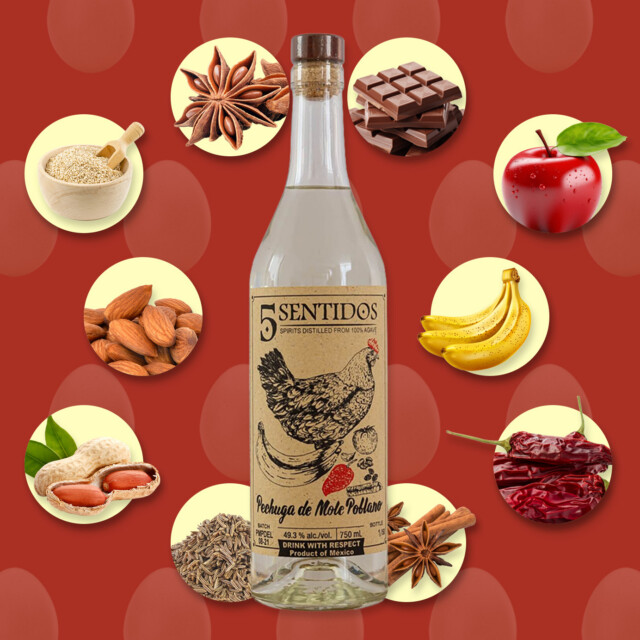
The first commercial version seems to be 5 Sentidos Pechuga de Mole Poblano, first released in the U.S. in 2017 with an initial batch of just 193 bottles. It uses a mole poblano paste from a local market made of chocolate, apples, bananas, dried chiles, cinnamon, cumin, peanuts, almonds, sesame seeds, and anise. It was distilled in the mountain valley of San Pablo Ameyaltepec, using wild-harvested papalometl in the base spirit with chicken and the mole added for the second distillation. Well reviewed and highly sought-after, additional batches have been produced near-yearly.
Erstwhile Mezcal first released its Turkey Mole Negro Pechuga in 2023. This was an experimental collaboration between the brand and mezcal producers Epifania Gómez and Epifania Gómez, at Palenque Don Lencho in Rancho Blanco Güilá, Oaxaca. Created as a special Thanksgiving release, it includes sweet potato, cranberry, seasonal spices, and a turkey marinated overnight in mole negro.
“Moles are already rich culinary infusions, very complex, so if you introduce that flavor into mezcal, it’s hard to go wrong,” says Ji. “You get a certain nuttiness, umami, and it’s chocolaty in my experience.”
“Pechuga is not a new fad. And moles are not either. Both of them have been around for quite awhile. So mezcal made with mole would naturally happen.”
Of course, mole is not just one thing, with perhaps 50 different types throughout Mexico depending on the specific region. In fact, Oaxaca is often known as the “Land of the Seven Moles” which includes mole rojo, mole negro, mole verde, mole amarillo, mole manchamantel, and mole coloradito.
Like Erstwhile, Xicaru’s Pechuga Mole Mezcal uses the most iconic of the Oaxacan moles, mole negro. The palenque makes a mole from scratch over two days, using molcajete-ground chiles, Oaxacan chocolate, and other fresh ingredients. It is then added to the still along with chickens.
There’s likewise the recent turkey-based Mezcasiarca Pechuga de Mole Mezcal produced by Sandra Ortíz of the famed In Situ Mezcalería in Oaxaca City. For it, Ortíz recreated her mother’s heirloom mole recipe, which includes over 20 ingredients and takes days to prepare. Briggs calls this mezcal “stunning,” noting that Astor Wines purchased the entire batch.
It seems, at least commercially, that this sort of mini category is just scratching the surface. Could it be poised to explode?
Maguey Mole
“When working with practices that are artisanal and rooted in centuries of tradition, it would be inaccurate to label pechuga con mole as either entirely traditional or definitively modern,” says Beatriz Munozcano Quintanar, director of agave brands for Del Maguey’s parent company Pernod Ricard.
While Del Maguey was the first brand to commercially bottle a pechuga for the U.S. market when it released a chicken-based one in 1999, it wasn’t until just last year that it would release a pechuga con mole — and even that wasn’t accessible for most consumers.
“Pechugas are traditionally made for celebrations and meaningful moments,” says Quintanar. “In that spirit, the 30th anniversary of Del Maguey felt like a moment that warranted a pechuga con mole.”
The liquid came from San Pablo Ameyaltepec, Puebla, produced by maestro palenquero Aurelio González Tobón, with multiple families in the village contributing. It was produced from wild agave papalote with a mole poblano’s ingredients placed on a mat above the fermented mash inside the still, before the mezcal was distilled slowly and continuously for more than 24 hours.
“Moles are already rich culinary infusions, very complex, so if you introduce that flavor into mezcal, it’s hard to go wrong. You get a certain nuttiness, umami, and it’s chocolaty in my experience.”
Only 800 bottles were made and, though it wasn’t commercially released, some were gifted to bartenders, influencers, and journalists. Recently, bottles have escaped to the auction market with ones going for upwards of $300.
Despite this, and despite the knowledge that there is seemingly a burgeoning demand for them, Quintanar claims we won’t see a commercially available pechuga con mole anytime soon from the company.
Capturing an Audience
“As the mezcal category has grown, and as more consumers, bartenders, and buyers have developed a deeper appreciation for the craft, complexity, and demanding distillation processes behind mezcal, these expressions are beginning to receive more attention and we are seeing more of them,” says Quintanar.
In this era of financial uncertainty, perhaps a pechuga con mole seems like less of an economic gamble than, say, a Tepextate mezcal. Briggs explains that pechugas and destilado con sabores (mezcals distilled with flavors) in general are seeing way more growth than rare agave varietal mezcals in Skurnik’s portfolio.
“I think [mole pechugas] capture the average U.S. consumer’s imagination just a shade more easily,” says Briggs, “and require a bit less category knowledge than the rest of mezcal’s increasingly complex top tiers.”
