Much like Americans, Europeans love beer. From the green, rolling hills of Ireland to the jagged Alps, beer has been a vital part of the continent’s culture for centuries. But not all of Europe’s beer cultures look the same.
Regional beer styles around Europe came about for a number of reasons. For one, early brewmasters worked with local ingredients and the machinery available to them, in turn developing an area’s palate for particular beers. Others came about out of necessity: Farm workers in pre-refrigeration times needed to develop strong beers that would last throughout the hot summer months.
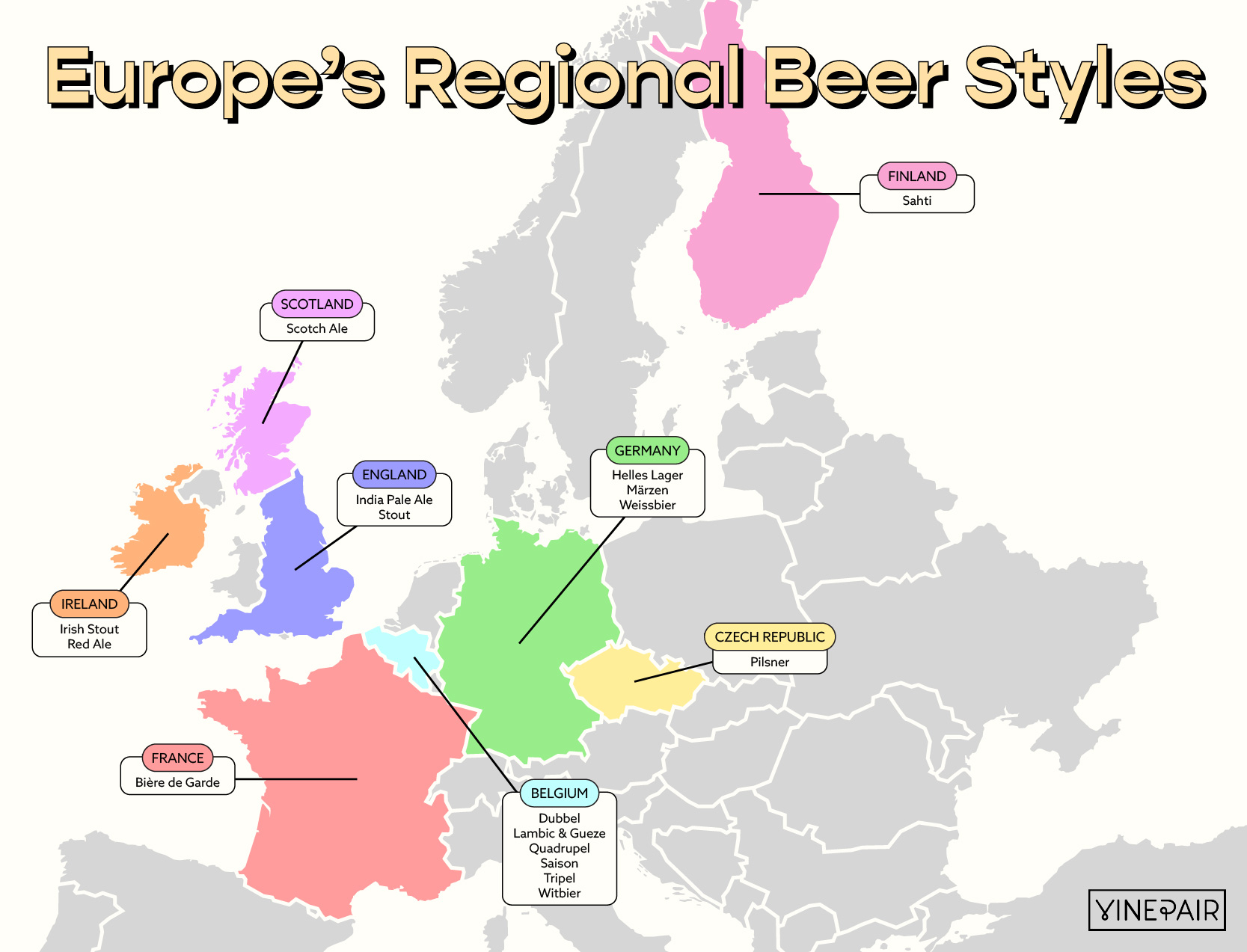
In some parts of the continent, drinkers opt for robust, full-bodied beers with high alcohol contents and dark, toasted flavors. In others, the regional style looks crisper, lighter, and more sessionable. Below, we mapped these styles and explained the standout features and flavor profile of each one.
Belgium
Dubbel
Along with Triple and Quadrupel (see below), Dubbel is part of a group of Belgian beers called Trappist or Abbey ales, styles that originated in the country’s monasteries. Dubbels are hefty beers — they are often amber in color and range from 6 to 9 percent ABV. The dark appearance comes from the inclusion of candi sugar, a caramelized sugar product traditionally used by Belgian brewers to create roasted, dark fruit, and chocolate flavors in a beer.
Lambic & Gueze
Lambic and Gueze — often coming from Brussels and Payottenland — are two Belgian styles frequently lumped together because the latter is a blend of multiple vintages of the former. Lambics are spontaneously fermented, meaning brewers rely on ambient, naturally occurring yeast rather than cultured strains. The result is a beer with funky, sour, and vibrant fruit flavors. Gueuze beers double down on the funk: They are blends of both young and barrel-aged Lambics, and microbes from maturation in oak casks impart even more sour, acidic notes. Lambic has a subcategory of its own — Fruit Lambic. Brewers noticed certain fruits matched the sour, sweet qualities of the beer and began adding varieties like cherries, raspberries, or peaches to the mash before fermentation.
Quadrupel
Quadrupels are the strongest of Belgium’s Trappist ales. Averaging 10 to 13 percent ABV, this style is easily recognizable by its dark brown hue with tinges of deep red. Roasted malt headlines Quadrupels’ flavors, deepened even more by the incorporation of caramelized sugar in the mix. Expect notes of dark fruit, toast, and molasses to come through.
Saison
Saison is a type of farmhouse ale that originated in Wallonia, Belgium, the French-speaking region of the country. Like other styles within the broader farmhouse ale category, Brettanomyces can sometimes be included in Saisons, yielding a barnyard-like flavor. Saisons are most often light in alcohol with crisp flavors of orchard fruit, citrus, and some ester spice. Overall, the style is known for its sessionability — it emerged before air conditioning and refrigeration when farmworkers needed to craft easy-drinking beers at the end of the winter that would quench their thirst while working during the balmy summer months.
Tripel
Tripel sits right between Dubbel and Quadrupel in the Trappist ale category in terms of ABV. Tripels often come in at 7 to 10 percent ABV, and though Dubbels’ colors are typically dark, Tripels are golden and hazy in appearance. That’s because unlike Dubbels and Quadrupels, Tripel beers do not include any caramelized sugar. The omission also results in a sessionable beer with flavors of tropical fruit, citrus, and spice.
Witbier
Witbier translates to “white beer,” a moniker that refers to the style’s typical straw yellow, cloudy appearance. The style is an ale that was once one of the most popular choices in Belgium before the arrival of lagers, the preference for which quickly outpaced that for Witbiers. By law, Witbiers’ grain bill must contain at least 50 percent unmalted barley. The result is light grain flavors balanced by notes of coriander and citrus peel.
Czech Republic
Pilsner
Now one of the most ubiquitous beer styles across the globe, Pilsners originated in 1842 in Plzeň, the fourth-largest city in the Czech Republic. As a way to veer away from the low-quality ales that were common in 19th-century Bohemia, brewer Josef Groll invented the Pilsner, a light, pale lager that ranges from 4.5 to 5.5 percent ABV, and sparked a worldwide taste for drinkable, crisp beers. On the palate, this style brings herbaceous, grassy qualities and a subtle hops spice.
England
India Pale Ale
India Pale Ale (IPA) is the darling of the craft beer world. The style is most known for its hop-forward flavor. Legend has it that English brewmasters added hops to pale ales to help preserve the brews during 18th-century voyages to India, which was then under British sovereignty. While the validity of that story remains in question, England was certainly the birthplace of IPAs. The style has since spawned a number of subcategories like American IPAs, West Coast IPAs, New England IPAs, and Hazy IPAs, among others. The hops’ punch and the ABV will vary depending on the style, but most IPAs bring floral, citrusy, and fruity flavors.
Stout
Stouts were first known as “Stout Porters” because they came about as a stronger version of a Porter. What gave Stouts — which were invented in London — their signature heft was the inclusion of roasted barley in the mash. These strong brews are generally mild in ABV, falling anywhere from 4 to 7 percent. Imperial Stouts, however, jack up the alcohol content and can reach up to 12 percent.
Finland
Sahti
Sahti is a traditional Finnish farmhouse-style ale. The mash tends to include a high rye content, imparting grassy, slightly spicy flavors. Sahtis tend to be low in carbonation and hops, and some don’t have either at all. In place of hops, juniper branches bring herbaceous, pine-forward flavors to these brews.
France
Bière de Garde
Bière de Garde translates to “beer for keeping” in French, pointing to the style’s pre-refrigeration history as a strongly brewed beer that could maintain its quality throughout the hot summer months. The ABV of Bière de Gardes ranges from 6 to 8.5 percent, and they often arrive with a light gold or amber hue. The style generally delivers a malt-forward flavor profile, and secondary flavors can vary from brewery to brewery.
Germany
Helles Lager
Helles Lager was Germany’s response to Pilsners from the Czech Republic, which quickly grew in popularity upon its invention in the 19th century as a go-to light beer. Hailing from Munich, the Helles style is maltier than Pilsners and less hoppy. These lagers range from 4.5 to 6 percent ABV and are pale yellow to gold in color.
Märzen
Also known as “Oktoberfest” or “Oktoberfestbier,” Märzen is best known as the signature beer of Germany’s annual fall fair. Märzen is a lager with an amber-brown color and an alcohol content of 5 to 6 percent. Both Munich and Vienna malts are used for this style, imbuing nutty, toasted flavors to the brew. Despite their robust flavor profile, Märzens are still quite sessionable thanks to their mild alcohol content and a residual sweetness that brightens the drinking experience.
Weissbier
Weissbier, which means “wheat beer” in German, encompasses a number of beer subcategories, such as Dunkelweizen, Hefeweizen, and Kristalweizen. The style is defined by certain strains of yeast in the Saccharomyces cerevisiae family that make the brews refreshing and quaffable. The Weissbier category can range from cloudy to crystal clear, but the common quality among all the style’s expressions is a thick, foamy head above each pour.
Ireland
Irish Stout
Irish Stouts are an offshoot of the Stout, but with the worldwide affinity for Guinness, they’ve come to define a style of their own. Whereas the typical Stout brings flavors of malty sweetness, Irish Stouts are dry, giving way to robust notes of chocolate, coffee, and toffee.
Red Ale
While Ireland’s beer scene has become defined by Guinness, the country is to thank for another style of beer: Red Ales. Red Ales, as the name suggests, are red in color, though the brews can also take on amber or copper hues. The appearance comes from caramel malts and other speciality malts included in the mash. Beyond the color, Red Ales deliver malt- and fruit-forward flavors with toasty nuances.
Scotland
Scotch Ale
The Scotch Ale style originated in 19th-century Edinburgh. What distinguishes it from other ales is that the wort boils for longer before fermentation, allowing the sugary ingredients to caramelize. Notes of malt and caramel headline Scotch Ales’ flavors, though an occasional bitterness can come through. These full-bodied brews fall anywhere from 6 to 10 percent ABV.
*Image retrieved from Brent Hofacker via stock.adobe.com
