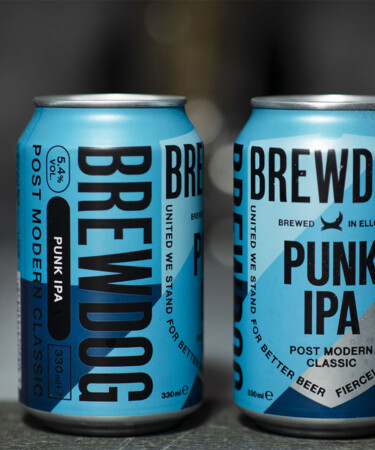
Tilray Brands, Inc. acquired BrewDog for £33 million, or $44 million, a sum representing a massive drop from the Scottish craft brewery’s peak $2.7 billion valuation. Tilray, a New York-based consumer packaged goods company producing cannabis and beverage products, assumes ownership of the global brand, UK brewing operations, and 11 brewpubs around the UK and Ireland.
BrewDog began eyeing potential buyers when it hired the consulting firm AlixPartners to oversee its sale last month. The purchase comes after a string of losses for the brand, which had made strides as a leading craft brewery after its 2007 founding. In 2025, the brewery posted a substantial $40 million yearly loss.
“This business needs some love,” said Irwin Simon, chief executive officer of Tilray, during a conference call with investors to discuss the purchase. “This business needs some innovation.”
The deal, effective today, puts an end to the craft brewery’s contentious crowdfunding, “Equity for Punks” scheme, from which the independent brewery amassed over $100 million by selling shares to individual consumers, Sky News reports. News of BrewDog’s search for a buyer stirred uncertainty among the approximately 220,000 ‘punks,’ a number of whom may be left with little return of their investments.
“The equity punks…helped shape this brand to what it is today,” Simon said on the call.
What will come of the investments and returns remains unclear, especially as the brand’s valuation shows dramatic collapse from its former worth. In addition to its peak of $2.7 billion, a 2017 investment from the private equity firm TSG Consumer partners suggested a $1 billion valuation.
The purchase also raises concern about BrewDog’s priorities in the beer space. It launched as a foil to corporate-run macrobreweries, and in 2009 and 2021 when the brand started crowdfunding campaigns, employees criticized it for favoring financial growth over the care of its employees. Simon addressed potential, similar backlash in today’s call.
“We are not here to corporatize BrewDog,” Simon said. “As I continue to say, beer is not going away, and we’re here to continue making beer fun again.”
Tilray has made recent acquisitions of beer brands, including Montauk Brewing Company, Shock Top, and Hop Valley Brewing Co. Its BrewDog purchase marks another expansion to its portfolio beyond cannabis products.
VP Pro Take
“Writing a weekly column means staying on the lookout for the next week’s column. So it was a real treat to wake up this morning with a bunch of texts from colleagues and sources letting me know what I’d be writing Friday’s Hop Take about.
“This is your perfect mash-up,” VinePair editor-in-chief Joanna Sciarrino told me as we discussed Tilray’s purchase of BrewDog in our editorial Slack this morning. Indeed.
Where to even begin? For BrewDog, this price — almost two full orders of magnitude cheaper than the global business’s implied valuation when private-equity firm TSG Consumer Partners bought ~22% of the business in 2017 — represents a colossal collapse. No serious person could have believed that BrewDog could go public at a frothier dollars-per-barrel valuation than Ballast Point in its prime, though for many of the company’s retail investors it would have had to do just that in order for them to make it out whole. Once the Scottish firm shelved its plans for a public listing, the situation looked dire for those “equity punks,” who were last able to sell their mostly illiquid holdings in March 2022 during a brief trading window that valued the overall business closer to $600 million. But even in mid-February when BrewDog’s board announced it had hired AlixPartners, a bona fide financial clean-up crew that made its bones restructuring General Motors and Enron and doing restitution work for Bernie Madoff’s fraud victims, I didn’t figure the firesale price would dip quite this low.
“No offer was made at any stage of the sales process, from any prospective bidder, which would have preserved BrewDog in its entirety,” AlixPartners said in a statement today. As independent financial investor and researcher Ben Ostrow, who first tipped me off to the firm’s funky financials back in 2021, put it to me in a text in mid-February 2026 reflecting on the then-looming sale: “Never a good sign when your banker thinks you’ll get more value separating business lines that previously were pitched as synergistic.” He was right five years ago, and he was even more right two weeks ago.
It’s a bad result for the retail investors, and a worse result for BrewDog’s 1,400 global employees, nearly 500 of which are already getting pink-slipped thanks to the immediate closure of 38 of its branded pubs in the United Kingdom. “A company does not lose 97% of its value in the space of nine years without catastrophic mismanagement,” trade union Unite told The Guardian in a statement. “Directors past and present pursued reckless expansion and failed strategies, and now workers are paying the price for boardroom failure.” ‘Twas ever thus.
Can Tilray’s chief executive, Irwin Simon, make this deal pencil out? He certainly seems to think so: the company’s press release projected its acquisition of the global BrewDog brand, Scotland brewery, and “11 strategic brewpubs” would “generate ~$200 million in annual net revenue” in the 2027 fiscal year. I’m skeptical for the obvious reason, that this figure is around five times today’s purchase price, and for the less obvious reason, that Tilray’s bargain-basement deals for half of Anheuser-Busch InBev’s craft portfolio in 2023 and all of Molson Coors’ craft portfolio in 2024 have yet to bear the synergistic fruits Simon envisions for BrewDog. Sure, this deal is a dirt-cheap route to the European market, but a transatlantic footprint adds complexity to the conglomerate’s operation even as it tries to simplify things stateside. Still, Simon loves a deal, so perhaps it’s no surprise that he’s also angling for BrewDog’s U.S. and Australian subsidiaries in separate transactions.
More reporting and analysis to come in my Friday column at Hop Take. If you work at BrewDog and have tips to share, get in touch: [email protected] or dinfontay.11 on Signal. You can remain anonymous.” —Dave Infante, VinePair columnist and contributing editor
This story is a part of VP Pro, our free content platform and newsletter for the drinks industry, covering wine, beer, and liquor — and beyond. Sign up for VP Pro now!
