Riesling is a profoundly aromatic grape used to create several distinct styles of wine. It’s also one of the most popular white wine grapes in the world. Native to Germany, the grape is exceptionally durable, with relatively thick skin that allows it to thrive in cool climates and develop its signature acidity. In Germany, Riesling was traditionally made in sweeter and off-dry styles referred to as süss and halbtrocken, respectively, and it is these wines that were historically exported around the world.
As such, Riesling is often unfairly judged as only a sweet or dessert wine. In reality, the grape is also used to produce crisp, acid-driven, dry white wines. Given Riesling’s versatility and ability to weather exceptionally cool climates, there are certain pockets of the globe best suited for growing the grape. Of course, several of these locales are located in the grape’s native home, with areas (called anbaugebiete in Germany) like Mosel, Rheingau, Nähe, and more regularly producing some of the world’s most expensive bottles.
But they aren’t the only Riesling regions worth paying attention to. Across the globe, there are numerous wine zones with expressive terroir perfectly suited for growing the grape, and bottles produced in these areas aren’t to be missed.
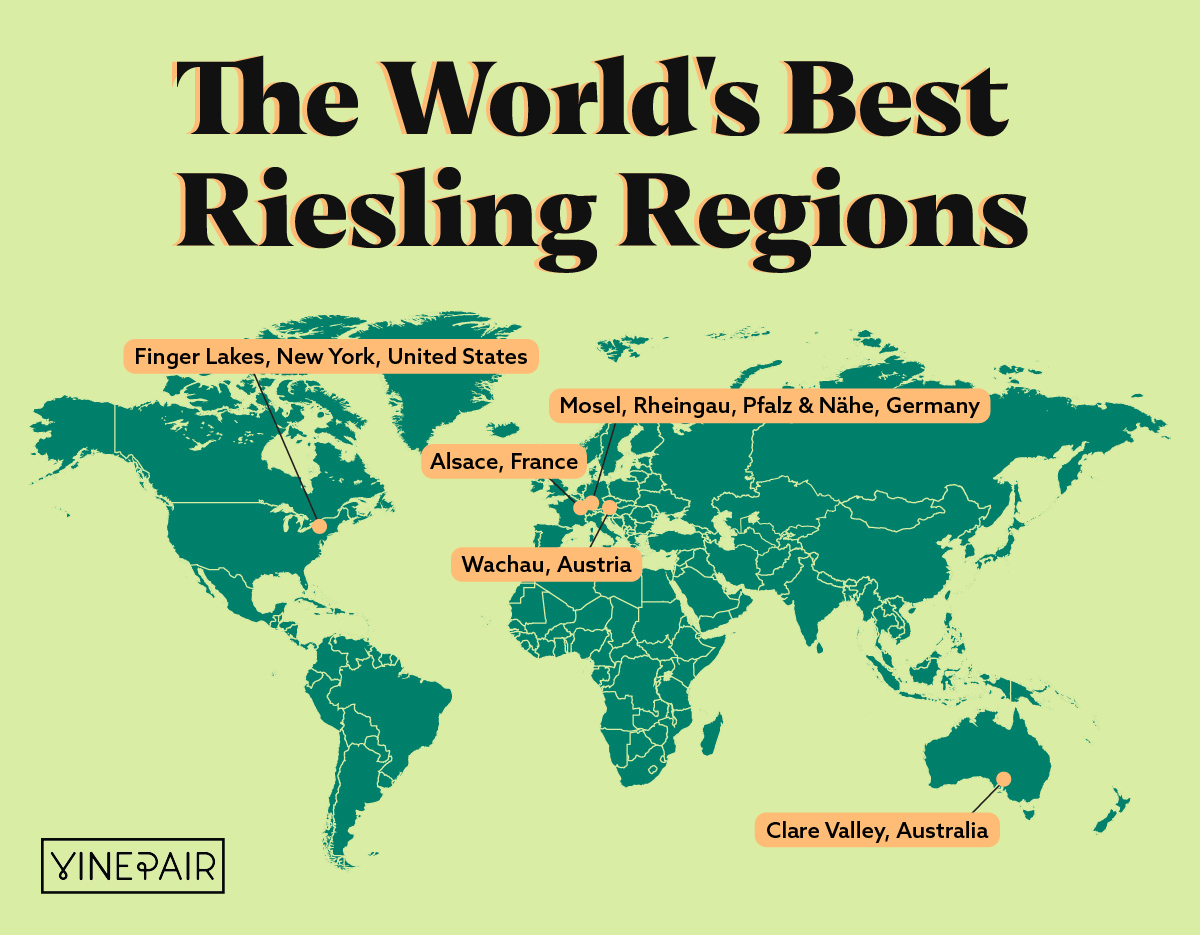
From Germany and Austria to Australia and beyond, here are eight of the world’s best Riesling regions.
Mosel, Germany
Located in southwest Germany, the Mosel is arguably the country’s most famous wine region and could easily be considered the world’s most important area for Riesling. Roughly 62 percent of all land under vine there is dedicated to this white wine grape, with vineyards planted on slopes along the Mosel River, a tributary of the Rhine. The territory benefits from cool climates year-round, and the sharp incline of its vineyards means that grapes receive maximum exposure to sunlight, allowing for prime ripening.
Further enhancing the quality of these Rieslings are the Mosel’s two predominant soil types: red slate and blue slate. Both are fantastic at absorbing heat, permitting vines to retain daytime warmth throughout long, cold nights, and further concentrating the grapes’ flavor and acidity. Grapes grown in the former soil type often yield a richer, rounder style of Riesling, while those grown in the latter tend to lean more floral and delicate. That said, regardless of soil, most Riesling in the Mosel has to be tended to and harvested by hand as the steep vineyard slopes are inaccessible with modern technology.
Because of that hands-on labor, wines from the Mosel can come with lofty price tags. A bottle from the area, Egon Müller Scharzhofberger Riesling Trockenbeerenauslese, is the only bottle on the world’s top 10 most expensive wines list that isn’t from Burgundy.
Rheingau, Germany
Due east of the Mosel is the Rheingau, the wine region home to the highest concentration of Riesling vineyards in Germany. Seventy-seven percent of the anbaugebiete is dedicated to the grape, which grows well in the numerous soil types there including chalk, slate, quartz, gravel, loess, and sandstone. The Rheingau sits along the Rhine, with roughly 90 percent of all vineyards in the region tucked alongside its northern bank. The river not only helps the region maintain its stable, cool climate all year, it also reflects sunlight back onto the grapes themselves, further illuminating the southern-facing vines.
Riesling from the Rheingau tends to be a bit more affordable than its Mosel counterparts, with wines most often made in the dry style. While Mosel Rieslings are generally described as floral and honeyed, Rheingau Rieslings typically deliver prominent citrus acidity with pops of smoky minerality.
Pfalz, Germany
Positioned along Germany’s western border is Pfalz, the country’s second-largest wine region (behind Rheinhessen) and also one of its warmest. Wine production here is a near-equal split between reds and whites, with the latter clearly driven by Riesling — roughly a quarter of all vineyard plantings there are dedicated to the grape. Pfalz enjoys close proximity to both the Rhine river and the Haardt Mountains, the latter of which have a profound impact on the region’s terroir. The range acts as a shield for the Atlantic Ocean’s cool breezes and rainfall, enabling the region to develop its signature sunny, temperate climate. Thanks to these unique conditions, Pfalz Rieslings are characterized by their richer texture and ripe stone fruit flavors, with prominent notes of peach, apricot, and mango as opposed to zippy citrus.
Nähe, Germany
Despite its relatively small size, Nähe is one of the most geologically diverse wine-growing regions in Germany, home to over 180 distinct soil types. The region is located right along the Nähe River to the north of Pfalz, but because it didn’t receive its official designation until 1971, its wines were historically overshadowed by those coming from larger, established anbaugebietes. Since the 1990s, the area has undergone somewhat of a revolution, pushing its way to the top of the country’s ranks, especially when it comes to Riesling. The grape accounts for roughly 27 percent of all plantings in Nähe, and it thrives in the mixture of volcanic soils that abound throughout the region.
While the majority of Nähe is covered in these volcanic soils, not all the wines from the region have similar profiles. In general, Nähe can be split into three main subzones — Upper Nähe, Lower Nähe, and Bad Kreuznach — each home to unique terroir and microclimates. Upper Nähe is known for its Mosel-like slopes and mountainous terrain, which tend to yield lighter-bodied Rieslings thanks to slower ripening times. Lower Nähe and Bad Kreuznach, on the other hand, are a bit flatter landscape-wise, with grapes typically producing rounder, fuller-bodied styles of Riesling.
Wachau, Austria
Given Rieslings importance in Germany, it should come as no surprise that the grape also flourishes in Austria — especially Wachau. Tucked in the country’s northeastern corner, the zone is located directly along the Danube River, which, over the centuries, has carved out soils rich with gneiss and amphibolite, two types of metamorphic rock Riesling adores. The soil types drain well, retain heat, and are rich in vitamins and minerals, imbuing Riesling grapes with Wachau’s savory, flint-like minerality.
Climate also plays a crucial role in the development of Riesling, and Wachau is predominantly influenced by two weather patterns — the cooler, alpine environment to its west and the warm, continental Pannonian to the east. The collision of the two creates a unique microclimate (moderated by the Danube River), characterized by long, warm summers, with Riesling grapes often picked toward the end of harvesting season.
In 2020, the wine region was awarded with a Districtus Austriae Controllatus (DAC) recognition, which formalized production and provided Wachau Rieslings (and others) with protected designation of origin. Within this classification, Wachau wines are categorized into three tiers: Ried (single-vineyard bottlings), Ortswein (from a specific municipality), and Gebietswein (across Wachau).
Making matters slightly more complicated is a separate classification system that also breaks wines into three tiers — Steinfeder, Federspiel, and Smaragd. Rather than location of origin, this taxonomy sorts Rieslings based on ABV, with Steinfeder serving as the lightest. Bottles in this category have a maximum ABV of 11.5 percent and are generally the lightest-bodied and most vibrant Wachau Rieslings. Federspiel wines are slightly more alcoholic, between 11.5 and 12.5 percent ABV, and are often described as mineral and savory, with refreshing stone fruit notes. Smaragd is the highest quality, with Rieslings in this style typically delivering the richest and fullest body. Bottled at a minimum 12 percent ABV, these wines are designed to be aged for years, if not decades.
Alsace, France
France is a country with no shortage of impressive wine regions. Among them, Alsace stands out for its high concentration of Riesling and Gewürztraminer, two grapes almost exclusively grown in France within the AOC’s borders. The immense presence of both white wine grapes is largely because the region borders Germany’s heavy-hitting Riesling regions and has changed hands between the Germans and the French four times since 1870. Despite its close proximity to Germany, Alsatian Rieslings are produced in a much different style, with almost every bottle crafted in the dry variation.
Like Pfalz, Alsace’s climate is tempered by a mountain range, in this case the Vosges, which guards vineyards from strong western winds and decreases the annual amount of rainfall. As such, despite its cooler climate, Alsace is a mostly sunny and dry wine region, creating the perfect conditions for Riesling to thrive. In general, the locale can be split into three designations: Alsace, Alsace Grand Cru, and sparkling Crémant d’Alsace, with the former accounting for 74 percent of all production.
Within the Alsace AOC, all Riesling must be produced from only that grape in order to be labeled as such, a sharp contrast to other regions that allow for a small percentage of other varieties to be blended in. Alsace Grand Cru is even more strict, with only four varieties allowed: Gewürztraminer, Muscat, Pinot Gris, and, of course, Riesling.
Clare Valley, Australia
Riesling might not be the first that comes to mind when you think of Australian wine, but there’s no variety more important in the Clare Valley than this versatile white wine grape. Located in South Australia, the region is home to nearly 34 percent of all Riesling planted in the country, and wines crafted here are often cited as some of the world’s best.
The Clare Valley experiences a temperate, Mediterranean climate with warm, dry summers and cool, wet winters, and its positioning 1,500 feet above sea level allows grapes to have near-constant access to sunlight. The distinct exposure lets the grapes remain on the vine longer, resulting in highly concentrated expressions with laser-beam acidity and prominent floral, orchard fruit, and citrus fruit notes. Clare Valley Rieslings are also famous for their capacity to age, with some of the region’s highest-quality bottles (like those from Grosset) capable of maturing for decades.
Finger Lakes, New York, United States
The Finger Lakes district is New York’s most famous wine region, and it’s been slowly gaining more national and international recognition thanks to its world-class Riesling and Cabernet Franc. Historically, the Finger Lakes zone was known for producing sweet Riesling — hence why it was perhaps overlooked — but in recent decades, winemakers have concentrated on refined, dry styles, drawing mass attention to the cool- climate area. It’s really no wonder why Riesling loves the Finger Lakes so much; the region has terroir almost identical to that of the grape’s native home.
Most vines in the Finger Lakes are planted on steep hills surrounding the 11 lakes, which have the same climate-dampening effect as the Mosel, Rhine, and Nähe rivers. Proximity to the lakes not only lends a slightly warmer temperature, but also ensures that air is constantly flowing across the vineyards, helping reduce the risk of frost damage in the winter. Moreover, Riesling here grows in similar mineral-rich soil, which imbues the grapes with savory, flint-like qualities.
*Image retrieved from markborbely via stock.adobe.com
