When it comes to high-end whiskey, Jack Daniel’s is on a roll. (Or perhaps more appropriately, a heater, based on the ABV of some high-octane releases.) From toasted barrel whiskey to “hazmat” rye, the famed Tennessee distillery has staked its claim among top producers of premium spirits. Those efforts have helped expand the brand beyond the Old No. 7 bottle, an omnipresent SKU that keeps it among the top two biggest sellers of American whiskey.
At the core of its premium releases sits an age-stated line, a series that launched in 2021 with a 10-year expression and has since expanded to 12- and 14-year versions. We ranked that first release among the most important American whiskeys of the 21st century, and for good reason. Each of those age-stated bottlings has proven a hit among drinkers, showcasing the distillery’s classic Tennessee whiskey with depth and complexity only age can bring. While the brand’s overall sales were flat in 2025 — and American whiskey in general faces headwinds — these aged releases usually fly off retail shelves (at least when available at or near MSRP).
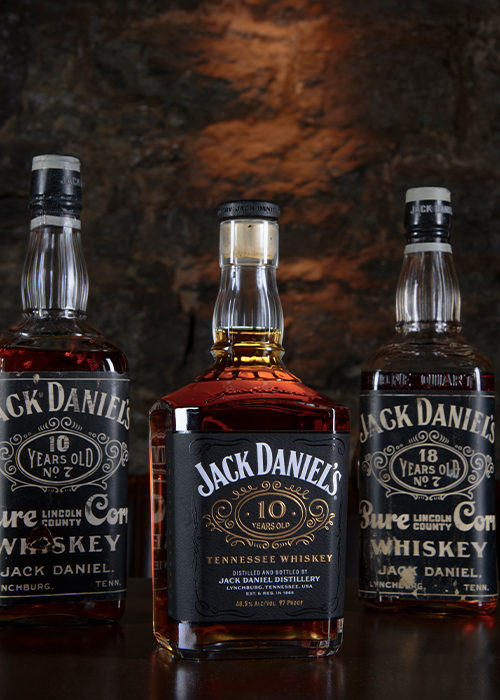
The behemoth producer isn’t done yet. Jack Daniel’s Distillery has sights set on going even further, including releases over 20 years old. And those age targets are hardly random. Indeed, they’re based on historic pre-Prohibition bottlings dating all the way back to the days of Jack himself. For Jack Daniel’s, 10-, 12-, 14-, 18-, and 21-year-old whiskeys aren’t technically firsts, but instead something of a return to form.
Of course, earmarking barrels for 20-plus years doesn’t guarantee the whiskey will make it, at least at quality. To get there, the distillery must battle a litany of known and unknown factors, including flavor swings and evaporation loss that could eclipse 80 percent. I sat down with two of the brand’s main signal callers, including master distiller Chris Fletcher, to talk about the future of the age-stated line as well as their learnings and speed bumps along the way.
Rediscovering Age-Stated Jack
Tucked away in a rural corner of Tennessee, Jack Daniel’s is one of the world’s largest and most carefully managed distilleries. Releases are scheduled years in advance; few if any innovations happen in a vacuum. Market economics — and directives from parent company Brown-Forman — are always at play.
At the same time, the distillery’s massive scale means its “smaller” bets often exceed a smaller distillery’s yearly production runs.
“The whole aged-stated line really started back with a small group of people [around 2014]. And we just decided to hold back a thousand barrels of what at the time was some single barrel product, distilled around 2010,” says Chris Fletcher, current master distiller and director of distillery operations for Jack Daniel’s.
“I don’t want it to sound like we had this idea of, ‘We’re going to make it 10 years old.’ We’re blessed with a great distillery and capability and scale. It was kind of like, ‘Sure, why not?’ It was a pretty casual conversation that started this whole thing off.”
As those barrels matured, Jack Daniel’s as a brand was planning for significant SKU expansion, additions that eventually included single barrel rye, barrel strength Tennessee whiskey, single malt whiskey, and a bottled-in-bond series. An age-stated lineup seemed like a natural progression.
“I’m thinking about the level of demand, which is incredibly high, and not being able to meet that demand, to reach new and different consumers and give them the opportunity to taste this whiskey.”
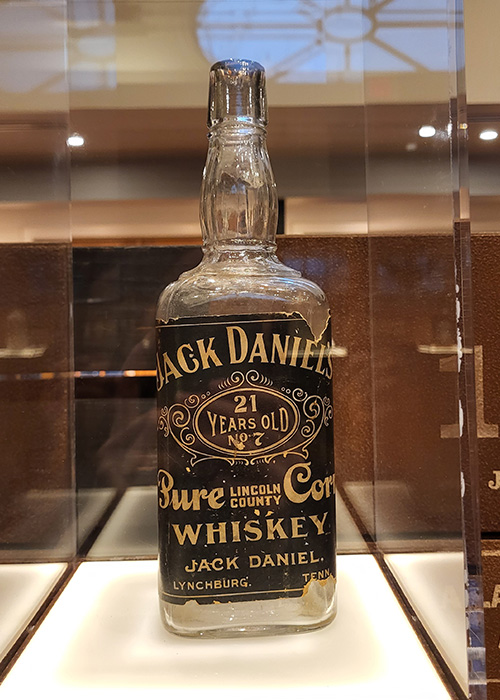
A look through the archives provided historical precedent — and some exact ages to aim for. The distillery had several examples on hand — either via vintage bottles or photographs — of 10-, 12-, 14-, 18-, and 21- year-old bottlings produced under the watch of the distillery’s namesake founder. (Jack Daniel ceded control of the distillery to his nephew in 1907 and passed away in 1911.)
“Innovation became more of a priority for the brand as a whole,” Fletcher says. “We started to accumulate a thousand barrels at a time, and we did this a couple years in a row. So now we’re sitting on maybe 3,000 of these barrels, and the question becomes, ‘How do we bring this to life?’ And it’s been one of the most rewarding projects I’ve ever worked on in 20-some years, to be able to recreate age statements that Jack Daniel himself had.”
Innovation, Rotation, and Fighting the Angel’s Share
Archival evidence provided an anchor for the new lineup. But getting the whiskey there would be another challenge entirely. Aging past the one-decade mark is often a challenge when maturing American whiskey in new oak barrels. It’s especially challenging for a brand known for keeping barrels in the south-central Tennessee heat.
With hardly any production records surviving, the 19th century left few clues about those historic whiskeys. Not that they would necessarily be relevant.
“That whiskey would’ve been distilled in the 1800s, so it would’ve been a bit different than today,” Fletcher says. “Just the variation in the actual barrels themselves would’ve been wildly different. Toasting wasn’t even a thing, and charring would’ve likely been all over the place. Long story short, the consistency and control we have now is hundreds of years better than they had then.”
While the modern whiskey aged, few could predict its exact flavor development. The barrels themselves were stored toward the top of the distillery’s warehouses, a hot aging environment common for its single barrel products. Frequent monitoring showed that around the eight-year mark, the whiskey began exhibiting intense oak influence.
In order for the whiskey to keep its balance, the team needed to slow the aging process. So they began rotating those barrels to lower, cooler floors. It’s a laborious and time consuming process, one the distillery’s barrels rarely undergo.
“You start pushing 10 years on a top floor, you run the risk of overdoing it and losing some of that sweetness. Not to mention the fact you’re going to lose whiskey to evaporation at a really aggressive rate. So there’s where moving the barrel becomes a necessity,” Fletcher says. “And we don’t typically do that. Once we have a barrel in place, 99 percent of the time that barrel would not be moved until it’s coming out to be dumped to go into a bottling.”
Once lowered, the barrels could age in cooler, more humid environments. For Fletcher, the first batch of 14-year-old whiskey — released in 2025 at a cask strength 126.3 proof — was a litmus test for the rotation process. (The 10- and 12-year version have thus far been proofed at 97 and 107, respectively.)
“You start putting 14 years on an American whiskey in that new barrel, that’s very considerable,” Fletcher says. “Are we going to lose that balance of sweetness? I think we absolutely have not. That being said, I think the runway is still very, very good for us to get to 18 years and hopefully 21 years some day.”
In addition to managing flavor, the team must also contend with a stark reality of whiskey maturation: loss due to evaporation, or the “angel’s share.” Fletcher estimates that between wood absorption and evaporation, a Jack Daniel’s barrel may lose around 12 percent of its whiskey in the first year. Each year after can be another 4 or 5 percent. And once a barrel has lost 50 percent or more of its total volume, loss can actually increase yet again.
“We started to accumulate a thousand barrels at a time, and we did this a couple years in a row. So now we’re sitting on maybe 3,000 of these barrels, and the question becomes, ‘How do we bring this to life?’”
“Once you get to the 50-percent liquid level, because of how much of the surface area is exposed to the air, [evaporation loss] actually speeds up again,” says Fletcher.
His current assumption is that for 10- to 14-year-old whiskey, Jack Daniel’s can expect a yield of around 10 cases per barrel — over 75 percent total volume loss. Aging for 18 or 21 years at the top of a warehouse would all but guarantee empty barrels. It remains to be seen exactly how lower-floor aging will impact yield for those even older products. Based on current trends, no one is expecting to bottle all that much whiskey per barrel.
The Future of Age-Stated Jack Daniel’s Whiskey
Since its release in 2021, the age-stated lineup has proven a domestic success. In 2025, Brown-Forman expanded it internationally, beginning with the tentpole 10-year whiskey. Ultimately, it became a cross-border hit.
“The success of the 10-year-old going international was really exciting,” says Amanda Fowler, Jack Daniel’s global strategy portfolio director. “This is where the limited quantities became a real struggle, because it sold out in seconds, kind of everywhere.”
Fowler thinks that demand can be a double-edged sword, especially if and when even the older expressions go international. On the one hand, it’s a chance to invite consumers into a more premium side of the Jack Daniel’s portfolio.
“I think that is such an opportunity, especially for a brand like Jack, to demonstrate what American whiskey can be in markets that may not always get exposed to the complexity, the specialness, and the unique characters that can come from these extraordinary whiskeys,” Fowler says.
Yet it’s a battle to balance demand with accessibility. Coveted whiskey can build lifelong fans while frustrating those who miss out.
“I’m thinking about the level of demand, which is incredibly high, and not being able to meet that demand, to reach new and different consumers and give them the opportunity to taste this whiskey,” Fowler says. “So it’s kind of that catch-22; it’s a nice problem to have.”
To Fletcher, managing supply and demand will be a constant dance for the age-stated whiskeys. Each will vary from one year to the next, perhaps greatly. Batch one of the 14-year-old bottling came out to around 24,000 bottles. In both flavor and yield, batch two could be significantly different.
“We’re going to see considerable variation,” Fletcher says. “That’s going to be the fun of it. If batch five of the 14-year-old is dropped to 110 proof, we’ll go in and we’ll select the best barrels to make that batch the best we can make. You know, that’s all we can do.”
According to the brand, the 10-, 12-, and 14-year Tennessee whiskeys are here to stay. Based on barrel stock, the earliest we could see 18- and 21-year Jack Daniel’s Tennessee whiskeys will be in 2029 and 2032.
But while he isn’t divulging exact details, Fletcher says fans may not have to wait that long to see a new, highly aged product — albeit one with a different mash bill.
“I can’t make any promises whatsoever at this point about it,” he says. “But in the next year or two, I think we’re going to have some rye whiskey with some pretty considerable age on it as well.”
