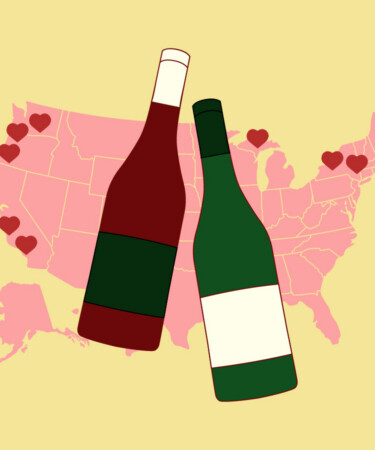
Scanning the shelves at a standard wine shop might make you think California is the only state making wine worth sipping. And while it’s true that Napa Valley and Sonoma County have some of the most famous wineries stateside, the U.S. is home to a wide swath of regions making excellent wine.
Every single state in the U.S. produces wine, which means there are dozens of overlooked regions worth exploring, whether that means taking a trip to the vineyard or simply picking up a new bottle to try. So we asked sommeliers from across the country to name the region they’re most excited about right now that deserves a little more love. From underappreciated regions in upstate New York to pockets of the Pacific Northwest that remain off the beaten path, here are the most underrated American wine regions, according to sommeliers.
The most underrated American wine regions, according to sommeliers:
- Hudson Valley, N.Y.
- Northern Michigan
- Ballard Canyon, Santa Barbara, Calif.
- Laurelwood District, Willamette Valley, Ore.
- San Luis Obispo Coast, Calif.
- Yakima Valley and Walla Walla Valley, Wash.
- Seneca Lake, N.Y.
- Applegate Valley, Ore.
“The Hudson Valley is one of those wine regions that rewards curiosity because it has never had the luxury of taking an obvious path. The climate is challenging, the growing season is shorter, and the wines tend to have a freshness and restraint that I really love. They’re energetic, food-friendly, and often much more nuanced than people expect from the region. What makes the Hudson Valley particularly interesting to me is that it doesn’t feel like a smaller version of somewhere else: unlike Long Island’s maritime, Bordeaux-leaning wines or the Finger Lakes’ extraordinary Rieslings, the Hudson Valley has developed a more eclectic identity, with winemakers embracing everything from Cabernet Franc and Chardonnay to French-American hybrids. There’s a sense of experimentation and discovery there that feels distinctly American, and I think we’re only beginning to understand how compelling these wines can be.” —Vanessa Price, wine director, Wildflower Farms, Auberge Collection, Gardiner, N.Y.
“The most surprising (and certainly underrated) wines that I’ve tasted in the last few years have actually been from Northern Michigan. Patience, thoughtfulness, and collaborative approaches on the peninsula are really driving a renaissance for the wines here. Names like Dave Bos and Brian Ulbrich (Left Foot Charley) bring a real unbending commitment to growth in the industry, and produce wines that are tasty and, in many cases, improve with each consecutive vintage. Although Riesling is king here, I have tasted multiple compelling examples of other Alsatian varieties that thrive in this climate as well as some interesting and quaffable reds from grapes like Pinot Noir, Gamay, and Blaufränkisch. Paired with a blossoming restaurant and cocktail scene, Northern Michigan is a place to watch (and visit!).” —Erin Healy, head sommelier, Restaurant Daniel, New York City
“Ballard Canyon AVA is a small valley within Santa Barbara County whose wines still fly under the radar. The sandy limestone soils and wide diurnal range give the Syrah produced in Ballard Canyon both ripeness and a savory, peppery, Northern Rhône character. Producers like Stolpman, Beckmen, and Likha are making structured, characterful, age-worthy wines rather than the cliché California fruit bombs produced in other regions. It’s genuinely site-expressive, Rhône-style wine priced at true value for quality. The region is represented on our lists in all three cities.” —Dean Fuerth, beverage director, Sushi Nakazawa, Los Angeles, NYC, and Washington, D.C.
“As one of the newest AVAs in Willamette Valley, the Laurelwood District can easily fly under the radar. Laurelwood is the first AVA to be named after its unique soil type, and also hosts the highest elevation in the Willamette Valley. I find this AVA champions some of the best blue-fruit forward Pinot Noirs, like one of my go-to favorite producers, Ponzi Vineyards.” —Kyle Amoroso, head sommelier, Aqua Roma and Aqua Kyoto, NYC
“I am personally loving the wines coming out of the San Luis Obispo Coast AVA right now. The SLO Coast has only been recognized as an AVA for four-ish years, and it absolutely makes sense to have that designation. The microclimate there is super interesting to wine nerds with lots of fog, tons of sunshine, sea breezes, and calcareous soil. And with a very long growing season, the grapes have plenty of hang time on the vine to develop complexity of flavor and so much depth. The area focuses on Pinot Noir and Chardonnay (I’ve had Pinot Noir from here that rivaled Savigny-lès-Beaune elegance), but it is also home to a growing hotbed for Albariño. The coastal influence is essential to build beautiful and typical Albariños, and as this is one of my favorite grapes to drink, I am excited to see more becoming available domestically.” —Shannon LaDawn, sommelier, Husk, Savannah, Ga.
“Washington produces some of the Pacific Northwest’s most distinctive wines, from savory, expressive Syrah to vibrant, black-fruit-driven Cabernet Sauvignon. A dynamic wine country with a beautiful landscape, the region is shaped by the Cascade Mountains, home to Mount Rainier, which create a rain-shadow effect; the historic Missoula Floods, which gifted the region with distinctive soils; and the gorgeous Columbia River, which provides irrigation to most of the vineyards. My suggestion for AVAs to explore in this state would be Yakima Valley and Walla Walla Valley.” —Slim Melo, assistant wine director, Aman, NYC
“Ballard Canyon has become one of the California regions I’m most excited about. Stolpman Vineyards captures what makes the area special, especially with La Cuadrilla — a vibrant, approachable Syrah that showcases both the character of Ballard Canyon and the people behind the wine.” —Chuck Tatum, sommelier, Olivine, Auburn, Ala.
“When asked about the most underrated wine region in America, I always point to Seneca Lake. It continues to astonish me and others in the wine world with the quality of its site-specific Riesling production. Producers like the young, brilliant winemakers at Forge Cellars have demonstrated the potential for cru-like distinctions within Seneca Lake. The not-so-subtle differences in wines from individual lieux-dits express themselves beautifully and uniquely. The racy acidity of the Rieslings produced from sites like Leidenfrost nods to Germany, while offering a distinct complexity shaped by the region’s shale soils and unique mesoclimate. I’m always excited to taste wines from this region because of their singular character and the talented winemakers drawn to this remarkable landscape.” —Brittney Johnson, sommelier, Marbled & Fin, Savannah, Ga.
“I gave this a lot of thought, and I kept coming back to the Applegate Valley in Southern Oregon as one of the most underrated wine regions in the country. It has this great combination of warm days and cool nights that really seems to suit Rhône varieties, which I love. The wines can be generous and expressive, but still have tons of freshness and savory character. Troon Vineyard is a favorite of mine, especially their Mourvèdre. I first tasted it during my time at Gramercy Tavern, and it was one of those wines that really stuck with me. It was earthy and spicy, with so much fruit, but everything was so well integrated. I think I told the rep who I was tasting with that it’s a wine that makes you want to turn into a cartoon and cannon ball right in the glass. It was super compelling, and I kept going back for another sniff, and another sip. It completely opened my eyes to what Southern Oregon could do, and I think Troon captures a lot of what makes Applegate so exciting right now.” —Dorian González Vega, beverage director, Union Square Cafe, NYC
