In the grand scope of whisky, Scotch is a universe unto itself. Across malt, grain, and blended whisky producers, Scotland is home to some of the most iconic brands in the world, along with an incredibly high density of distilleries. The Scotch Whisky Association (SWA) — the trade body representing the vast majority of Scotch whisky production — counts 154 malt and grain distilleries as of 2026. That list boasts incredible diversity across styles, flavors, and production techniques.
Yet one of the most common ways to parse Scotch distilleries is by region. The partitioning of Scotch into distinct areas traces its early origins to the Wash Act of 1784, which drew an imaginary line dividing the Highland and Lowland regions. This created differing legal and tax requirements for production, including still size and speed. The Act’s implications influenced production methods and helped spur the development of individual styles.
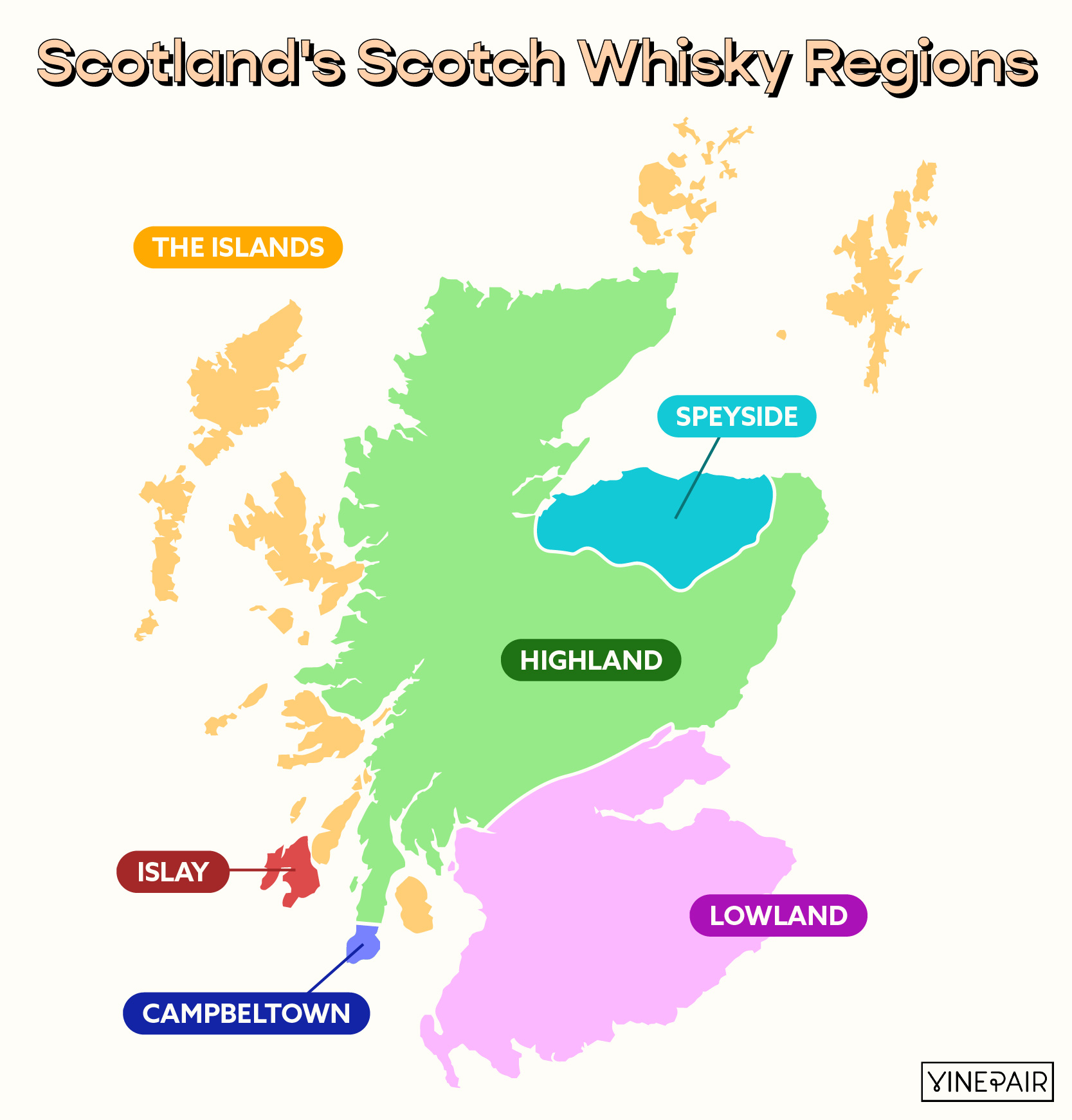
As laws changed and the industry grew, other regional designations gradually developed, often more geographical than stylistic. By 1909, the U.K.’s Royal Commission on Whisky and Other Potable Spirits included the five Scotch whisky regions still widely recognized today: Highlands, Lowlands, Speyside, Islay, and Campbeltown. In 2009, The Scotch Whisky Regulations formally acknowledged three protected regions (“Highland,” “Lowland,” and “Speyside”) along with two protected localities (“Islay” and “Campbeltown”).
Today, those five areas comprise the official Scotch geographic designations. Each features a diverse array of whisky styles, and the modern regions often speak more to history and proximity than flavor profile. A sixth, informal designation — the Islands — has emerged due to the proliferation of new distilleries across the Inner and Outer Hebrides, in addition to the Northern Isles. Though technically still a part of the Highlands, for the purposes of this article and graphic, we’re breaking out the Islands into its own classification. Read on to discover more about each of these regions — and the range of whiskies to expect from each.
The Highlands
The Highlands are separated from the Lowlands by an imaginary line slicing across Scotland, from Dundee in the east to Greenock in the west. That artificial divide can lead to some categorical oddities. For example, Glengoyne is a Highland single malt producer that straddles the border. Its stills are situated in the Highlands, while its warehouses — nestled across a single road — are in the Lowlands region.
By far the largest Scotch region, the Highlands traditionally includes most of the country’s surrounding islands, with the notable exception of Islay. Its distilleries are situated over an array of terrain, climates, and water sources.
Accordingly, the region’s whisky exists across a wide spectrum of styles, one that’s difficult to bucket into a particular flavor profile. Highlands whiskies range from full-bodied, heavily sherried Glendronach bottlings to Glenmorangie, which utilizes the country’s tallest pot stills for a lighter and more floral spirit. The region is sometimes (and unofficially) subdivided into the Northern, Southern, Western, Eastern, and/or Central Highlands.
Speyside
Speyside is located in the northeastern Highlands, with distilleries concentrated along the River Spey, which historically provided ample freshwater for whisky production. While technically a subregion, Speyside’s unique history and styles have led to separate recognition and special status. Contemporary Speyside distilleries can choose whether to market their whiskies as either Highland or Speyside. For example, the Macallan labels its bottles as Highland single malts while frequently emphasizing its Speyside heritage. (“Nestled Above the River Spey” is a common refrain in its marketing.)
Speyside currently has more than 50 active distilleries, more than any other Scotch region; the SWA calls Speyside “the most densely populated whisky region in the world.” Speyside whiskies are celebrated for sweet, fruit-forward profiles, and distillers commonly mature across ex-bourbon and/or sherry casks. (The latter style often leads to more robust flavors, richer in dark fruits.) Large and prominent producers include Glenfiddich, Glenlivet, and Roseisle, to name a few. While Speyside whiskies are best known for being unpeated, some distilleries — including Balvenie, Benriach, and Benromach — also produce peated distillate.
The Lowlands
Scotland’s Lowland whiskies span a range of styles. In addition to single malts, the area is famed for its grain whisky distilleries, which typically employ high-volume distillation via column (or “continuous”) stills. It’s home to large-scale operations like Cameronbridge, widely recognized as Europe’s highest-volume grain distillery. Historically, Lowland grain whiskies have been integral components of blended Scotch, though some are commonly released and branded under various single grain labels.
The Lowlands is also home to a number of well-regarded single malt producers, including Auchentoshan, Bladnoch, Glenkinchie, Daftmill, and Rosebank, which was shuttered for decades before restarting production in 2023. Lowland single malts are known for showcasing lighter flavors, in addition to both floral and grassy profiles. In recent years, the style has expanded as producers experiment with and incorporate various techniques, including peated whiskies.
Campbeltown
The smallest of Scotland’s whisky regions, Campbeltown is located on the Kintyre Peninsula in western Scotland’s Argyll and Bute, a unitary council area. In the late 1800s, Campbeltown was home to roughly 30 distilleries. That extreme density of production led to its moniker as “Whisky Capital of the World.” Today, those numbers have dwindled to just three operating distilleries: Springbank, Glen Scotia, and Glengyle.
While no longer in its powerhouse heyday, Campbeltown is still an influential locale for distilling, producing a wide variety of flavors. The three current Campbeltown producers are known for a breadth of whisky styles, even within the same distillery: peated and unpeated malts, heavy and lighter distillates, and a mix of ex-bourbon and sherry cask maturation. Many Campbeltown expressions are renowned for an oily texture and sea-influenced briny flavors.
Islay
The only Scottish island with an approved SWA designation, Islay lies to the west of the mainland and is the southernmost of the Inner Hebrides. With a permanent population of around 3,000 inhabitants, Islay is home to 11 modern distilleries: Ardbeg, Lagavulin, Laphroaig, Port Ellen, Caol Ila, Bunnahabhain, Ardnahoe, Bowmore, Bruichladdich, Kilchoman, and Laggan Bay. Alongside farming, whisky is one of the island’s main economic drivers and largest employment sectors.
Islay distilleries are famed for producing some of the world’s most heavily peated single malts, with pronounced smoky flavors ranging from meaty to medicinal. However, not all Islay whisky is peated. Bunnahabhain’s core offerings are unpeated, and its limited peated offerings tend to showcase a lighter side of smoke. Bruichladdich also produces a range of whiskies across the smoky spectrum, ranging from unpeated (the flagship Bruichladdich line) to the “super heavily peated” Octomore series.
The Islands
Under Scottish law, there is no official “Islands” category for Scotch. The term generally refers to whiskies produced across the islands of Arran, Jura, Mull, Orkney, Skye, Lewis, Harris, Raasay, and Shetland — all of which technically fall within the Highlands.
In recent decades, the islands have seen a proliferation of distilleries. Founded in 2017, Torabhaig was the first new legal distillery on Skye in almost 190 years, joining Talisker (founded in 1830) in producing peaty, briny malts. Founded in 2015 and 2017, respectively, the Isle of Harris and Isle of Raasay distilleries became the first legal spirits producers on their islands. The informal Islands region also encompasses Scotland’s northernmost distilleries, including Highland Park and Scapa (Orkney). Lerwick Distillery, located on the Shetland Islands more than 100 miles north of the Scottish mainland, is currently aging casks for its first release.
The region’s styles vary, though whisky makers frequently take advantage of extreme climates, allowing coastal winds and sea spray to batter warehouses as spirits age.
*Image retrieved from Rick Barrett for Ambitious Studio via unsplash.com
