When you move into a new house in the Phillipines, salt is a common housewarming gift. “Filipinos are a very superstitious group of people,” Darwin Pornel, the co-owner of New York City’s new Filipino-American cocktail bar June Baby, says. “It’s for good luck and prosperity in your new home.”
So when Pornel, Roxanne Diaz Bangalan, and Ben Rojo were ready to swing open the doors of their East Village bar last month, it was a welcome gesture when they received a giant sphere of salt as a congratulatory gift. The rare Filipino sea salt, called Asín tibuók, was a gift from Mary Palac, the Mexican spirits portfolio ambassador for Campari America, whom Pornel calls an “ate,” meaning big sister.
Produced on Bohol Island in the Philippines, Asín tibuók is a large piece of unbroken sea salt that’s made through a traditional method passed down since at least the 1600s. To make the salt, craftspeople collect coconut husks and soak them in seawater for months. The husks are then dried and slowly burned over about a week and mixed with seawater to create a brine. The brine is boiled in clay pots, eventually forming a mound of smoky sea salt that resembles a white, cracked dinosaur egg in a brown shell. The four-month production process is so painstaking that it’s been named to the UNESCO list of intangible cultural heritage in need of urgent safeguarding and is becoming difficult to find even in Bohol.
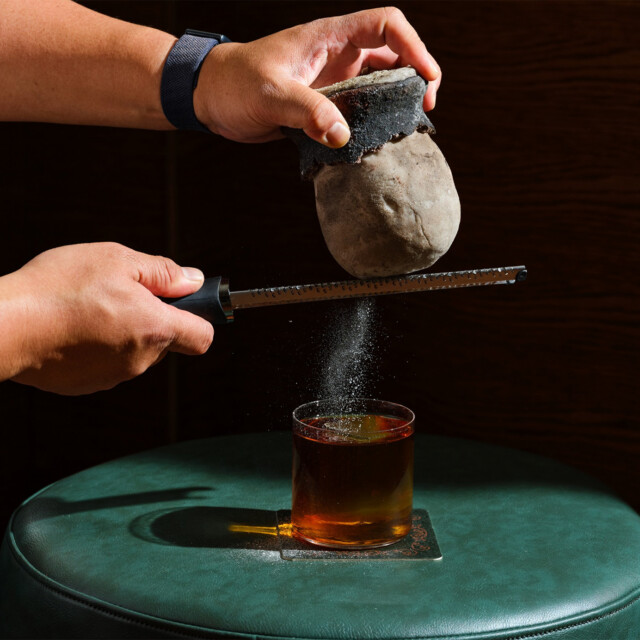
In the Philippines, it’s often used as finishing salt dusted over fresh-caught fish or savory rice porridge. But at June Baby, the salt is shaved over an Old Fashioned riff called Taste and See. Bourbon fat washed with brown butter, rich date syrup, and a splash of Madeira come together for a cozy, warming cocktail. The drink’s flavor profile takes inspiration from a dessert that Pornol ate every Christmas called Food of the Gods, a blondie-style bar made with brown sugar, dates, and walnuts.
At June Baby, when a guest orders the Taste and See, the bartender finishes the build with a theatrical finishing touch, pulling out the large hunk of salt to grate over the drink with a microplane. Pornel says it’s an “absolute showstopper.”
But the salt is much more than just an eye-catching garnish, it’s an “if you know, you know” nod to the community that the team is catering to at June Baby. “We intentionally designed the space without very common motifs of Filipino culture like the flag or the sun and stars,” he says. “It’s such a payoff when people see the salt, they’re like, ‘oh my god, you guys are using that on drinks?’”
The fine crystals of Asín tibuók floating on its surface give the Taste and See a subtle smoky aroma and a burst of salinity on the first sip. The salt nicely balances the Old Fashioned riff’s richly sweet notes, and the team was excited to highlight an ingredient that’s meaningful in Filipino culture to bring the drink together. “We wanted to add a subtle yet significant touch to it to make it ours,” Pornel says.
Filipino ingredients like calamansi and ube show up in several of the cocktails at June Baby and the food options are inspired by Filipino drinking snacks called pulutan. Dishes like Lumpiang Shanghai and Salt and Pepper Kanto Fried Chicken Wings appear on the menu under a header that says “did you eat yet?” because it’s a phrase the team heard “10 times in a row in the same span of an hour from relatives” growing up in Filipino-American households. “When people walk into the space, we really want them to feel like they’re at their favorite Tita’s house,” he says.
These thoughtful touches don’t come easy. The team’s grapefruit-sized piece of Asín tibuók won’t last forever and it can be tricky to source replacements stateside as the ingredient becomes even more rare. Still, Pornel says the challenge is worth it to create a space that really feels like home. “Plus, it’s a good excuse to go home to the Philippines,” he says.
