![A Visual Guide to Europe’s Most Popular Olive Oil Varieties, From Koroneiki to Picual [MAP]](https://vinepair.com/wp-content/uploads/2026/10/guide-to-olive-varieties-of-europe-map-card-375x450.jpg "A Visual Guide to Europe’s Most Popular Olive Oil Varieties, From Koroneiki to Picual [MAP]")
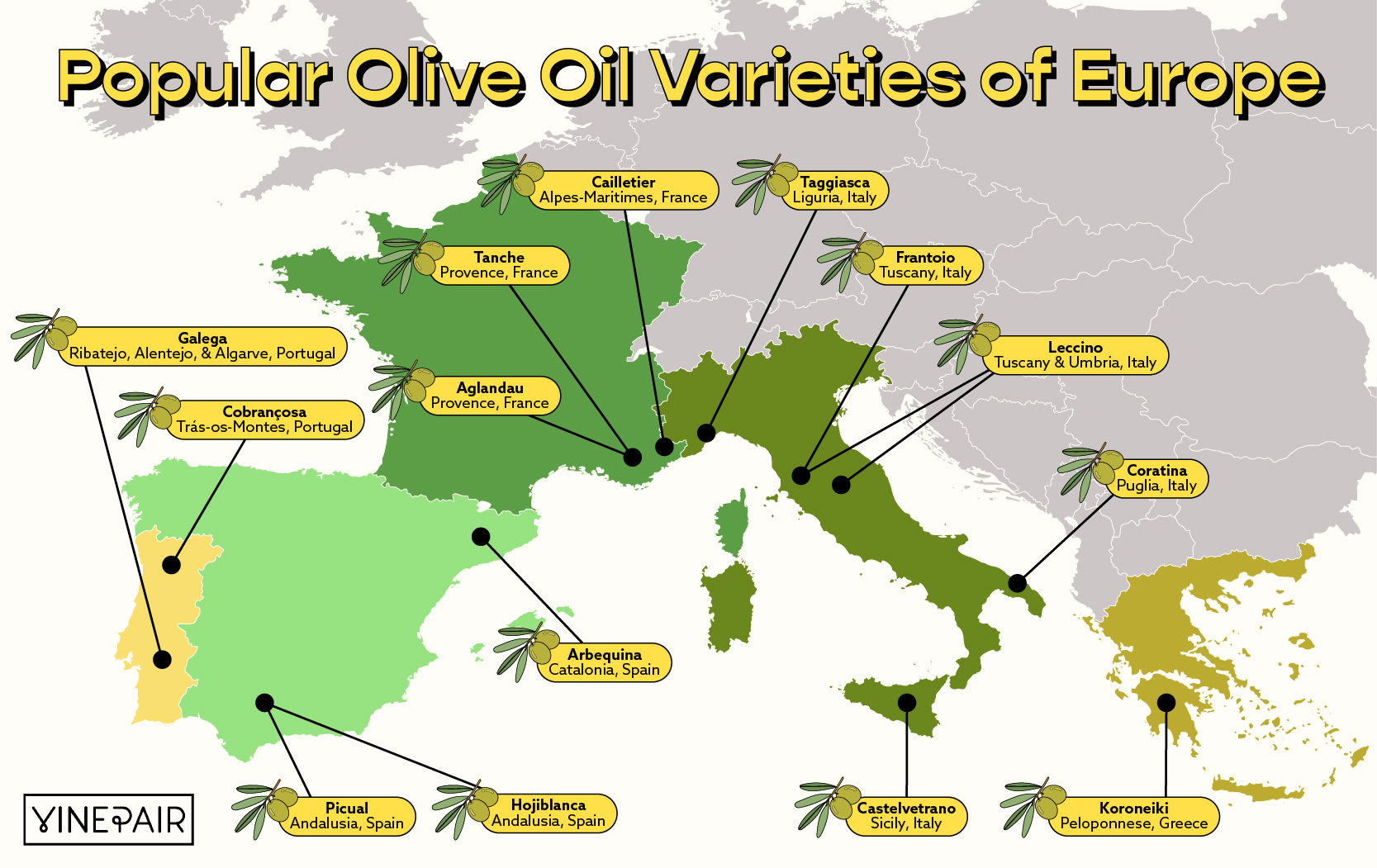
Throughout Europe, there’s a rich diversity of olive varieties. The continent’s warmer, Mediterranean regions are especially abundant in the crop, with a number of notable varieties coming from Spain, Italy, Greece, France, and Portugal. But while some cultivars might be best suited for snacking or for mixing up a batch of Dirty Martinis, others are best known for their role in olive oil production.
Due to the wide variety of olive types, the corresponding olive oils range in flavor from buttery and silky to piquant and spicy. And the inherent characteristics of each cultivar — such as size and natural fat content — inform its corresponding oil’s look and taste. One of the most significant factors in shaping the flavor of an olive oil is the fruit’s polyphenol content. Polyphenols are compounds that bring a peppery, back-of-the-throat spice, and such olive oils are often reserved for dressing dishes as a flavorful finishing touch. On the other hand, low-polyphenol olive oils deliver a silky mouthfeel and neutral flavors, and are usually used for cooking over heat.
Before grabbing any olive oil off the grocery store shelf, read on to discover which cultivars produce the oils best suited to your needs.
Portugal
Cobrançosa
Often thought of as the counterpart to Galega in Portuguese olive oil, Cobrançosa comes from northern regions like Trás-os-Montes. Its oil is all-things power: The nose is a bouquet of herbs, and the palate brings the bold, peppery, and bitter profile that will nag at the back of the tongue. Its intensity is a result of a high polyphenol content, and it is often blended with Galega to produce a well-balanced oil. Galega oil brings a rounded sweetness, and Cobrançosa oil delivers a punchy structure.
Galega
Galega is Portugal’s most planted olive cultivar, popular in the country’s southern regions like Ribatejo, Alentejo, and Algarve. In turn, the variety is one of the most common in Portuguese cooking. Galegas are small olives and, with a relatively low polyphenol content, offer a sweet and mild flavor to the oil. Galega oil has a delicate texture, bringing little to no peppery bite at the end. Where it shines in palatability, Galega oil lacks in verve — and to compensate, it is often blended with Cobrançosa.
Spain
Arbequina
Arbequina olives come from Spain’s Catalonia region but are now a popular olive cultivar grown across the globe. The variety’s trees are easily identifiable, as they are smaller and sparser than those of other cultivars. Arbequina oil is appreciated for its fruity and delicate character, with little to no spice or bitterness.
Hojiblanca
Hojiblanca olives are indigenous to Andalusia in the south of Spain. The variety is well adapted to the region’s intense heat and dryness, making it a reliable cultivar for olive oil production. Hojiblanca oil is bold, grassy, and slightly peppery, balanced by sweet notes of fruit and almonds. As a result, home cooks and chefs alike prize Hojiblanca oil for its versatility: Its high smoke point makes it suitable for cooking, and its strong flavor makes it ideal to be used as a dressing.
Picual
Picual is the most widely planted olive in Spain, and possibly in the world. Also hailing from Andalusia, Picual olives are relatively high in oil content, making them a favorable cultivar for olive oil producers. The corresponding oil tastes aromatic and fruity on the front with a bouquet of herbaceous and tropical flavors on the back. The olive’s high polyphenol content also delivers a bright, zippy edge to the oil.
France
Aglandau
Grown in and around the Provence region in southern France, Aglandau olives are some of the most common in Mediterranean dishes. But their high oil content, coming in at around 20 percent, also makes the cultivar a viable choice for olive oil. Its extra virgin extract is most common in Mediterranean cuisine for dressings and dips, though it is sometimes used for cooking over heat as well. Aglandau oil brings a fruit-forward palate, with background flavors of artichoke and almond. Aglandaus are typically harvested just before they’re ripe, resulting in a lively and bright oil with a tinge of pepper at the back.
Tanche
Also coming from Provence are Tanche olives, dark purple to black in color with a mild, mature flavor. Tanches are the same variety as the renowned Nyons olive — named after the specific area where they grow — and were the first cultivar to join France’s AOP system. Producers tend to harvest the cultivar after the fruit is fully ripe to result in sweet, jammy flavor and a full-bodied, unctuous mouthfeel. Expect a velvety texture to bring about notes of green apple, dried fruit, and toasted nuts.
Cailletier
Better known as the fan-favorite, small and dark Niçoise olive, the Cailletier cultivar grows around the Alpes-Maritimes region in the southeast of France. It is the variety used to produce the famous huile de Nice (oil from Nice), prized for its blend of smooth, fruity flavors with a bouncy bitterness. Cailletier oil is almost ubiquitous in Niçoise cuisine — a style of cooking that brings together ingredients from both southern France and northern Italy.
Italy
Castelvetrano
Castelvetrano olives may be better known for snacking or dirtying Martinis, but it’s also common for the Sicilian cultivar to be pressed for its oil. When consumed whole or as the oil, these olives bring a silky mouthfeel and buttery taste. For olive oil production, this variety is better known as Nocellara del Belice, a classification protected under Italy’s Protected Designation of Origin (DOP) system.
Coratina
Coming from Puglia, Coratina is notorious for being one of the spiciest, most bitter olive oils out there. Around the region, massive Coratina trees grow in groves that extend for miles. On the palate, Coratina oil begins with a burst of fruit that leads into a grassy, peppery kick on the finish. That sharp, spicy bite is a result of its high polyphenol content. The cultivar’s oil is mainly used for finishing dishes or for dipping, but make sure to not use too much, lest the spice become overwhelming.
Frantoio
Frantoio olives come from the hot, rolling hills of Tuscany. When mature, Frantoios range anywhere from dark purple to black, but they are usually harvested just as the color changes from green to preserve their vibrance in flavor. These olives are high in oil content — around 25 percent of the fruit is oil — and produce sweet, earthy flavors of grass, artichoke, and green apple. The finish is bitter and peppery, a complexity that makes this cultivar’s oils a go-to for finishing dishes rather than cooking.
Leccino
Leccino olives originated in Tuscany but are now cultivated in the neighboring region of Umbria as well. The cultivar — grown on large, drooping trees — is used to produce both olive oil and black table olives. Leccinos are high in fat content, and depending on the harvest time, the oil can range from fruity and intense to neutral and almost flavorless. That versatility makes Leccino oil common for both cooking and dressing.
Taggiasca
Coming from Liguria, Taggiasca olives look like a kaleidoscope on a tree: On the same plant, the olives’ colors can range from green to brown to purple. Taggiascas boast a relatively low water content, lending a lively and powerful flavor. The resulting oil is bright and fruity with nuances of sweet almonds. However, the olive’s low polyphenol content doesn’t impart much of a bite. Instead, Taggiasca oil is known to be silky and buttery.
Greece
Koroneiki
Koroneiki olives come from Peloponnese, a large region in southern Greece. The Koroneiki trees yield high volumes of small, polyphenol-rich olives. As a result, the olives are prized for their oils that deliver vibrant flavors of pepper, grass, and herbs. The prestigious oil is most often used for dressing dishes, but some chefs like to use it in low- to medium-heat cooking scenarios to impart that strong, bright flavor.
*Image retrieved from Skyler Ewing via unsplash.com
