I recently somehow added Google Discover to my iPhone and suddenly I was getting push notifications for content it thought I might like to read. It was annoying at first, but I had to admit the picks were usually spot-on with my interests.
Hosannas to Michael Olise’s latest stunning performance in the Champions League.
Critical reviews of “You Can See Everything.”
Reviews for the new Georgian restaurant in my neighborhood.
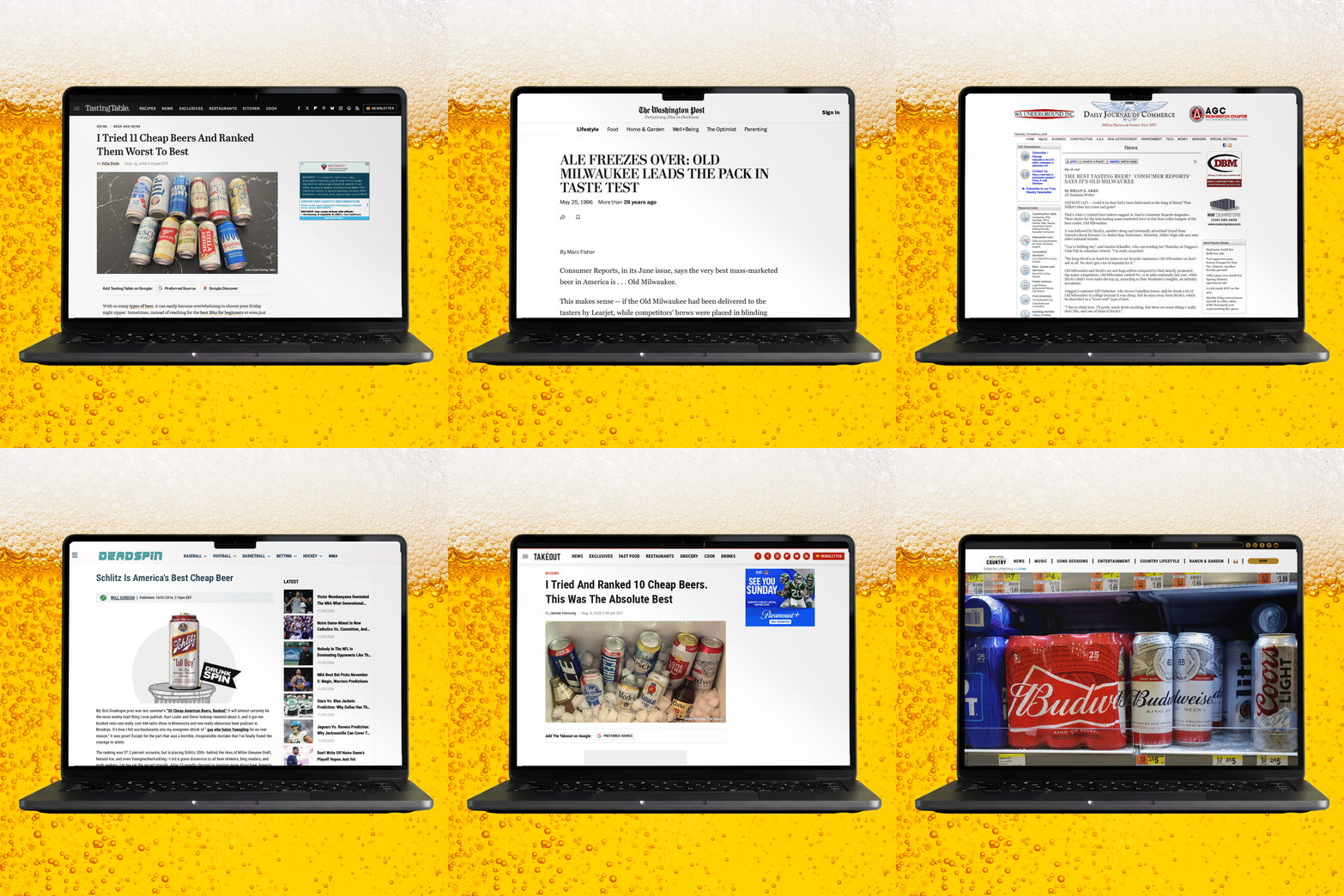
And one morning a few weeks ago, I got pushed a just-published Tasting Table story entitled: I Tried 11 Cheap Beers And Ranked Them Worst To Best
I didn’t need to know who wrote it. I didn’t even need to read it yet. I knew it would be a viral hit.
Indeed, within days the article would be widely shared on social media and message boards and syndicated by Yahoo Life and AOL. (For what it’s worth, author Julia Duda would select Miller High Life for “its impeccable balance between crispness and flavor.”)
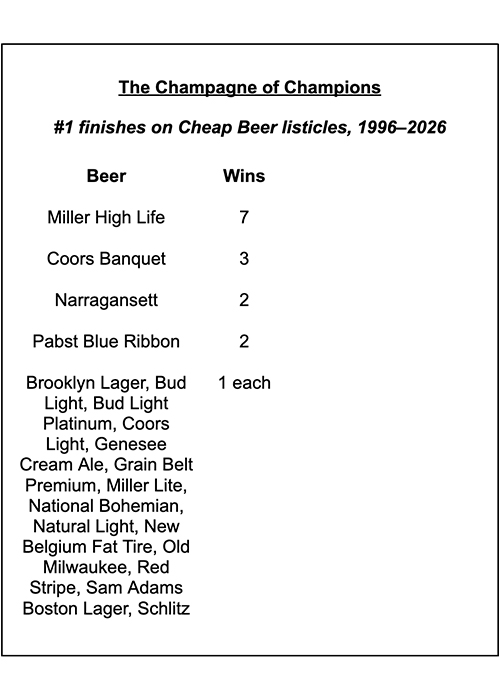
Now entering its fourth decade of existence, the “cheap beers ranked” listicle is seemingly, still, one of the most reliable ways for a publication to garner easy viral traffic.
Consuming Reports
June 1996. Consumer Reports, that ad-free arbiter of car, appliance, and electronics quality, decided to, for the first time, put its powers of evaluation toward “mass-marketed beers.” They gathered 17 academically-trained beer tasters (brewmasters and PhDs in fermentation sciences mainly) to determine the “blue-collar bargain of the beer cooler” by tasting 69 different beers.
The winner was Old Milwaukee, then the second cheapest beer in the country, averaging $1.69 per 6-pack. Second place was even more surprising — Stroh’s, created by German immigrants in 1850, and not even a top 25 best-selling beer in America by 1996. Third place got even stranger, being awarded to Red Dog, a now-defunct product from Miller.
Even in this mid-1990s nascent era of craft beer and online chatter, the unexpected results went viral — print viral.
The Washington Post covered it, quite aghast at the report and with a ton of editorializing from writer Marc Fisher. “[The result] makes sense — if the Old Milwaukee had been delivered to the tasters by Learjet, while competitors’ brews were placed in blinding sunlight for several years.”
The article was covered by The New York Times, the Los Angeles Times, and Tampa Bay Times. AP business writer Brian S. Akre asked “Could it be that Bud’s been dethroned as the King of Beers?” While the New York Daily News thought “Magazine Ratings are Hard to Swallow” and gathered 25 of their own employees to conduct their own tasting.
Though surely earnest in their intentions, Consumer Reports had unwittingly taught the mainstream media that rating cheap beers could inspire such intense debate that virality was all but guaranteed. The race was on, and for the next 30 years “cheap beers ranked” has been as dependable an article as one can publish.
The Best Worst
These listicles would mostly remain the purview of print for the first decade of the 21st century. The Washington Post would do their own cheap beer blind taste test in 2009, defining that as ones priced at less than $6 a sixer. Baltimore’s beloved local lager National Bohemian would win and the story would be covered by NPR and others.
It would take modern internet culture — and the rise of high-priced craft beer — however, to launch “cheap beers ranked” into the stratosphere. Audiences have all but demanded this story.
In 2012, Slate offered its readers a chance to assign a feature to one of its authors. The top seven picks — which included “Make Seth Stevenson explain the scourge of scaffolding” and “Make Matt Yglesias explain why hotel rooms cost so much” — were voted on, and ultimately the winner was “Make Troy Patterson review cheap beers.”
His resulting article, “The Best Worst Brews,” didn’t really rank beers but just had him trying and offering his thoughts on some cheap notables like Natural Light (“If you’re having only one beer, Natty Light is one to avoid.”). Perhaps due to his wishy-washy thoughts and lack of a forced ranking, the story only received one comment and, so far as I can tell, is just about the only cheap beers ranked listicle to not go viral. Maybe Slate should have opted for that Yglesias story.
In 2013, just as craft beer was undergoing a massive boom and clearly differentiating itself from the macros, offbeat sports blog Deadspin, then at the peak of its powers, offered “36 Cheap American Beers, Ranked.”
Author Will Gordon would stir debate by blasting beloved favorites like Miller High Life and Yuengling while crowning Minnesota’s Grain Belt Premium as his No. 1. As I’ve written about before, this was an era where you could go insanely viral on the internet and this piece did massive numbers, with over 2 million views, thousands of comments on the article itself, and a colossal amount of sharing it across the World Wide Web. Gordon appeared on AM radio and podcasts to discuss it and CBS News even did a report on it.
It ended up being Deadspin’s 7th most popular post of the year — in a year they uncovered the Manti Te’o dead girlfriend hoax — and might very well be the most widely-read piece of beer criticism ever written.
So seismic was Gordon’s article that other websites tried to quickly draft off the traffic, like First We Feast, which posted “America’s Best Cheap Beers, Ranked” a mere day later, even addressing its inspiration.
“Yesterday, writer Will Gordon set a certain segment of the suds-swilling, butt-scratching Internet on fire,” wrote then-editor-in-chief of First We Feast (and future “Hot Ones” creator) Chris Schonberger. “Since we’d been working on our own cheap-beer rankings in honor of July 4, our first thought was, ‘Damn, we’ve been scooped!’, followed shortly by, Oh wait, this is not an original idea at all!’, and then finally — upon reading through Gordon’s hastily summarized picks — ‘This list completely blows!’”
Schonberger would end up ranking Narragansett Lager as his No. 1, which incidentally Gordon had already ranked as his No. 2.
I think Gordon’s article was such a hit because he went above and beyond everyone else who had ever done it before, ranking 36 different beers, including plenty of beloved local lagers like Iron City, Olympia, Rainier, and Lone Star, while not being afraid to take down sacred cows. There was something for literally everyone to applaud — or be pissed off about — in an era where Twitter was likewise at its zenith and everybody had something to say and post.
Even Gordon, who would offer rebuttal to himself the very next year when he published for Deadspin a mea culpa that “Schlitz Is America’s Best Cheap Beer.” He had previously ranked it No. 30.
From Awful to Drinkable
You would think that would be the end of it, but no, the cheap beers listicle would storm on into the second half of the decade.
The Washington Post yet again went to the well in 2016, keying in on canned beers sold in D.C. bars for $4 or less. New York’s Genesee Cream Ale would prevail. A website called Cheapism would do their own rankings in 2016, considering anything $10 or less per 6-pack.
And, yes, of course, we here at VinePair have done it too, with two separate cheap beer lists penned in 2017 alone. There was “8 Cheap Light Beers, Ranked” (the little discussed Bud Light Platinum won), and the “11 Cheap American Beers Ranked From Awful to Drinkable” (or Natural Ice to Narragansett) which reeled in a cool 1.2 million views.
Over the last decade, cheap beers have been ranked by Maxim, Gear Patrol, Uproxx, Delish, Paste, Outside, Taste of Home, Wide Open Country, The Takeout, and Porch Drinking.
We haven’t even discussed the countless free alt-weeklies, college newspapers, personal blogs, message boards, and YouTube videos (8 million views!) offering their own rankings.
And here we are in 2026, an era where the cheap beers listicle improbably still prevails. Things have changed, though, and the lists have likewise changed with the times.
If those initial lists two and three decades ago mostly only included multinational-owned American adjunct lagers, slowly but surely cheap Mexican lagers started appearing as well — matching the rise of the category itself — as did so-called “supermarket craft beers” like Brooklyn Lager, which took the top spot when Food & Wine published We Ranked 20 Mass-Market North American Lagers by Taste Alone — Here’s Who Won just this June. (For what it’s worth, Brooklyn Lager was actually one of the more expensive pints one could buy when I first moved to New York in 2000.)
More importantly, and perhaps as the authors of these articles have shifted from jaded Gen X writers to Millennials and now Zoomers, the idea of these lists as ironic counterpoints to the rise of craft beer has begun to fade and most publications are now publishing these listicles more earnestly. Like Chowhound, who in July offered Ranking Cheap Beer Brands From The Least Drinkable To The Absolute Best. Author Sarah Dealy noted that these beers are “near and dear to my heart,” even going on to explain that she’s never been a fan of expensive double IPAs that cost $9 a pint. She, like Duda at Tasting Table, opted for Miller High Life as her No. 1.
Cheap Cheep
Beer, like life, is only getting more expensive.
People are losing interest in craft beer and that old “macro vs. craft” war is all but over.
But everyone still has their own opinion on and, theoretically, can afford cheap beer. Perhaps that’s why once-maligned, low-brow brands like Busch Light are all of a sudden booming in sales. People can’t afford to be snarky toward swill any more. Likewise, a cheap beer listicle might be the least expensive piece of tasting content a food or drink publication can produce.
It’s easy to tell a just-out-of-college freelancer to go review 10 macro beers — they’ll have already tasted most and already formed an opinion on plenty. It would be harder to get them to assess the best papalote mezcals on the market. And, as the spirits editor here, I’m sad to admit that also would get a lot less traffic as I doubt most people have had or have strong thoughts on, say, the Sanzekan Papalote ‘Eufemio Sanchez.’
The cheap beer listicle is an idea that has outlived print, personal blogs, message board culture, Twitter, and Deadspin (now owned by a digital media company in Malta!), and is now basically the last evergreen feature that will surely outlive us all. The next incarnation of these lists will probably be written by AI agents, but it doesn’t take a supercomputer to know how to reel readers in. You just need the headline.
In fact, just yesterday as I write this, Google Discover pushed me yet another story entitled “The Hands-Down Best Cheap Beer Isn’t Pabst Blue Ribbon or Miller Lite.”
I couldn’t help myself. I clicked.