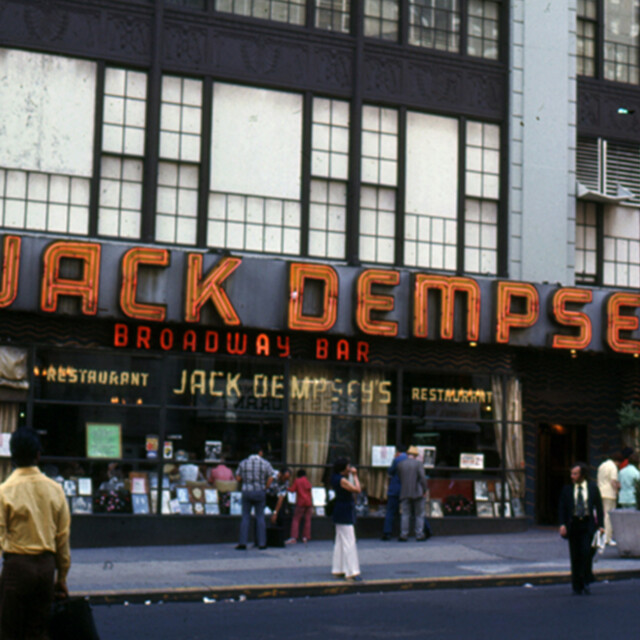
February 18, 1935. A star-studded crowd including singer Rudy Vallée, famed defense attorney Edward J. Reilly, and actor William Gaxton, along with 600 eager diners, gathered at a new two-story restaurant on 50th Street and Eighth Avenue, just opposite of the then-location of Madison Square Garden. Guests dined on beluga caviar and Joan Delight, the restaurant’s house dessert, while slugging Gin Rickeys, Clover Clubs, and the Jack Dempsey Knockout, a specialty cocktail served in a souvenir coconut.
This was the grand opening of Jack Dempsey’s Restaurant, owned by and named after the former boxing champion, who greeted his customers while clad in a black morning coat with a Kewpie doll lapel pin.
Dempsey was arguably the greatest heavyweight of all time when he retired. He was a bona fide celebrity of the Great Depression era who was once even engaged to Hollywood bombshell Mamie Van Doren. He was also the first famous American athlete to ever open a bar or restaurant.
By 1947 Jack Dempsey’s would move to 1619 Broadway, between 49th and 50th Streets. There, a giant James Montgomery Flagg painting depicting the 1919 heavyweight championship fight between Dempsey and Jess Willard was displayed prominently. Displayed more prominently was the Champ, who often sat at the corner booth by the street-view windows.
“Jack Dempsey’s Broadway Restaurant attracts record ‘gates’ for the same reason the Manassa Mauler did in his Champ Days—plenty of action and color to be found,” wrote Earl Wilson in the New York Post.
Over the next four decades, Dempsey’s would become an institution in New York City, serving a mix of French and American cuisine of the era: stuffed celery, shrimp cocktail, chicken gumbo, soft shell crab on toast, and a cheesecake that Charles de Gaulle allegedly would have air-mailed to him in Paris. The restaurant would appear in movies such as “Requiem for a Heavyweight” and a key scene in “The Godfather,” TV shows such as “The Odd Couple,” and even books like “Billy Bathgate.”
“Dempsey was certainly a trailblazer in successfully transitioning himself from the boxing ring to the dining room,” claimed food writer Joseph Temple. “Long before other celebrities decided to invest in the restaurant industry, Dempsey proved it could be done through a powerful one-two combo of an irresistible atmosphere and a larger-than-life host eager to please his legions of adoring fans. The food came second.”
The restaurant closed in 1974, the building’s owners seeking an astonishing $100,000 per year in rent. But by then, the idea of a famous athlete as bar owner and restaurateur had long been established.
The Dugout, Golden Arm, and Big Wilt’s
If today’s professional athletes are so well paid that they don’t exactly need side hustles, back in an era before free agency and monster contracts, that wasn’t the case.
In the 1960s, the Dodgers’ two star pitchers, Don Drysdale and Sandy Koufax, were hoping to bump their salaries to half a million dollars paid out over three years, even staging a holdout in 1966.
“[We need to] reflect on what we want to do with ourselves if we don’t play this season or ever again,” Koufax told the press at the time.
Luckily they already had little streams of income lined up in the form of hospitality. The southpaw Koufax had Sandy Koufax’s Tropicana Motel on Santa Monica Boulevard in West Hollywood, while Drysdale had opened Don Drysdale’s Dugout in Van Nuys in 1962. The 60-seat restaurant and cocktail lounge leaned heavily into a baseball theme, with giant baseball bats framing the entrance along with baseball-shaped light fixtures and tiki mugs. Highly popular among locals, he would go on to open two other Don Drysdale restaurants in Santa Ana and Maui.
Baseball players (and boxers) were the most famous athletes during this mid-century era and they also owned the most bars and restaurants. In San Francisco, Joe DiMaggio opened Joe DiMaggio’s Grotto, to be run by his fisherman father Giuseppe, which would eventually become Joe DiMaggio’s World Famous Restaurant, serving the Joe DiMaggio Cocktail, its recipe now lost to time. Nearby, Lefty O’Doul likewise had his own cocktail lounge. In St. Louis, Stan Musial had Stan Musial & Biggie’s Steak House, with cocktail glasses that featured the future Hall of Famer printed on them in gold leaf. While in Cincinnati, there was Johnny Bench’s Home Plate, with a giant scoreboard in the dining room and red lockers to hang your jacket; a variety of wines were served in the adjoining bar dubbed the Dugout.
“So valuable was Chamberlain’s name now, so incandescent his persona, that a historic Harlem nightclub … let him buy in as a part-owner and put his name first on the marquee in exchange for his presence.”
For successful athletes, owning and hanging out at their own eponymous dining and drinking establishments could aid in not only building more fortune but also more fame in an era before nonstop highlights were shown on television and streaming devices.
Such was the case with basketball superstar Wilt Chamberlain who, according to Gary M. Pomerantz in his book “Wilt, 1962: The Night of 100 Points and the Dawn of a New Era,” “had long wanted his own nightclub, an environment that had always drawn him as a stage for his fabulousness.” Thus, in 1961, he became involved with Small’s Paradise, which had opened on New York’s 135th Street in 1925.
“So valuable was Chamberlain’s name now,” wrote Pomerantz, “so incandescent his persona, that a historic Harlem nightclub … let him buy in as a part-owner and put his name first on the marquee in exchange for his presence.”
Big Wilt’s Smalls Paradise offered live rhythm and blues music from a young Ray Charles and standup from African American comedians like Redd Foxx, while Chamberlain stalked the floor as host, often working 18 hours a day in the off-season. (This, despite the fact he rarely ever drank alcohol.) It was a huge hit among the hippest Black New Yorkers of the time, including most of the burgeoning stars in the still-young NBA.
“Wilt Chamberlain’s cash registers are running as hot as gyrations on the dance floor,” wrote Ebony.
Harlem was a bit of an epicenter of Black athlete-owned bars. Boxers Joe Louis and “Sugar” Ray Robinson had opened their own spots, The Joe Louis Bar and Sugar Ray’s, in 1946.
As the NFL began to become America’s most popular sports league in the late-1960s, football players would become the dominant sports bar owners. Baltimore Colts quarterback Johnny Unitas (and his teammate, defensive back Bobby Boyd) opened the Golden Arm in 1968. The 160-seat restaurant promoted “elegant dining in a relaxed atmosphere,” with local specialties like Maryland imperial crab, while its sunken cocktail lounge, The Pit, offered a piano player and served “king size cocktails.”
Colts fans would pack the restaurant for Sunday brunch then board buses to Memorial Stadium to watch the game, with many fans (along with players and coaches) returning post-game.
The Colts unceremoniously left Baltimore in 1984, and Unitas sold the place — but not his name — in 1988. It ran on fumes until 1994.
“In its last years, the Golden Arm Restaurant had ceased to be anything more than, well, a restaurant,” wrote The Baltimore Sun. “While Johnny Unitas’ pictures were still all over the place, he was no longer an owner, his Baltimore Colts pals were gone and with them an association between professional athletes and fans that now seems as quaint as a leather football helmet.”
Contractual Obligations (and Free Food)
Indeed, by the 1980s and 1990s, the idea of the athlete-owned bars and restaurants was becoming more professionalized with sports legends cynically attaching their names to these businesses to make a mere buck.
“Since 1969, Mickey’s first year out of baseball, we’ve had innumerable opportunities to license his name for a bar and restaurant in New York City,” Mickey Mantle’s lawyer, Roy True, told the The New York Times in 1988.
True finally jumped on an opportunity that year to license his client’s name to a glossy restaurant on Central Park South. The aging slugger would make $100,000 a year plus receive non-investor equity and free meals.
“He is under contractual obligation to hang out there from time to time,” wrote The Times, calling the restaurant a baseball shrine loaded with sports memorabilia and a diner base filled predominantly with “male hero worshippers.”
“This is not about basketball and Michael Jordan the basketball star. It’s about fine dining and Michael Jordan the businessman. There will not be any sports memorabilia or photographs of Michael Jordan shooting baskets in the restaurant.”
This was really the final era before athletes became able to expand their portfolios with their own clothing lines, spirits brands, and podcasts. Bars and restaurants remained one of the few categories available to most retired athletes to garner a little extra income. But, even the king of investment diversification, Michael Jordan, would attach his name to a steakhouse at Grand Central Terminal beginning in 1997.
“This is not about basketball and Michael Jordan the basketball star,” restaurateur and business partner Peter Glazier explained at the time. “’It’s about fine dining and Michael Jordan the businessman. There will not be any sports memorabilia or photographs of Michael Jordan shooting baskets in the restaurant.”
Nor the man himself who, if he ever visited his namesake restaurant once, there doesn’t seem to be any evidence online.
Up in Toronto around the same time, fellow GOAT and hockey legend Wayne Gretzky opened Wayne Gretzky’s Toronto near the future site of the Toronto Blue Jays’ stadium. The restaurant featured, of course, memorabilia from the all-time points-scorer’s famed hockey career alongside The Great One burgers branded with his iconic No. 99.
The Dumbest Thing
Just a few days ago, LeBron James announced he would soon open his first-ever restaurant: Buckets. This makes him a bit of an outlier in today’s sports world where most of its current superstars have never once got into the business, even as they have another zillion side hustles. Indeed, while the idea of the athlete-owned bar or restaurant still exists, to varying degrees of success, its presence as a necessary professional endeavor has long passed, chiefly because these people are major celebrities who already make gobs of money.
Likewise, bars and restaurants have some of the absolute worst return on investment of any businesses — it’s said some 60 percent fail within five years. Compare that to the $375 million contract Tom Brady gets for calling games with Fox Sports or the sorts of multimedia empires someone like Carmelo Anthony is building with hosting gigs on NBC, a well-listened-to podcast, and a TV and film production company.
Why would they want to hang out in the window booth of some Midtown Manhattan restaurant with crummy burgers and their name on the facade?
And, in the 21st century, even most famous athletes from a previous generation have been getting out of the bar and restaurant game altogether, whether it’s their choice or not.
Michael Jordan’s Steakhouse left Grand Central in 2018 and Wayne Gretzky’s Toronto closed in 2020. Yao Ming had a bar and grill in Houston that closed in 2012. Vince Carter’s Daytona Beach spot shuttered in 2016; Bret Favre’s Steakhouse in 2018 and Jerome Bettis’ Grille 36 in 2021. Michael Irvin’s Playmakers88 closed last year and so did his former teammate Emmitt Smith’s Las Vegas a few months later; the Vince Young Steakhouse closed earlier this year.
“It’s the dumbest thing anybody could do to think they could operate a restaurant as an athlete,” former quarterback Joe Theismann told Forbes in 2007.
Nevertheless, he’s had a Theismann-themed bar and restaurant in the Washington, D.C., suburbs since 1975.
