![The Legal Drinking Age Used to Be Different in Every State. Here’s What America Looked Like Before 1984. [MAP]](https://vinepair.com/wp-content/uploads/2026/08/legal-drinking-age-in-1984-map-card-375x450.jpg "The Legal Drinking Age Used to Be Different in Every State. Here’s What America Looked Like Before 1984. [MAP]")
It’s difficult for many Americans to imagine the United States without 21 as the federal drinking age. In the U.S., legally consuming an alcoholic drink at 21 years old has become a rite of passage, largely due to the National Minimum Drinking Age Act of 1984, which mandated that all states make 21 years old the legal drinking age.
But before then, states’ alcohol laws were constantly shifting. So, how did the state-by-state landscape look just before the 1984 legislation?
Hawaii, Louisiana, and Vermont — where the legal drinking age was previously 18 — felt the biggest sting upon the law’s enactment. Many of the states’ residents and legislators immediately pushed back against the ruling, and in response, the U.S. government threatened to slash millions of dollars in their federal highway funds. That financial pressure forced Hawaii and Vermont to succumb to the law in 1986, followed by Louisiana in 1995.
The 13 states that had implemented 19 as their legal drinking age felt a similarly dramatic shift when the federal government upped the nationwide minimum to 21. Others saw no change at all: 21 states, including California, Delaware, Kentucky, New Jersey, Oklahoma, and Washington, had already decreed 21 as their legal drinking age.
To see how the rest of the country changed, the map below plots the state-by-state legal drinking ages in 1984 prior to the federal law’s passing.
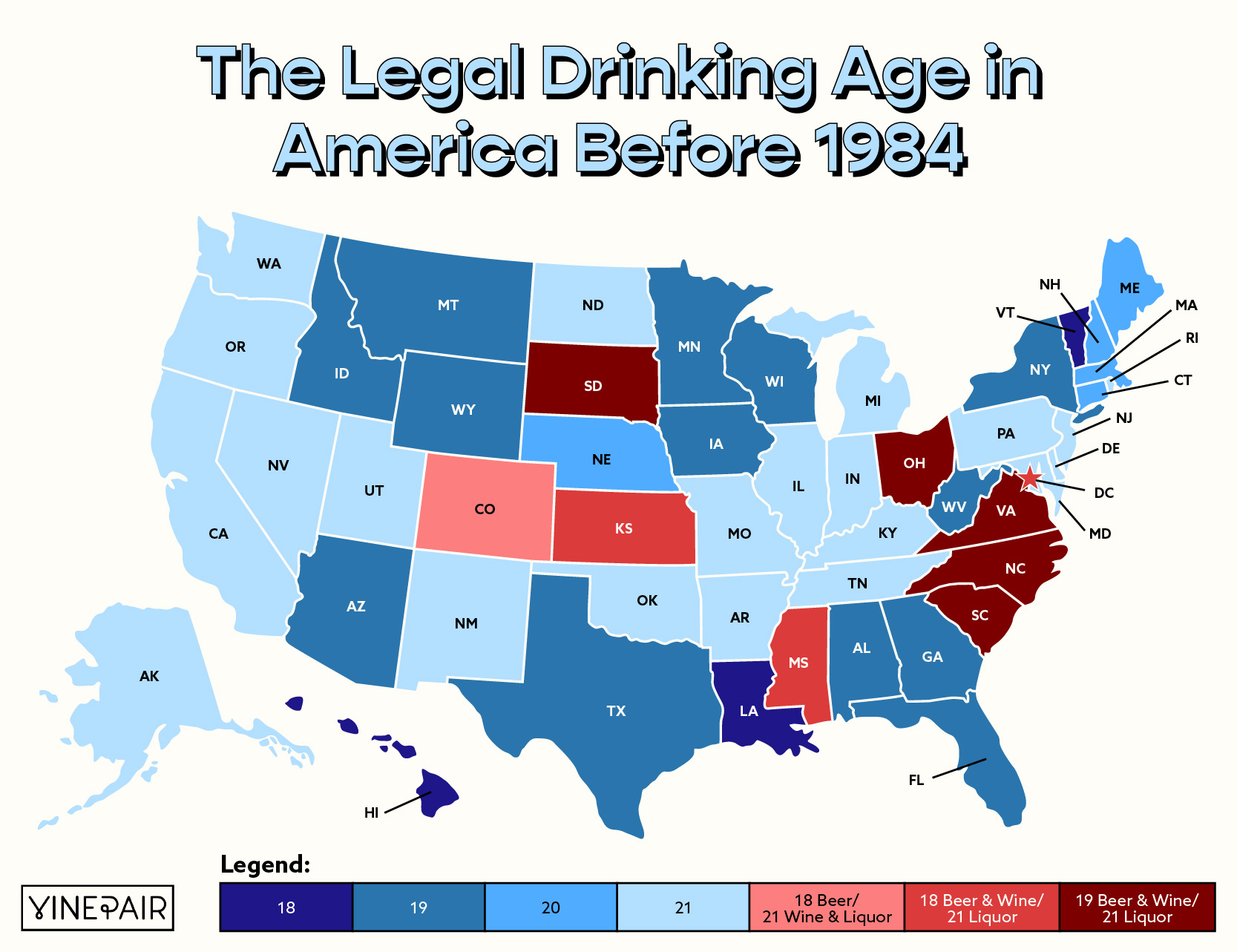
*Image retrieved from Christina Kernohan and the OurWhisky Foundation via unsplash.com
