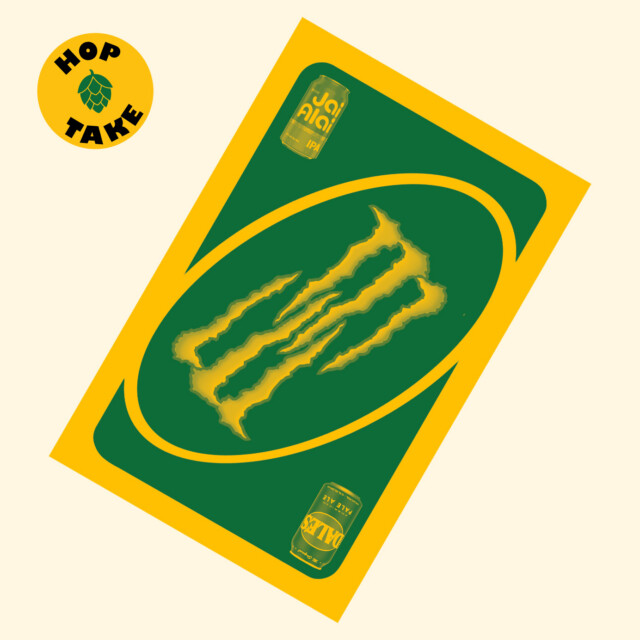
Gambling is fun. Unless you lose. Unless-unless you were gambling with house money the whole time. In which case, who cares?
Hold that thought. Earlier this month, Monster Beverage Corporation (MBC) reported its earnings for the second quarter of 2026. They were pretty spectacular.
“Net sales, excluding the alcohol brand segment, increased 20.8 percent” in the three months through June 30, said chief executive Hilton Schlosberg on the company’s earnings call on August 6. The growth is remarkable given Monster’s age — it was founded in 2002 — and the challenges faced by upstart rivals like Celsius in this market. (The latter brand’s revenue declined almost 12 percent on the quarter, though it was buoyed by strong performance from Alani Nu, which it acquired in 2025.) And of course, there’s the “Trump trade war” of it all to contend with, though Schlosberg told analysts he didn’t expect Monster to experience much harm from the tariffs beyond “a continued modest sequential increase in our aluminum costs through at least the end of 2026.” Yes, things are going very well indeed for Monster Beverage Corporation these days, and it has the $90-billion market capitalization to show for it.
Of course, this is a beer column, and as such, you will likely have noticed that Monster’s CEO conspicuously carved out Monster Brewing Company from these top-line results. “Excluding the alcohol brand segment from our reported results is purely illustrative as it remains part of our ongoing operations,” Schlosberg said. Which is a bit of an issue, because while MBC is raking in the chips, its bev-alc division is crapping out faster than Tim Robinson in a toupee.
Through the second quarter of the year, Monster Brewing posted a year-over-year net sales decrease of 15.2 percent, or $32.2 million. Not to put too fine a point on it, but that’s bad compared to both the overall beer business, and the craft brewing segment, neither of which are doing particularly well at the moment. It’s even bad compared to the division’s own first-quarter performance, when it managed to eke out a net sales loss of just 5.9 percent. The World Cup, which really hit its programming stride once the knockout round began just days before the end of Q2 on June 28, delivered very mixed results for the category, as Hop Take has previously reported. By the looks of off-premise scans, at least, the stretch since the quarter’s close has been a real mixed bag for Monster Brewing, too.
The CANarchy Craft Brewery Collective — the network of half a dozen craft-beer brands that MBC acquired in 2022 for $330 million to jumpstart its bev-alc ambitions — has actually performed decently well in multi-outlet grocery, mass retail, and convenience stores tracked by the market-research firm Circana, posting mid-to-low single-digit percentages on dollar growth and just-barely there volume growth in two consecutive 30-day frames through mid-August. This is hardly gangbusters stuff, but it’s outpacing the category, which was slightly in the red on both measures for both periods. Cigar City’s Jai Alai, the closest thing Monster Brewing has to a company-wide beer flagship, is up 6.3 percent in dollars and 2.5 percent in volume year-to-date through August 9 — a darn solid result in this market, even if that growth has decelerated a bit in the most recent four weeks.
The portfolio formerly known as CANarchy is meaningfully larger than Monster Brewing’s “everything else” bucket, which is led by its Beast Unleashed flavored malt beverage. But the point of MBC’s nine-figure buy-in nearly five years ago was to set up the beverage juggernaut with a turnkey “platform” of production infrastructure, routes to market, and so forth that would allow it to quickly transmogrify its energy-drink marketing prowess into drink-drink revenues with new brands that could fill niches out of reach to traditional brewers.
This was sound logic, and it continues to be, what with virtually all the bev-alc growth opportunities coming from the flavor-forward meta-segment. The top 10 vendors in beer, wine, and spirits — 27 companies in total, because a few overlap — grew NIQ-tracked off-premise dollars of what Bump Williams Consulting calls “flavored alcohol” by 31.4 percent over the 52 weeks through June 6, compared to the same period in 2022. That figure, calculated by the longtime trade consultancy and first reported by Brewbound earlier this month, overshadows the moderating growth year-over-year between 2025 and 2026, when the cohort — larded with entries from new brands and cannibalizing extensions from existing firms — was up 3.3 percent. But that’s still better than those vendors’ “traditional” sales last year, which were down 3.3 percent in dollars.
The thing is, despite its tastebud-pwning pedigree, Monster Brewing has not figured out how to ride the flavor wave. After showing some early promise, The Beast Unleashed has struggled mightily to find a dedicated, scaled consumer base. Its rollout this year of Perfect 10, a 10-percent alcohol-by-volume tallboy primed to compete with the Twisted Tea Extremes and White Claw Surges of the gas-station fridge, came and went with nary a whisper. MBC understands the convenience-store channel’s thirsty customer about as well as any firm in the country, but its non-beer offerings have been getting clobbered. Monster Brewing LLC (under which Circana buckets all the company’s beyond-beer stuff) is down 21.9 percent in dollars and 23.7 in volume year-to-date in the latest scan sheet. What’s worse: those losses are accelerating in the most recent four-week period. The Beast Unleashed does not have a meaningful on-premise footprint. For the foreseeable future, the c-store is the ballgame, and Monster Brewing is losing it.
This raises two questions. The first is: what gives? How did MBC, with a sophisticated marketing operation mind-melded to the American manosphere’s drywall-punching id and visions of bev-alc grandeur, wind up with a mid-major craft-beer business that’s substantively outperforming its new flavored brands in a market that’s down on craft and up on flavor? You can chalk some of this up to the operational vagaries of the bev-alc business. Rodney Sacks, Schlosberg’s former co-CEO, told analysts as much in January 2025 by way of explaining an upcoming impairment charge MBC was then planning to take on the brewing division. (It was a doozy, bringing the company’s total bev-alc write-downs to $181.5 million in March 2025; that number soared in March 2026 to $232.4 million, or roughly 70 percent of the original purchase price.)
There’s also the gaping hole in Monster Brewing’s portfolio where a spirits-based ready-to-drink offering should be. As consumers have shifted to that format, major bev-alc firms from Anheuser-Busch InBev to the Mark Anthony Group have acquired brands to follow that spending. Even Molson Coors made an M&A move in that direction, acquiring Monaco Cocktails earlier this year. That’s the way the wind is blowing, especially in the c-store, where loosening rules around placements have allowed spirits-based stuff more market access. Monster Brewing is missing out on that entire market.
This brings us to the second question, which is in dialogue with the first: how much does this matter? For a company like, say, Tilray Brands, its bev-alc division matters a lot, especially since federal legalization of recreational marijuana use remains such a quagmire. The Canadian conglomerate’s dozens of craft breweries are “one of Tilray’s most important growth engines,” as CEO Irwin Simon put it on an earnings call last month. That’s just not true for MBC. With the overall company firing on all cylinders and racking up serious net-sales growth from its core business, its brewing division doesn’t have to stir its own drink. Whether this has engendered a lack of urgency within Monster Brewing is impossible to say from the outside looking in. (If you’d like to tell me about it, get in touch: [email protected]. Anonymity available.) For now, it’s playing with house money in a sense.
Of course, MBC is a publicly traded company, not a casino. And at some point, the house money usually runs out. When the day comes for Monster Brewing to roll the dice for its own dinner, will it come up big, or go bust? If I had to place a bet today, I know which one I’d stack my chips behind. But for now, the game goes on.
🤯 Hop-ocalypse Now
Last week, the Washington Examiner published an “exclusive” report on a poll that purported to show that 65 percent of likely voters would back tariffs on Mexican beer, with 89 percent “support[ing] policies that protect American beer jobs and businesses.” This is good fodder for the Teamsters, who have been angling to get the Trump administration to make Modelo’s supply-chain costs expensive enough for parent company Constellation Brands that it decides to bring those brewing jobs north of the border. Whatever merit that scheme has, though, this data has less: it was produced by John McLaughlin, a pollster so MAGA-brained that the national Republican Party at one point warned its candidates against relying on his work.
📈 Ups…
Speaking of Constellation’s intra-continental route to market, its beer division just hired a new chief supply chain officer… Allagash Brewing Co. has a new national sales director… Tune in to your humble Hop Take columnist on recent episodes of The Brewbound Podcast and North Catch… Ninkasi Brewing acquired some $400,000 worth of Rogue Ales & Spirits barrel inventory at auction…
📉 …and downs
Sapporo USA plans to lay off 220 workers as it closes down former Stone Brewing locations in Southern California… The Brewers Association is bidding farewell to its state government affairs director…
This story is a part of VP Pro, our free platform and newsletter for drinks industry professionals, covering wine, beer, liquor, and beyond. Sign up for VP Pro now!
