![14 Essential Wineries in American Wine History [Timeline]](https://vinepair.com/wp-content/uploads/2026/06/essential-wines-in-american-wine-history-card-375x450.jpg "14 Essential Wineries in American Wine History [Timeline]")
If you asked the average American what happened in 1976, you’ll likely get an answer related to the country’s bicentennial. This is a sensible response, especially since the country is turning 250 this year so commemorations involving the U.S. and nice, round numbers are top of mind.
Asking an American wine enthusiast or someone in the domestic wine industry the same question may yield a different response. The legendary Judgement of Paris also went down in 1976, and oenophiles may view your prompt as an excuse to wax poetically about the time wines from California bested bottles from France during a blind tasting in Paris. It’s almost a knee-jerk reaction to do so, since the domestic wine scene has spent the last half-century spinning this yarn, possibly to the point of tedium.
Such persistent retelling carries a cost. The narrative overshadows the other cool plots on the American wine timeline, practically relegating them to viticultural history’s dump bucket. Yet plunging the depths of American wine history unearths a wealth of interesting narratives that are just as important in shaping the country’s modern wine culture. What follows is a tour of the wineries and bottles that helped establish this wider, richer story of American wine. Granted, setting out to capture the intricacies of American wine in just a few bottles is an impossible task, but this list aims to highlight essential moments in the industry — wines that kickstarted viticultural areas or set up entire regions for commercial success. It’s a journey that starts after the Revolutionary War and extends well beyond Napa’s borders.
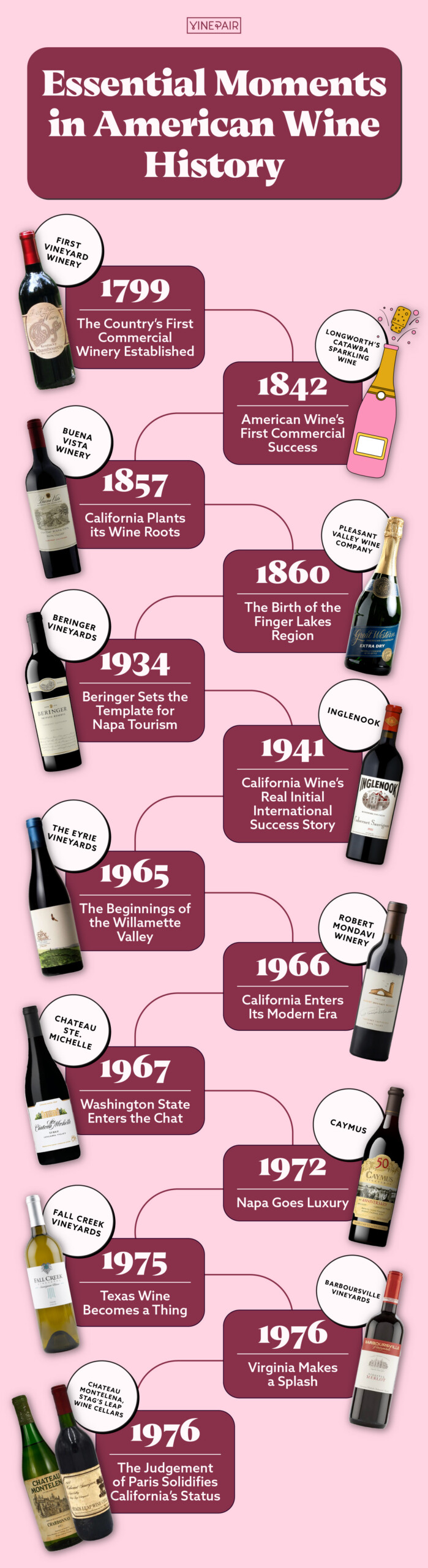
1799: The Country’s First Commercial Winery Established
Winery: First Vineyard Winery
Kentucky is famous for being the birthplace of bourbon. It’s less famous for being the launching pad for the country’s commercial wine industry. The appropriately named First Vineyard began operations in the tiny town of Nicholasville in 1799, some 16 years after Evan Williams started up the state’s first commercial bourbon distillery. Its run was brief yet shiny — Thomas Jefferson and James Madison received bottles from the winery during their respective presidencies. Shuttered in 1809, First Vineyard was officially resurrected in 2012 after about a decade of property restoration and vine planting, making it an intriguing side quest for those exploring the state’s bourbon trail.
1842: American Wine’s First Commercial Success
Winery: Longworth’s Catawba Sparkling Wine
The country’s first successful winery didn’t come from the West Coast or even upstate New York. It came from Cincinnati. Seriously. In the 1830s, an Ohio vintner named Nicholas Longworth began producing wine from the Catawba grape, a red variety known for producing bright pink and aggressively fruity wines. In 1842, Longworth erroneously put a batch of Catawba through a second fermentation à la Champagne. It ended up being a happy accident: Longworth’s sparkling Catawba took off like gangbusters, gaining popularity in the U.S. and even finding success in Europe. Henry Wadsworth Longfellow based his famous poem “Ode to Catawba Wine” on the juice. The success of Longworth’s Catawba was sadly short-lived. The vines eventually succumbed to rot, the Civil War took a toll on manpower, and Longworth’s heirs shuttered operations in 1870.
1857: California Plants Its Wine Roots
Winery: Buena Vista Winery
California’s storied wine scene came into being thanks to the efforts of Agoston Haraszthy. A Hungarian immigrant and son of a landowner, the self-proclaimed “Count of Buena Vista” used his agricultural knowledge and connections within the California government to pioneer viticulture in the Golden State. Central to these efforts was his opening of Buena Vista Winery in Sonoma in 1857 as one of California’s first commercial winemaking establishments. It was a groundbreaking operation: The Count used the property to introduce techniques like gravity-flow winemaking and wine cave storage to California. A few years later, he’d import roughly 300 grape varieties from the Old World. Buena Vista shuttered in 1878 and remained dormant for nearly 70 years, until the property’s new owners officially revived the winery and released new wines to the public in 1949.
1860: The Birth of the Finger Lakes Region
Winery: Pleasant Valley Wine Company
When Pleasant Valley Wine Company began operations just outside of Hammondsport, N.Y., in 1860, it became the country’s first bonded winery. This distinction isn’t a reference to wine quality; it basically means it took out an insurance policy for tax purposes. But there’s more to the winery’s legacy than the paperwork it still proudly displays on its property. Its debut technically established the Finger Lakes wine region, a popular area that’s now just as famous for its Rieslings as it is for its breathtaking bucolic views.
1934: Beringer Sets the Template for Napa Tourism
Winery: Beringer Vineyards
Prohibition devastated the fledgling American wine industry, and outside-the-box thinking became a requirement for survival. Beringer Vineyards, which had been around since 1876, survived by being one of a handful of wineries that successfully lobbied the government to produce sacramental wines. Once the 21st Amendment ended the Noble Experiment, the challenge of bringing consumers back instantly manifested. Beringer met this moment by opening its winery to public tours in 1934, the first Napa Valley winery to do so. It was a rousing success. Wine enthusiasts and the era’s Hollywood luminaries would make the journey to sip the fruits of the winery’s efforts. Beringer’s innovative thinking was the drip that eventually led to a flood of cash for the region: In 2023, visitors to Napa Valley spent $2.5 billion supporting local businesses.
1941: California Wine’s Real Initial International Success Story
Winery: Inglenook
California wines were not totally unknown on the global market prior to the Judgement of Paris. The best example of this axiom comes from Inglenook. This may also double as the most surprising example, given Inglenook’s late-20th-century reputation as a low-quality jug wine. But from the end of Prohibition until the winery was sold to corporate buyers in 1964, Inglenook’s Cabernet Sauvignons were synonymous with international acclaim. Its 1941 vintage is largely considered the winery’s crowning achievement. Such recognition arguably gives the bottle the first concrete modern example of California’s capacity for producing world-class wines.
1965: The Beginnings of the Willamette Valley
Winery: The Eyrie Vineyards
Before 1965, Oregon’s Willamette Valley was just a pretty stretch of land marked by gently rolling hills. Then David Lett came along and planted his first vines in 1965, and officially opened The Eyrie Vineyards in McMinnville in 1966. His rationale was simple yet bold: He felt the area’s terroir could produce Pinot Noir reminiscent of Burgundy, which, considering the two areas share the same latitude, made perfect sense. This hunch became the seed that eventually would grow a highly acclaimed region featuring more than 700 wineries. He was also right about his assumption: The Willamette Valley is now home to some of the finest Pinot Noirs in the world.
1966: California Enters Its Modern Era
Winery: Robert Mondavi Winery
Much like Inglenook, Robert Mondavi‘s reputation as a wine is not what it once was. Yet it’s not an exaggeration to say without Mondavi, modern California wine culture would look radically different. When Mondavi opened his eponymous winery in 1966, his aim was to give Bordeaux a run for its money — an unthinkable concept back then. He matched this ambition by creating high-quality wines through techniques like temperature-controlled fermentation and French oak aging, but he also augmented it through his brilliant marketing strategies. Mondavi pioneered the practice of putting grape varieties on wine labels. He also turned the much-maligned California Sauvignon Blanc from an ugly duckling to a swan by rebranding it Fumé Blanc. This combination of quality and hype transformed California wines into something more than wine: a symbol of cool.
1967: Washington State Enters the Chat
Winery: Chateau Ste. Michelle
Chateau Ste. Michelle’s timeline is a bit weird. It was technically founded in 1967 as Ste. Michelle Vineyards, and is considered to be Washington’s first premium winery. However, the brand was spun off from American Wine Growers, a winery established in 1954 as a merger of two other wineries founded in 1933 and 1934. The brand didn’t really hit its stride until 1976, when the winery moved from Seattle to Woodinville and changed its name to its current moniker. Confusing? Absolutely. But the impact the brand has imparted on Washington State’s wine scene is rather clear. Though the winery has recently downsized its production considerably and closed some of its tasting rooms, in the half-century since Chateau Ste. Michelle’s move, Washington State has grown to be the country’s second-largest wine producer behind California, bolstered by a reputation for producing exquisite Cabernet Sauvignon and Syrah.
1972: Napa Goes Luxury
Winery: Caymus
Mondavi made Napa wine feel chic. Caymus made it feel luxurious. It didn’t start out this way: When Chuck Wagner launched the winery in 1972, it struggled to find an audience. Then pioneering wine critic Robert Finigan gave the wine a glowing review, and fortunes swiftly changed. As it grew in popularity, it continued to build a reputation for being the type of fancy, special-occasion wine that was typically reserved for Old World bottles. This reputation still holds steady, even if the label is somewhat of a lightning rod among wine lovers.
1975: Texas Wine Becomes a Thing
Winery: Fall Creek Vineyards
In the world of wine, it’s not just about growing grapes. It’s about growing the right grapes. This was something Ed and Susan Auler surmised when they established Fall Creek Vineyards in Driftwood, Texas, in 1975. After researching European wine regions with growing conditions similar to theirs, the couple planted varieties known to thrive in such environments. This meant growing grapes that weren’t household names in the American wine market, like Grenache and Tempranillo. It was a risky move to take, even if it was the right one from an agricultural standpoint. The gamble paid off. The surrounding area would steadily grow into a region known as Texas Hill Country, and the acclaimed wineries tend to follow the Auler’s viticultural strategy.
1976: Virginia Makes a Splash
Winery: Barboursville Vineyards
In 1976, Gianni Zonin, an heir to a Venetian winemaking family, acquired farmland in Virginia with the intent of creating a unique spin on his relatives’ tradition. It was kind of a bonkers decision from a historical standpoint: The first colonists attempted making wine practically as soon as they established Jamestown in 1607, first with local grapes, then with imported grapes. It didn’t work, so they grew tobacco instead. Of course, a lot about winemaking had changed in more than 350 years, and Zonin relied on techniques like grafting European grapes on American rootstock to avoid the same fate. Zonin’s vines thrived, establishing the still-popular Barboursville Vineyards, and the state’s wine scene has been growing ever since.
1976: The Judgement of Paris Solidifies California’s Status
Wineries: Chateau Montelena, Stag’s Leap Wine Cellars
We know the Judgement of Paris hogs the historical spotlight at the expense of other cool stories. But let’s be real here: Not mentioning this seminal event in a timeline of American wine history would be like omitting “Star Wars” from a list of most influential sci-fi movies. It just can’t be skipped, so let’s get into it. The gathering’s climax is well known in wine circles: In a Parisian blind tasting arranged by wine educator Steven Spurrier, Chateau Montelena’s 1973 Chardonnay and Stag’s Leap Wine Cellars’ 1973 Cabernet Sauvignon scored higher than French whites and reds among a panel of judges. What’s not as readily discussed is its aftermath, which is equally fascinating and influential. The results angered the French wine community, which essentially blacklisted Spurrier from the scene. But the anger subsided to the wine world’s benefit: Legendary winemaker Philippe de Rothschild, whose 1970 Château Mouton Rothschild Cabernet Sauvignon finished second in the red category, would go into partnership with Mondavi in 1978 to launch Opus One Winery.
*Image retrieved from Barboursville Vineyards
