![14 Essential Bottles of Rye [Timeline]](https://vinepair.com/wp-content/uploads/2026/02/rye-timeline-card-375x450.jpg "14 Essential Bottles of Rye [Timeline]")
Bourbon might be referred to as “America’s Native Spirit,” but rye is actually the country’s first whiskey, with distillation predating that of bourbon by several decades. The grain first arrived in the United States in the early 1600s with Dutch and English colonists who settled in the Northeast. Rye’s resistance to disease and drought, not to mention its resilience in cold temperatures, allowed the crop to thrive throughout the region, and attempts to turn it into alcohol occurred as early as 1637.
By the mid-1750s, commercial rye distillation was underway, with production dominated by two styles: Pennsylvania or Monongahela-style rye and Maryland-style rye. By 1810, Pennsylvania was leading rye distillation, churning out 6.5 million gallons per year compared to Kentucky’s 2.2 million. Rye remained immensely popular up until the ratification of the 18th Amendment, which almost killed the category entirely. After Prohibition was lifted, the demand for rye simply didn’t match that of bourbon, and the spirit remained in the shadows until the cocktail revolution of the mid-2000s.
As rye reentered the fold, its popularity skyrocketed, and production shot up from just 88,000 cases in 2009 to well over 1.4 million by 2020, a whopping 1,500 percent increase. It’s no coincidence that this is also when several of the world’s most sought-after bottles hit the market.
In order to track the spirit’s progression over the centuries, we’ve compiled this timeline of watershed moments in the history of rye whiskey, with specific bottles tied to each. From Old Overholt and Rittenhouse Rye to LeNell’s and Willett Family Reserve, here are 14 rye whiskeys that have shaped the category.
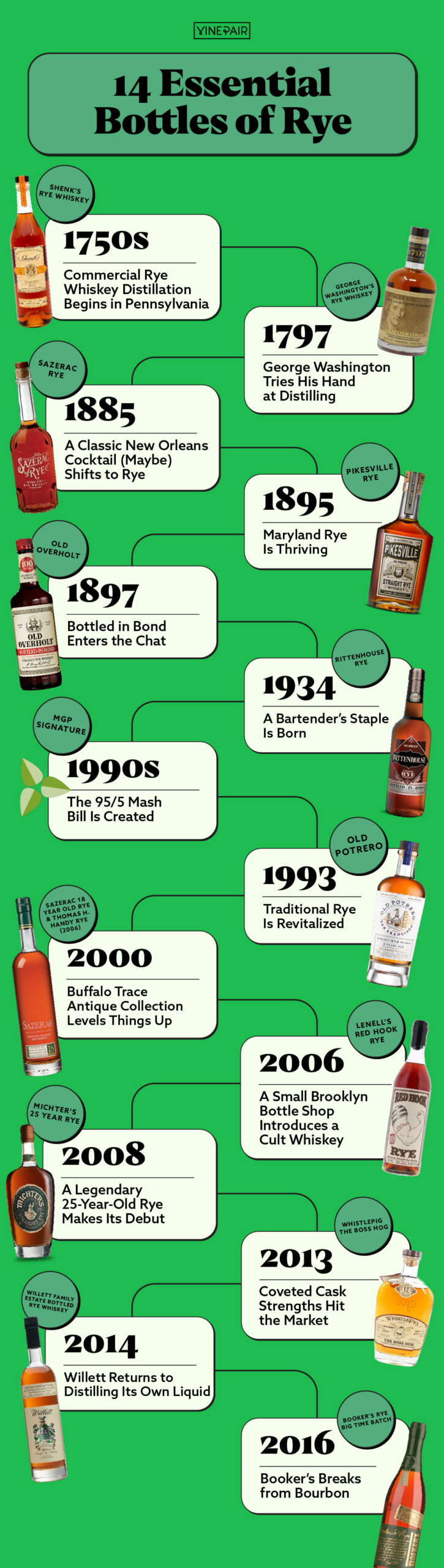
1750s: Commercial Rye Whiskey Distillation Begins in Pennsylvania
Bottle: Shenk’s Rye Whiskey
The vast majority of Dutch, German, and Swiss Mennonites who arrived in the 1700s settled in Pennsylvania, where they tended to the land as they had in their native countries. Grains like wheat, corn, and, of course, rye were the most abundant crops. As such, it wasn’t uncommon for farmers to own a personal still to craft spirits from these grains, with some estimates placing the number of stills in the colony at approximately 3,000. But it wasn’t until 1753 that commercial distillation began.
That year, Johann “John” and Michael Shenk established a distilling operation in Schaefferstown, Pa., known as Shenk’s Distillery. The distillery is widely credited with popularizing Pennsylvania-style rye, which is notable for its lack of corn in the mash bill. Instead, Monongahela rye whiskey, named for Pennsylvania’s Monongahela Valley, contains only rye or rye and malted barley. It’s rumored that George Washington himself visited Shenk’s while he was a general during the Revolutionary War, purchasing enough of the rye to keep soldiers stocked up at Valley Forge. As such, Shenk’s Rye Whiskey is affectionately referred to as “the whiskey that warmed the American Revolution.” Today, the brand goes by a name that’s perhaps a bit more recognizable: Michter’s.
1797: George Washington Tries His Hand at Distilling
Bottle: George Washington’s Rye Whiskey
Shenk’s Rye Whiskey supply might have been enough to get General Washington and his soldiers through the Revolutionary War, but once the first president’s term in office came to a close, he took distilling into his own hands. In 1797, a newly retired George Washington established a commercial distillery at Mount Vernon in Northern Virginia at the suggestion of his farm manager James Anderson. Anderson, a Scottish former distiller, convinced Washington that there was money to be made in whiskey, especially given the fact that Mount Vernon had a gristmill on site. Originally, the whiskey was produced at a makeshift facility with only two stills, but its success warranted an expansion. By 1799, the distillery had five operational pot stills and was producing 11,000 gallons of rye per year, making it one of the largest operations in America at the time. Following Washington’s passing in 1799, the Mount Vernon distillery fell into disrepair, though it was revitalized as a working distillery and opened to the public in 2007.
1885: A Classic New Orleans Cocktail (Maybe) Shifts to Rye
Bottle: Sazerac Rye
The Sazerac is a quintessential classic cocktail and helped put New Orleans on the map for drinkers. But the spec didn’t always call for rye. When it was first stirred up in the early 1800s, it actually called for brandy — Sazerac brandy, at that. In France, the Sazerac family had been producing eaux de vie in Cognac as early as the 1630s, with Sazerac de Forge et Fils debuting in 1782. By the early 1800s, the family was exporting the spirit to New Orleans, where, as legend goes, it was favored by Antoine Amédée Peychaud, who opened his apothecary in 1833. There, he purportedly mixed the spirit with his eponymous bitters and sugar to serve to those who felt under the weather. In reality, the story of how the Sazerac cocktail came to be is much more convoluted, with recipes evolving through the city’s coffee houses, including Sazerac House, which opened in the 1850s. But everything changed three decades later.
In 1885, the European phylloxera outbreak decimated the Sazerac family’s vineyards, and they could no longer produce enough of the spirit to meet demand. So New Orleans bartenders started making their Sazeracs with American rye whiskey, which was abundant. (Some cocktail historians argue that this switch never happened, and that the Sazerac was made with rye from its inception.) Around this same time, Sazerac started distilling a rye of its own, though the whiskey faded into obscurity after that. In 2006, Buffalo Trace relaunched the same rye in bottles that reflect the original whiskey’s packaging.
1895: Maryland Rye Is Thriving
Bottle: Pikesville Rye
While it’s true that Pennsylvania rye accounted for a decent chunk of the total distilled in the 19th century, those south of the Mason-Dixon line — most notably in Maryland — produced a different type. By comparison, Maryland-style rye whiskey is notable for the inclusion of corn, with rye content typically sitting around 65 percent, while malted barley and corn account for the rest of the mash bill. Where Pennsylvania-style ryes tend to deliver an abundance of punchy spice, Maryland-style spirits are often sweeter and rounder. One of the most popular examples is Pikesville Rye.
The Pikesville brand was founded in its namesake town in 1895 and produced at the nearby L. Winand & Brothers Distillery until Prohibition, when the distillery was mothballed. At this point, production moved to Baltimore, where it remained until 1972, making it the last Maryland-style rye distilled in the namesake state. Ten years later, the brand was sold to Heaven Hill, which introduced a new iteration of the historic whiskey in 2015: a 6-year-old, 110-proof American straight rye whiskey featuring a rye, malted barley, and corn mash bill.
1897: Bottled in Bond Enters the Chat
Bottle: Old Overholt
First established in 1810, Old Overholt is widely regarded as the longest continuously operating whiskey brand in the U.S. It was founded in West Overton, Pa., by Abraham Overholt as A. Overholt & Co., though a 1888 rebrand changed the name to its current one. Nine years later, the brand made history by becoming one of the first whiskey producers to adopt the federal Bottled in Bond (BIB) Act. The legendary 1897 consumer protection act was the first of its kind in the U.S. and mandated that any whiskey labeled as such had to mature for four years and be bottled at a sturdy 100 proof.
Despite Prohibition outlawing distillation at large, Old Overholt’s then-majority owner Andrew Mellon was acting U.S. Treasury Secretary, granting him the ability to distribute medicinal whiskey licenses to select producers. Naturally, Old Overholt was one of those operations, and production of both its bottled-in-bond and standard expressions continued. The bottled-in-bond version was discontinued in 1963 and remained a fixture of the past until 2018. That year, the brand, now owned by Suntory Global Spirits, added it back to its portfolio.
1934: A Bartender’s Staple Is Born
Bottle: Rittenhouse Rye
Now practically ubiquitous on back bars nationwide, Rittenhouse Rye made its debut just one year after the repeal of Prohibition. It was launched in 1934 by Philadelphia’s Continental Distilling Corp. and was originally named Rittenhouse Square Rye after one of the city’s most famous parks, though it changed to its current moniker in 1948. That same year, Continental Distilling Corp. reformulated the 2-year-old, 100-proof rye, relaunching it as a bottled-in-bond expression matured for the requisite four years. Rittenhouse Rye went on to be distilled in its home city of Philadelphia for several decades, though by the 1980s all of the rye distilleries along the Mid-Atlantic were defunct. A 1999 acquisition by Heaven Hill saved the brand from slipping into obscurity. But with little to no demand for the stuff, the company only had to produce rye one day per year to fulfill it.
As the cocktail revolution got underway in the mid-2000s, bartenders rediscovered the spirit, stirring it into cocktails like the Little Italy and choosing it as the preferred base for classics like the Manhattan. Heaven Hill has also launched a number of prized expressions, and the brand remains a beloved bartenders’ staple to this day.
1990s: The 95/5 Mash Bill Is Created
Bottle: MGP Signature
While some watershed moments in rye whiskey history are tied to specific bottles, others are tied to recipes, as is the case with the development of the 95/5 mash bill. The combination was first thought up in the ’90s by Larry Ebersold, then master distiller of Lawrenceburg, Ind.’s Seagram Distillery, now known as Ross & Squibb and owned by Midwestern Grain Products (MGP). In the ’90s, Ebersold wanted to craft a new formula that would allow the bold rye spice flavor to permeate the final mix even when combined with other whiskeys or grain-neutral spirits.
A 100 percent malted rye recipe worked, but was deemed too expensive, so he pulled back slightly, opting for a 95 percent rye and 5 percent malted barley spec. The recipe was just used for blending until 2011 when the facility was purchased by MGP and whiskey produced from the mash bill was made available for craft distilleries to bottle under their own labels. 95/5 quickly became a telltale sign that a rye was distilled in Indiana and not by the brands themselves, though craft distilleries nationwide have since adopted it for themselves.
1993: Traditional Rye Is Revitalized
Bottle: Old Potrero
It sounds crazy, but it’s possible that this criminally underrated whiskey brand wouldn’t exist had it not been for the invention of the washing machine. Old Potrero was founded in San Francisco in 1993 by Fritz Maytag. Yes, of those Maytags, and also the same Fritz Maytag that used the majority of his inheritance to save the ailing Anchor Brewing in 1965, transforming it into a pioneering craft brewery. (Anchor closed in 2023 and is still yet to reopen, despite an acquisition by billionaire Chobani founder Hamdi Ulukaya.) Without this brewery, there would be no Old Potrero. Not only is the whiskey named for the hill the brewery resides on, but early batches of the stuff were distilled in Anchor Brewing’s basement.
To craft the rye, Maytag researched colonial-era whiskey production in the Library of Congress before landing on a 100 percent malted rye recipe that harkened back to the spirit’s earliest days. The first official batch of Old Potrero was laid down in 1994 and launched by Anchor Distilling (now Hotaling & Co.) a few years later, though production was so limited that tracking down a bottle took considerable effort. Today, Old Potrero still exists in the shadows, and it’s some of the most impressive rye around. In 2025, the brand’s Gundlach Bundschu Gewürztraminer Finish nabbed the title of VinePair’s best whiskey of the year.
2000: Buffalo Trace Antique Collection Levels Things Up
Bottles: Sazerac 18 Year Old Rye and Thomas H. Handy Sazerac Rye
In 2000, Buffalo Trace launched what is now one of the most prized collections of whiskey in existence: the Buffalo Trace Antique Collection. Released once per year, the series is intended to showcase the best of the distillery’s aged, uncut, and unfiltered expressions. It was first introduced with just three bottles, though has since expanded to six. Of those original three, only one was a rye: Sazerac 18 Year. This 2000 release marked the first time the Sazerac brand had been seen on shelves in decades. Believed to contain a mash bill of rye, corn, and malted barley, it’s aged for approximately 18 years, though often goes for a bit longer, regularly making it the oldest expression in the collection.
Six years later, Buffalo Trace added two more bottles to the collection, another bourbon and a second rye — the famous Thomas H. Handy Sazerac Rye. Bottled at barrel proof, the whiskey pays homage to the famous New Orleans bartender who worked at the Sazerac House and allegedly oversaw the bar’s switch from Cognac to rye in the same-named cocktail. All the bottles in the collection are now coveted commodities on the secondary market, retailing for hundreds, even thousands, of dollars.
2006: A Small Brooklyn Bottle Shop Introduces a Cult Whiskey
Bottle: LeNell’s Red Hook Rye
In the early 2000s, LeNell Camacho Santa Ana, then LeNell Smothers, operated a small liquor shop in Brooklyn’s Red Hook neighborhood. As the American whiskey industry started heating up, she found herself frustrated by how difficult it was to get these newly prized bottles into her shop. So between 2006 and 2008 she took matters into her own hands, selecting four barrels of cask-strength rye from the Willett Distillery in Bardstown, each between 23 and 24 years old. Distilled in 1984, the whiskey was produced from a low-rye mash bill at Heaven Hill’s Bernheim Distillery before maturing at Willett, where the barrels were chosen by LeNell. From there, LeNell’s Red Hook Rye was born, though only about 850 bottles were produced. While those from barrel No. 1 retailed for around $100, they were so popular among whiskey aficionados that prices soared to over $350 by the time barrel No. 4 came around. Now, they can fetch upwards of $45,000 at auction and bottles are often regarded as some of the most legendary ryes of all time.
2008: A Legendary 25-Year-Old Rye Makes Its Debut
Bottle: Michter’s 25 Year Rye
Michter’s is a historic whiskey brand with roots tracing all the way back to the 1750s and the founding of the Shenk’s Distillery in Pennsylvania. The brand’s name changed to Michter’s sometime in the 1950s, and a number of praiseworthy ryes (and bourbons) have been released under the line since then. Perhaps none is as notable as its 25-year expression. First launched in 2008, the single-barrel straight rye whiskey is distilled from an undisclosed mash bill and available only as stocks allow. Since the whiskey’s debut, Michter’s has only released the 25-year expression an additional four times, and bottles don’t come cheap. On the secondary market, a single bottle can command upwards of $30,000.
2013: Coveted Cask Strengths Hit the Market
Bottle: WhistlePig The Boss Hog
Relative to most whiskey brands on this list, WhistlePig, established in 2008 by Raj Peter Bhakta, is the new kid on the block. In 2013, the Vermont-based distillery released the first expression in its lineup of limited-edition, cask-strength bottlings: The Boss Hog. Aged for 12 years and nine months, WhistlePig The Boss Hog “1st Edition” Rye was sourced from just 24 single barrels and comes in at a sturdy 67.4 percent ABV. Since 2013, expressions in The Boss Hog lineup have grown increasingly experimental (and valuable), like 2020’s rye finished in Spanish Oak and South American teakwood and 2024’s finished in thandai barrels, which have robust notes of saffron, cardamom, and more. Though some of these may sound gimmicky, one sip proves they’re the real deal.
2014: Willett Returns to Distilling Its Own Liquid
Bottle: Willett Family Estate Bottled Rye Whiskey
Established in Bardstown, Ky., in 1936, the Willett Distillery has, like most long-standing whiskey operations, gone through its fair share of trials and tribulations. For example, in the late ’70s, Willett was forced to cease whiskey distillation operations due to the nationwide energy crisis, shifting instead to ethanol for gasohol fuel. In the ’80s, the facility shut down entirely, with the brand shifting to become an independent bottler. As such, the name was able to stay alive by bottling sourced liquid.
In this period, Willett launched a number of notable expressions, including Willett Family Estate Bottled Rye, Bourbon, and Pot Still Reserve, though none were distilled at its facility. In 2012, Kentucky Bourbon Distillers Ltd. regained control of the Willett Distillery moniker and brought distilling back to the premises. In 2014, the first whiskey to come off the still in 2012 was finally released to the public: Two-Year-Old Willett Family Estate Bottled Rye Whiskey.
2016: Booker’s Breaks From Bourbon
Bottle: Booker’s Rye Big Time Batch
Originally launched in 1988 by Jim Beam master distiller Booker Noe, Booker’s is a label most often associated with bourbon. But, in 2016, Booker’s released its first (and only) rye whiskey: Booker’s Rye Big Time Batch. Distilled in 2003, the whiskey was one of the final expressions Noe produced before his passing in 2004, at which point his son, Fred Noe, took over operations. Just over 13 years old, the whiskey is bottled at 68.1 percent ABV and is said to have a much higher percentage of rye than standard Beam offerings, resulting in punchier, spicier flavors. Fewer than 10,000 bottles of the prized rye were produced, allowing Big Time Batch to easily be considered a modern “cult” rye.
*Image retrieved from OneBit via stock.adobe.com
