In some parts of the United States, it still feels like 1920. When the federal government repealed Prohibition in 1933, it left the decision on how to legislate the production and sale of wine, beer, and spirits to the individual states. State governments then handed alcohol regulation to towns, counties, and other municipalities, and laws on drinking diversified to a fine-tooth comb level across the country. A “dry” county, meaning it prohibits the sale of alcoholic beverages, could neighbor a fully “wet” county, one that permits the sale of alcoholic beverages.
Ninety-three years later, some counties across the U.S. are still dry, and the reasons behind the abstinences range from historic to religious.
Below, we mapped out the 47 counties in the U.S. that still prohibit the sale of alcohol. What is most evident at first glance is the concentration of teetotalling neighborhoods in the South, along what’s otherwise known as the “Bible Belt,” dubbed so because of the region’s high density of practicing Christians. In Arkansas, the state with the most dry counties at 29, sects like Methodists, Baptists, and Evangelicals — the latter makes up roughly 50 percent of Arkansas’ population — have promoted abstaining from alcohol since the 1800s. In 1831, local churches in the state aligned to form the Little Rock Temperance Society.
Temperance was also historically associated with the women’s rights movement of the mid-19th century, particularly in Kentucky, where there are six dry counties. Advocates of a prohibition warned of how alcohol worsened some men’s maltreatment of women at home. One Kentucky native, Carrie Nation, famously wielded a hatchet around towns, hacking at the walls and doors at saloons and clubs.
Some counties returned to teetotalism after Prohibition’s repeal. In Arkansas’ Craighead and Crawford counties, current accounts attribute the alcohol ban to municipal votes that occurred in 1944 when many American men were overseas fighting in the Second World War, and at-combat soldiers could not cast their ballots. Since then, petitions to turn wet have yet to amass enough voters. Just getting the question to permit alcohol on ballots in certain counties requires a much larger percentage of voters than most other issues.
Other reasons that some counties across the U.S. remain dry include low population and lobbying from successful liquor stores in nearby wet counties who fear losing business, among others.
The map below omits the in-between examples, referred to as “moist” counties. While these counties are de jure dry, they leave the decision up to each local government, so regulations vary from town to town. The map does include dry counties that allow special permits to certain on-premise accounts, such as country clubs, restaurants, and other businesses.
Curious to see where residents still can’t buy a drink in the U.S.? Check out our map and table below.
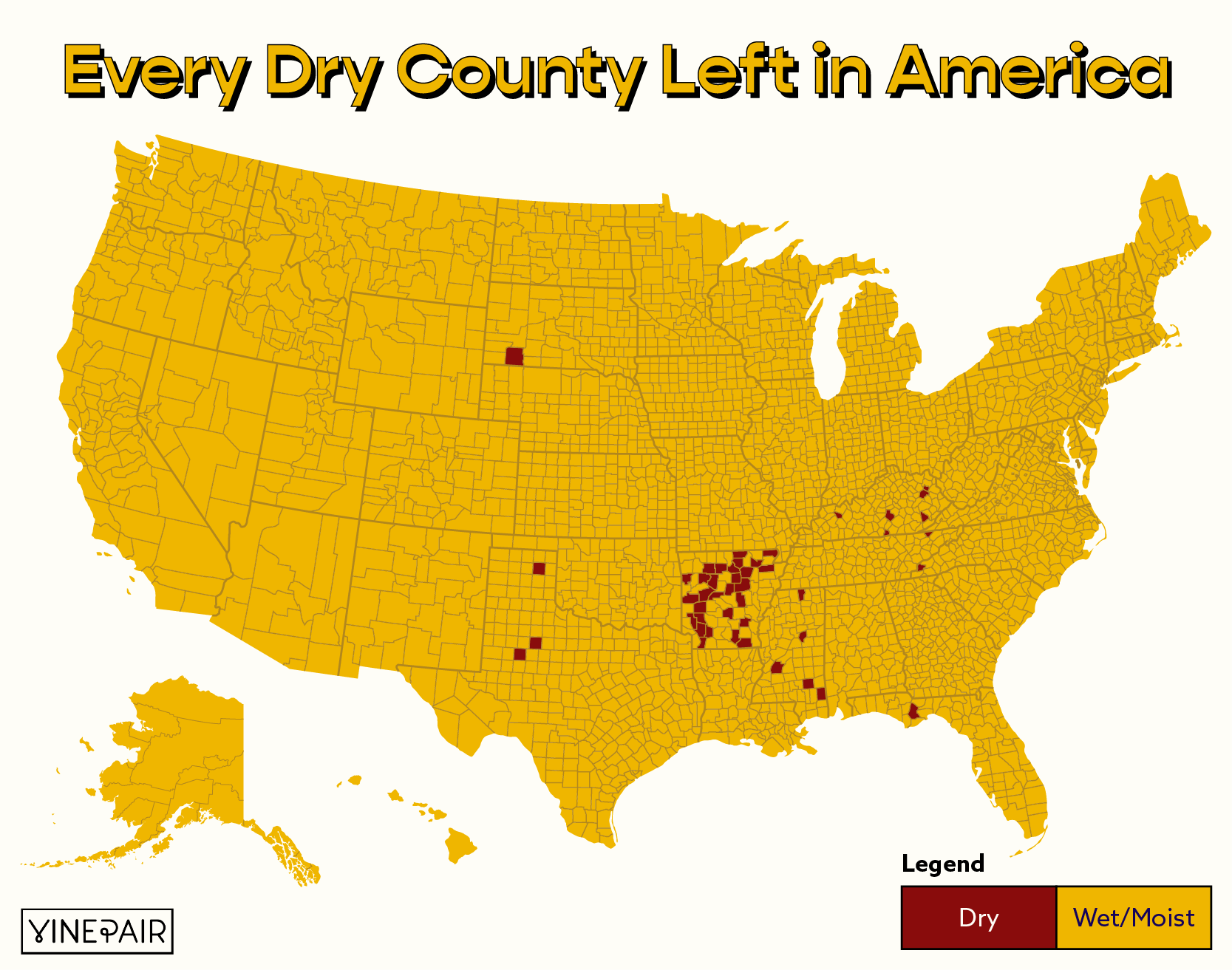
The Number of Dry Counties in Each State
| State | Number of Dry Counties |
| Arkansas | 29 |
| Kentucky | 6 |
| Mississippi | 5 |
| Texas | 3 |
| Florida | 1 |
| North Carolina | 1 |
| South Dakota | 1 |
| Tennessee | 1 |
| Alabama | 0 |
| Alaska | 0 |
| Arizona | 0 |
| California | 0 |
| Colorado | 0 |
| Connecticut | 0 |
| Delaware | 0 |
| Washington, D.C. | 0 |
| Georgia | 0 |
| Hawaii | 0 |
| Idaho | 0 |
| Illinois | 0 |
| Indiana | 0 |
| Iowa | 0 |
| Kansas | 0 |
| Louisiana | 0 |
| Maine | 0 |
| Maryland | 0 |
| Massachusetts | 0 |
| Michigan | 0 |
| Minnesota | 0 |
| Missouri | 0 |
| Montana | 0 |
| Nebraska | 0 |
| Nevada | 0 |
| New Hampshire | 0 |
| New Jersey | 0 |
| New Mexico | 0 |
| New York | 0 |
| North Dakota | 0 |
| Ohio | 0 |
| Oklahoma | 0 |
| Oregon | 0 |
| Pennsylvania | 0 |
| Rhode Island | 0 |
| South Carolina | 0 |
| Utah | 0 |
| Vermont | 0 |
| Virginia | 0 |
| Washington | 0 |
| West Virginia | 0 |
| Wisconsin | 0 |
| Wyoming | 0 |
