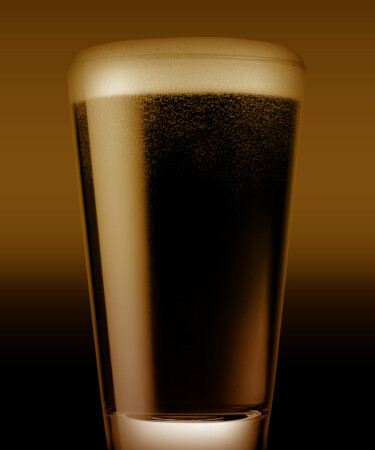
If there is one beer style that has practically defined craft brewing for the past two decades, it’s the India pale ale. Bitter, fruity, and typically accompanied by a heftier ABV than styles like lagers or pilsners, IPAs’ popularity skyrocketed in the 2010s when hazies went mainstream. Today, these hazy New England IPAs are still the king of the category, though other substyles like the West Coast IPA now take up more space on taproom menus.
There’s one style of IPA that lives in comparative obscurity, though, and it doesn’t look much like an IPA at all. In fact, its appearance could easily lead it to be mistaken for a porter or a stout. It is, of course, the black IPA. But what even is a black IPA, and how can it be classified as a pale ale if it’s not pale? We tapped Nile Zacherle, head brewer at Napa Valley’s Mad Fritz Beer, to find out.
“The thing that makes black IPAs stand out, and makes them more challenging in my opinion, is the use of roasted malts,” he explains. “These malts have some bitterness to them, so you have these tannins and phenolics that juxtapose the hops, which are already bitter. So it’s a deft line one needs to walk when putting these beers together.”
The creation of the black IPA subcategory, sometimes referred to as Cascadian dark ales, is often credited to Greg Noonan, who founded The Vermont Pub & Brewery in Burlington, Vt., in 1988. In the early ’90s, he brewed Blackwatch IPA for the first time, fusing the roasted, coffee-like qualities of dark beers with the bright, hoppy bitterness of American IPAs. It’s this very brew that’s widely credited with birthing the black IPA category in the States.
Even so, it wasn’t until the 2010s that the subcategory — along with a number of other IPA styles — truly took off. Mid-decade, brewers across the country set out to produce IPAs of all colors, also introducing red, white, and brown versions, each brewed using various grain-to-hop ratios and unique malting techniques. For black IPAs, this involves incorporating dark or roasted malts — typically debittered for a more palatable profile — that imbue the beer with its signature hue.
“You can make a ‘black’ anything, really,” Zacherle says. “For example, with dark lagers, you have roasted malt fermenting, but it’s only hopped to a maximum of about 30 IBUs. But it’s fermented with lager yeast, so technically, it could be called a black lager. The same is true here.”
As Zacherle points out, the term “black IPA” references the beer’s color and intense bitterness, a characteristic it shares with other India pale ales. In his view, one could argue that a black IPA is a brown or robust porter that’s been aggressively hopped such that it falls into IPA territory.
“Bitter IPAs are typically brewed at 55 IBUs, and most black IPAs I’ve encountered are over 60,” Zacherle says. “Plus, they’re packaged around 6.5 to 7 percent ABV, which to me, settles the style firmly in the IPA niche.”
Despite being associated with the widely popular category, black IPAs failed to thrive in the same way as their hazy or West Coast counterparts. After being a part of Stone Brewing’s year-round lineup for eight years, Self-Righteous Black IPA was demoted to a limited release in 2015. Similarly, Firestone Walker’s Wookey Jack made its debut in 2012 and was shelved in 2016 before reemerging in 2020 as a seasonal offering. Some beers that fit the black IPA bill aren’t even referred to as black IPAs, like 3 Floyds’ Alpha Klaus, described as a Christmas Porter yet brewed with American hops to an IBU of 67.
Given the beer’s darker appearance, it makes sense that some brewers don’t want to refer to it as a black IPA — the phrase itself can feel like somewhat of an oxymoron. That said, it could be this “IPA” signifier that attracts drinkers to the variant in the first place.
“The IPA has been the elephant in the room as far as beer styles go — it’s where the money is. IPAs are just high-velocity beers,” Zacherle explains. “So if you brew a black IPA, it’s probably good to call it one. Especially in the winter when they might be more apropos, it’d probably sell more than it would under any other name.”
