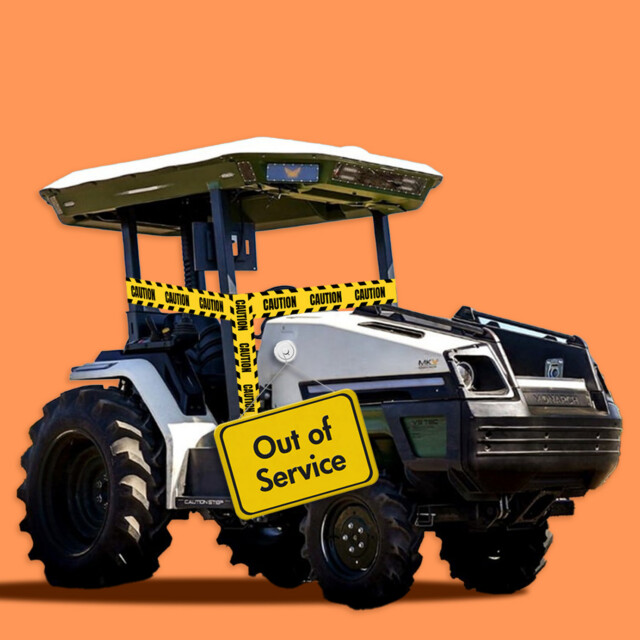
It was a bold claim: a new tractor that would revolutionize modern agriculture and save American farmers hundreds of thousands of dollars.
Albeit, it wasn’t just any tractor. Monarch Tractor — founded in 2018 by Napa scion and winemaker Carlo Mondavi, former Tesla exec Mark Schwager, and robotics and manufacturing expert Praveen Penmetsa — is a brand of fully electric smart tractors that can autonomously circumnavigate vines, even without a driver. Impressive, right?
But the product didn’t only promise convenience. The company also suggested the tractor would save operators an average of $18,000 a year through the elimination of diesel costs. It would snip carbon footprints and chemical use, and help soothe the pressures of labor costs and shortages. Even more, the AI-driven tractor could collect data on its routes, giving insights into grape and crop health, yields, and vine performance.
Investors were into it. Over eight years, Monarch brought in $200 million through funding rounds. Forbes Magazine called the tractor one of the world’s next billion-dollar start-ups, with a valuation of over $500 million.
Wineries were similarly psyched. Monarch did demonstrations at Livermore Valley’s esteemed Wente to showcase its capabilities. Powerhouse wine companies like Jackson Family Wines, Gallo, and Constellation were on board, as were food brands like Dannon and Driscoll.
Then it all went south. In September 2025, a tractor dealer sued Monarch for “defective” vehicles. By November, an Idaho-based dealership filed another suit, claiming breach of contract for the tractors’ failure to operate autonomously.
Layoffs followed, and existing employees received warning of future shutdowns.
Mondavi exited, a move spurred by debates with Penmetsa on how to handle the tractor’s technical defects. “I left due to fundamental differences in approach,” Mondavi stated in a comment on Instagram. “When I saw similar reliability issues on my farm and among friends, I wanted to address them through hardware changes, while the CEO believed they could be solved more through software. I believed strongly in a different path but was ultimately blocked and pushed out alongside another co-founder.”
By April, Monarch Tractor’s assets had been acquired by construction giant Caterpillar and the company had shut down.
Overarchingly, it’s a bummer. The American agriculture industry is in the midst of a crisis, spurred by sky-high labor costs, the challenges of climate change, and the softening of global sales. Technology like Monarch’s tractors could be a huge salve for small farmers who are constantly trying to navigate the current turmoil.
Which leads to the question: What happened? Was it internal issues: mismanagement, over-extension, or faulty products? Or external: tariff pressures, supply chain woes, or the current administration’s lack of support for environmental initiatives? But even if the products were flawless, was the wine industry actually ready for such innovation?
Monarch Takes Flight
Monarch started in Livermore, Calif. — a short haul to San Francisco and Silicon Valley. It was born as a solution to labor shortages, and out of growing concerns surrounding food safety, climate change, and chemical use. Worker safety was a priority for Monarch, as was gathering intensive farm data, driving forward sustainable farming, and enabling clean energy. The end goal was to make electric farming affordable and accessible.
Agriculture represents a significant chunk of fossil fuels burned on Earth, with a substantial percentage of that number coming from fertilizers and pesticides. Increasing mowing — a labor-intensive strategy, and a carbon-intensive practice if using a diesel tractor — would significantly reduce the number of synthetic chemicals used in the farming process. That’s where Monarch would shine — preventing extensive use of fertilizers, while also reducing the amount of fuel needed to mow.
Then there was the added benefit of reducing labor costs for wineries. “Everyone is hurting — expenses are rising, it’s tough to find labor,” says Tim Bucher, a Dry Creek Valley winemaker, mechanical engineer, and founder of Agtonomy, an agriculture autonomy software. “Overtime alone has crushed so many farmers in recent years.” Products like Monarch can reduce the stress of labor costs, allowing producers to operate with lesser margins.
This concept came together in a pretty tricked-out tractor. Zero emissions and electrically driven, with a big lithium ion battery pack that could hold up to 14 hours of power on a single charge. A 360-degree color camera could gather data on the land, and an interactive live map could track the vehicle, even remotely.
“Silicon Valley may think in quarters, but farming thinks in seasons, weather windows, parts availability, and banker conversations. If autonomous tractors cannot prove ROI under those conditions, they stay a showroom conversation instead of becoming field tools.”
It was a $90,000 piece of equipment but programs in California, like the Carl Moyer subsidy from the California Air Resources Board or REACT (Rural Electrification and Charging Tech) were in place to help offset that cost.
Understandably, Livermore wine pioneers Wente Family Vineyards started working with the brand in 2019 — grants from the Bay Area Air Quality Management District bolstered the partnership — by testing the tractor in the vineyard. It optimized Wente’s process — prior to Monarch, the winery would send people into the vineyard to count clusters manually. With the tractor they could optimize each pass, reducing fossil fuel usage.
Mondavi estimated Monarch had touched 45,000 acres of farmland by 2023, and saved farmers $1 million in fuel expenses. Orders were in from 81 countries.
The company plowed ahead, despite the cracks appearing around the edges. In 2024, after completing a Series C funding round, funded in part by Foxconn, a Taiwanese company known for producing iPhones, GameCubes, Kindles, and PlayStations, Monarch cut just under 15 percent of its 250-plus person workforce.
Monarch Loses Wind
There were pain points. Production shifted from Livermore to Foxconn’s Ohio factory. “Foxconn builds iPhones — they’re not known for building tractors,” Bucher notes.
In August 2025, Foxconn sold the plant, leaving Monarch in a lurch.
Then the lawsuits started. Burks Tractor, an Idaho-based farm equipment dealer, purchased 10 Monarch tractors for $773,008. Immediately upon delivery, glitches started. The Monarch team admitted there were issues with functionality, but refused to refund or take back the defective tractor.
As Monarch unravelled, social media took notice. “Our tractor is now a giant piece of hazardous waste on a farm — the battery won’t charge and it won’t turn on,” wrote one user.
“This is the result of tech nerds thinking they know what’s required to build a reliable and fit for purpose tractor,” said another.
Tom Gamble, of Gamble Estates, purchased several Monarch tractors in 2023. As he realized, the machinery is cloud-dependent, so when the company shuttered, so did his five-figure tractors.
To move it, Gamble and his team had to crawl under the tractor to unlock the wheels. “That’s the only way we could get it back to the shed, where it sits rotting,” he says.
“There was dead silence from the company,” Gamble says. “Imagine Waymo turning off all systems and all those vehicles grinding to a halt on San Francisco street.”
Currently, he’s working with neighbors to see if they can hack the system, but “this speciality software won’t play with any others. It’s extremely frustrating.” Essentially, these eco-friendly tractors are now large piles of junk metal.
Other users are frustrated at the lack of parts. If pieces broke, there was no supply chain or access to back-up parts. “It’s impossible to fix or adjust these tractors,” Gamble says. (And, if you did finagle with them, it would invalidate the warranty — if anyone was left to honor it.)
Diagnosing the Issue
What went wrong? There’s the obvious: It’s a $95,000 tractor that did not always work.
“There were huge issues with mechanical efficiency,” Patrick O’Connor, who runs Moonvine Wines in the Sierra Foothills, stated in an Instagram video. The tractor would veer off, run into vines. “I can barely drive this thing by myself,” he said.
“When people who have never seen a farm design a tractor for farmers lol,” wrote one commenter.
One former technician for the company commented, “It was like pulling teeth to get the engineers to listen to any input from people who had actual experience with mechanics and equipment.”
“A solar-powered tractor that has no emissions was a good selling point but, without proper functionality, it was a complete failure,” says Ryan Carr, the co-owner and winemaker of Carr Vineyards & Winery and the farmer-winemaker at KÆRSKOV Vineyard. “We were never able to achieve autonomy, let alone even just proper functionality. The tractor consistently had mechanical issues, including transmission, breaking, inability to run implements properly or for a length. The only thing that tractor was really good for was hauling a trailer during harvest.”
To run a full diagnostics on the fallout, let’s start with scope. Monarch Tractors made not only an electric tractor, an autonomous tractor, and one that could map vineyards, deal with pest control, and solve harvesting woes. Which is an ambitious, bold stride, considering none of the founders were lifelong farmers, or had decades experience in the agriculture industry.
“There’s a long history of equipment manufacturing in agriculture,” Bucher notes. He points to colors: green (John Deere), red (Kubota), yellow (Caterpillar), blue (New Holland). “These are companies that have been making products for over 100 years. That foundation of trust is really important to the industry.”
While heavily subsidized, there were no financing systems in place to purchase the five-to-six-figure machinery, unlike other agricultural manufacturers. ”I don’t know anyone who buys a tractor and pays cash,” Bucher adds.
“There was dead silence from the company. Imagine Waymo turning off all systems and all those vehicles grinding to a halt on San Francisco street.”
There were also concerns about the subscription model (close to $10,000 annually) and cloud-centric programming, which, as Gamble flagged, became obsolete to him as the system shuttered. Plus, California’s butt-in-seat law, requiring driverless tractors to have supervision, doesn’t allow California farmers to harness the full potential of the technology.
Penmetsa also admitted they had focused hard on vineyards and fruit farms, waiting until 2024 to start centering other agricultural industries, like dairy farms. At one point, they also pivoted to targeting airports.
Lack of variety was another concern. Monarch had three models of tractor: a standard tractor, a dairy-focused model, and a utility tractor that was in the works. Bands like John Deere or Kubota have hundreds, modeled to every farming need or type of field imaginable.
Mondavi is also quick to note the challenges brought on by the tariff war, the troublesome supply chain, and the current administration shifting its priorities away from sustainability initiatives.
The final nail was dealing with Silicon Valley banks and investors, who wanted return on Silicon Valley timelines.
“Venture capital funding demands lightning-fast scaling and quick turnarounds on investment,” says Dusty Vauters, an equipment and maintenance supplier at Mid-South Ag. “Farming operates on tight, weather-dependent capital cycles and requires rugged, unwavering reliability. First-generation tech challenges — like we saw with the recent dealer lawsuits and hardware limitations — shouldn’t be a burden carried by the farmers or local dealers.”
“Silicon Valley may think in quarters, but farming thinks in seasons, weather windows, parts availability, and banker conversations,” says Patrick McIntosh, a farmer in Clayton, La., who has worked with Monarch. “If autonomous tractors cannot prove ROI under those conditions, they stay a showroom conversation instead of becoming field tools.”
“I do think autonomous and electric equipment may have long-term promise, especially for labor pressure, fuel costs, and environmental efficiency,” he adds. “But the biggest barriers are price, subscription costs, service networks, field-specific reliability, and whether the technology is being built around farm timelines rather than investor timelines.”
The Future of AgTech
Sure, Monarch Tractor fell apart. It’s a failure for Big Tech — an over-zealous company that fell at the hands of mismanagement and a too blue sky idea.
“This was a first-generation product trying to do something incredibly hard,” Mondavi wrote in a comment on Instagram. “Bringing electrification, autonomy, and AI into agriculture isn’t incremental, … it’s a deep-tech leap, and that comes with real challenges.”
It’s easy to cast armchair feedback. It’s easy to say Monarch Tractor was venture capital decoupled from functionality — but it is sad. They worked to make a product that offered huge environmental and financial benefits to farmers at a time they are struggling.
“Agriculture is under such incredible pressure right now — skilled labor is going down like crazy,” says Bucher. “How many people do you know who are farmers?”
On the other hand, embracing software development and AI models could help bring more people to this struggling segment. “One of the greatest things, though, is we’re attracting a younger workforce,” Bucher notes. While younger generations haven’t been into farming or agriculture, they’re into running automation systems.
There are other green-minded tractors on the market, Monarch just had the most promise, the most potential, and the industry co-sign.
There’s the Bakus-owned Vitibot, an autonomous electric robot that can weed soil, mow grass, and eliminate the use of herbicide. Founded in Champagne — Laurent-Perrier has invested — it’s lighter than a tractor, making it more nimble and less impactful on the vineyard. Naïo Technologies in Toulouse is an autonomous vineyard straddle robot, which can be controlled via a cellphone. Bucher’s Agtonomy works with existing brands (John Deere and the like) to build in AI automation. These brands aren’t trying to reinvent the wheel, just refine it.
HammerHead, by Italy-based Field Robotics, is a compact electric rover that can help wineries weed, mow, spray, and do under-vine soil work while simultaneously gathering data on the vineyard. For Stefano Casadei, owner-agronomist at Famiglia Casadei, the draws of the tech are endless. It cuts emissions to zero and the cost savings are substantial. “It’s a charge that costs just a few euros in exchange for hours of autonomous operation,” he says.
“In a market where high-volume, low-margin producers will increasingly struggle, this ability to care for each individual vine, with a reduced environmental footprint, becomes a genuine point of differentiation,” he adds.
There is promise, even amid all the fuss and chaos surrounding Monarch’s dissolution. “It hurt the industry,” Bucher says. “Yesterday we closed a deal with a grower in Napa who bought 20 Monarchs. The deal was rough — it took a while because they believe in the technology, but they got screwed.”
This story is a part of VP Pro, our free platform and newsletter for drinks industry professionals, covering wine, beer, liquor, and beyond. Sign up for VP Pro now!
