This article is part of our Cocktail Chatter series, where we dive into the wild, weird, and wondrous corners of history to share over a cocktail and impress your friends.
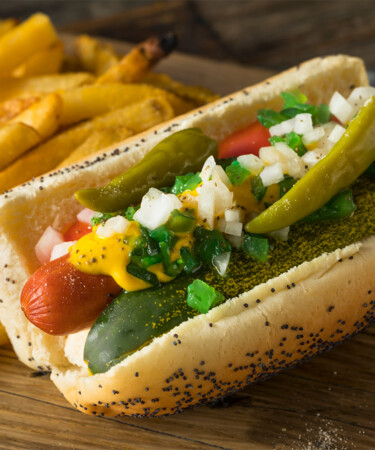
A Chicago dog is a rainbow served in a paper tray. A strict set of criteria rule the Windy City’s hot dog: It must be an all-beef frank enveloped in a poppy seed-studded bun topped with diced white onion, neon-green relish, a dill pickle spear, sliced tomatoes, pickled sport peppers, and a sprinkle of celery salt — and absolutely no ketchup.
This comes in stark contrast to hot dog stands in most other parts of the country, which have few to no guardrails in place: The average weiner cart features toppings galore for customers to mix and match however they like. When strolling through the Windy City with a hankering for a frank, however, don’t dare mess with tradition. But hot dogs made in Chicago weren’t always dragged through the garden.
The Chicago dog’s history begins with the arrival of hot dogs in the New World. Snackable sausages first came to the United States with the influx of German and Austro-Hungarian immigrants who landed on American shores in the 19th century. Austro-Hungarians, many of whom came from Vienna (or Wien in German), brought wieners, and Germans, many of whom came from Frankfurt, brought frankfurters.
The exact history is murky, but food historians generally agree a German immigrant set up the first New York hot dog cart in the 1860s. The presence of the sausages gradually extended westward as German immigrants moved to the Midwest in search of agricultural and industrial careers. One city where the German population was particularly large was Chicago.
Then landed a wave of Jewish immigrants, who caught onto the lucrative business of hot dog stands in Chi-town. This cemented a crucial criteria for the Chicago Dog: Kosher law prohibits the consumption of pork, so Jewish immigrants popularized all-beef hot dogs at their operations. Chicagoans trusted that the Jewish vendors were offering safer hot dogs than the city’s loosely regulated, non-kosher meatpacking businesses.
The poppy seed bun followed next. At just 16, Sam Rosen emigrated from Poland to New York City and opened a bakery there. A few years later, in 1909, Rosen moved to and set up shop in Chicago, where his rye bread and poppy seed buns became a favorite among the German and Polish residents of the city.
The Chicago dog’s world-famous toppings didn’t become standard until the Great Depression. When businesses across almost all industries crumbled after the stock market crash in 1929, hot dog stands became even more pivotal to poverty-ridden communities. The supply was cheap, and the demand was high.
But the product wasn’t entirely nutritious. Cart owners began adding relatively cheap vegetables, such as tomatoes, peppers, and onions, to their franks to both satiate and nourish hungry Chicagoans for just a nickel (about 98 cents today). At the time, it was called a “Depression Sandwich,” and because the Chicago dog had yet to become a set-in-stone dish, a Depression Sandwich could have included other vegetables that don’t appear on the hot dog today like lettuce.
Eventually, the Depression Sandwich stuck with Chicagoans, going from its beginning in an industrial, working-class city where most constituents had to eat cheaply to make ends meet to the Chicago dog as we know and love it today. Now, the acclaimed glizzy offers a sense of pride for Chi-town natives, who prefer their franks all dressed up.
