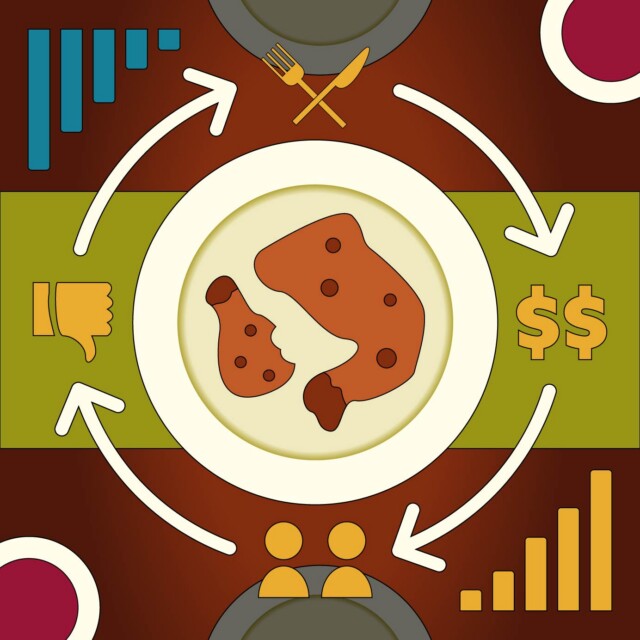
You’re already suffering from half-chicken fatigue. The phrase “$40 half-chicken” has been evoked with such great repetition, it’s lost all meaning. But the truth is, we’re not really talking about a half-bird anymore. Well, we are — but we’re also talking about the sustainability of restaurant economics, and the bleak, ever-worsening affordability crisis that’s changing both how we eat, and how our local venues operate.
For those who have managed to keep news of poultry-gate at bay, the debacle began with an Instagram post from New York City Councilman Chi Ossé, reading: “$40 half-chicken at a wine bar? Really?” While he neglected to call out any one restaurant directly, it was deemed an obvious jab at GiGi’s, a new Greenpoint wine bar from the team behind the former Fulgurances. At the time of the post, the venue had barely been open a week, and as several commenters pointed out, Ossé’s district is restricted to Bedford-Stuyvesant and north Crown Heights.
The comments, as is customary amid internet scuffs of this ilk, run the gamut. On the one hand, you have missives of the “10 piece chicken Mcnuggets have never failed me” variety. On the other, you’ll find scathing indictments calling Ossé “profoundly irresponsible” or “fantastically ignorant about the costs of running a small business.”
However menial or fleeting the post’s prevalence may seem, the damages to GiGi’s are substantial. “We have people posting one-star reviews from cities across the country who have never been to our spot, and it’s so difficult to dispute those with Google,” says the restaurant’s co-owner, Hugo Hivernat. “We’re barely two weeks old, and now we have this huge reputation — and it doesn’t feel deserved.”
A Look at Chickenomics
As Hivernat points out, the team at GiGi’s sources its chicken from Bobo’s Farm upstate at around $14 a piece, which puts a half-chicken at roughly $7 in raw costs. Each dish includes three house-made sauces (dijonnaise, green garlic chimichurri, and jus) and potatoes from Norwich Meadows Farm, bringing the total food cost to about $11 per plate. At a $40 price point, that means they’re operating close to a 25 percent food cost, which is fairly standard across the restaurant world. And if you’re wondering where the profits are going: “Thus far, 46 percent of our expenditure just goes to paying our staff,” says GiGi’s co-owner and sommelier, Thibault Dubreuil. “Everyone is salaried, given paid time off, and health insurance. Our employees are local Brooklynites.”
At bottom, GiGi’s seems an unfortunate victim in the internet crossfire here. There are, of course, a host of other operators pricing their chicken within the same bracket — as well as in the next tier up. Just blocks from GiGi’s at Oxomoco, a half-chicken runs for $59. It’s $46 at Frenchette, $47 at Roman’s, $40 at Sailor, $32 at Badaboom, and $37 at The Odeon. While Ossé was quick to note in the comments that a half-chicken at The Fly in Bed Stuy only runs for $19, if you add starches and sauces, you’re well into the $30 range. The point is, right now, chicken costs too much — but so does running a restaurant.
While, yes, we could instead take offense at $30 tweezer portions of crudo, or $24 glasses of wine, chicken is the people’s food. It’s inoffensive, sating, familiar, affordable. “Chicken is the most consumed protein in the U.S. — so people feel like a chicken is just a chicken,” says Henry Glucroft, who helms Bed Stuy rotisserie Badaboom with his business partner, Charles Gerbier. “It’s a household commodity.” And while alcohol prices can feel elusive and near-incomprehensible for the average consumer, the price of a rotisserie chicken is indeed widespread knowledge.
To that end, saying “this costs $5 at Costco” about a $90 caviar-studded or foie gras-stuffed chicken is a bit like saying, “I could make that” about a Jackson Pollock painting. Of course you can pick up a rotisserie chicken anywhere — just like you can splatter paint on a canvas. But in a restaurant, you’re paying for the poetry: lengthy careful preparation, quality product, ambiance, service — and in the case of GiGi’s, side sauces.
“We have people posting one-star reviews from cities across the country who have never been to our spot, and it’s so difficult to dispute those with Google. We’re barely two weeks old, and now we have this huge reputation — and it doesn’t feel deserved.”
All the same, that’s not really the point here.The more important question is not about poultry, but restaurant economics. “In reality, it’s extremely difficult to run a restaurant right now. We’re looking at higher labor costs, higher insurance fees, higher product costs, higher rents, and that’s eating into the bottom line for restaurant operators,” says Dr. Chad Moutray, chief economist at the National Restaurant Association. “Normally, vendors would be able to pass those higher costs onto consumers to even things out, but right now, that’s just not possible. Americans are having trouble making ends meet, so they’re spending far less on luxuries — which in turn hurts the restaurants. It’s a vicious cycle.”
This past year, Moutray and his team’s “State of the Restaurant Industry” report showed that only 42 percent of American restaurants were profitable at all — and those that were operated mainly at a 2.8 percent profit margin. For the most part, that means that the standard venue is kicking on at a loss. And no, the $40 chicken surplus is not piped into the owner’s pockets. Instead, it’s used to keep the lights on. “I don’t imagine we’ll be profitable for two full years — and that’s if we do well,” says Hivernat.
On the matter of value, consumers are first questioning what they can afford, and second questioning what they’re willing to pay for. “If I’m going to a wine bar and I’m ordering a chicken, I’m looking for the overall ambiance. I’m looking to be able to socialize with my friends. I’m going to get great service, right?” says Moutray. “A lot of things go into that value conversation, and certain people might walk out of there thinking they got great value for their dollar — and others won’t. But this is a larger conversation in the restaurant sector: How can we continue to communicate and deliver on value?”
For Gerbier and Glucroft of Badaboom, the same question rings true. “I wish we could ask our customers what they’d be willing to sacrifice to lower prices. Lower-quality meat? Paper napkins? QR codes instead of servers?” says Glucroft. “But ultimately, those are the things we’re choosing not to compromise on for the sake of the identity of the restaurant we built. And those are all things that contribute to the cost of eating there.”
As he explains it, we’re all glamorizing the Costco chicken — which is fine and good. But the metrics are not the same, the labor is not the same, the whole charade is different. It’s like comparing apples to oranges, or chickens to… chickens. So, which part of the song and dance are you willing to trade in?
If the chicken is purely for the purpose of satiation, then likely, paper napkins will do just fine. At a capital R Restaurant, however, you’re paying for an experience as much as the food itself. You’re paying to watch the theatrics of fine (or even middle-tier) dining. “Grocery-store rotisserie chicken is a loss leader — no retailer is making money on it, but if you go to Costco to buy it, you’ll also end up buying six months’ worth of toothpaste, so the loss is worthwhile for the business in the end,” Glucroft explains. “The problem is, we’re a restaurant, not a retailer.”
Displacement, Gentrification, and Dining Models
The question of loss leaders, however, extends much further than supermarket poultry. Per Dr. William Payne, assistant professor of geographic information science at Rutgers, it all relates to the matter of gentrification — a force that’s inextricably tied up in restaurant economics. “There are real-estate developers who will open a coffee shop in a lower-income neighborhood to lure renters into new-build luxury apartments. They don’t care if the coffee shop makes decent money, they care if it helps bring renters over,” he explains. “That’s a gentrifying force.”
Then again, a wine bar with pricey [insert chicken or non-chicken item here] represents a less insidious type of displacement. Unlike, say, a GoPuff facility that replaces a community hub, a restaurant still presents a space for locals to patronize, but with an asterisk. “Yes, this is a place that’s technically open to the public, but then again, who can afford to go there? Who will feel comfortable there? Can everyone get a reservation?” Payne asks. “Moreover, it’s not necessarily about the food being expensive — it’s about the existence of the expensive restaurant making people’s rent go up. You can choose not to buy the $40 chicken, but you can’t choose not to pay your rent.”
Per his research on “New York’s gourmet gentrification frontier,” it’s inevitably true that higher rents and changes in demographic often follow the addition of gourmet amenities — likely an element in Ossé’s complicated gripe. For any local politician, $40 half-chicken may feel more like a symbol for gentrification and displacement than a petty price complaint. But at the same time, as Payne sees it, the independent restaurant is in a tricky position. More and more, massive and pre-established restaurant groups are the sole operators who can afford to open new venues (much like in Hollywood, we’re dealing in prequels and sequels). Sure, there are restaurateurs who take payouts from developers or investors to bring new money into lower-income neighborhoods, but for the most part, chefs and creatives are doing it alone (discounting their investors). That means they can no longer afford SoHo real estate. In fact, for the most part, these restaurateurs are longtime tenants of the neighborhoods in which they’re opening.
“In reality, it’s extremely difficult to run a restaurant right now. We’re looking at higher labor costs, higher insurance fees, higher product costs, higher rents, and that’s eating into the bottom line for restaurant operators. … Americans are having trouble making ends meet, so they’re spending far less on luxuries — which in turn hurts the restaurants. It’s a vicious cycle.”
“The sad trade-off is, if new restaurants are banned from opening in less-than-fully-gentrified neighborhoods, you lose the notion of cuisine as an art form,” says Payne. “Artists need to take risks, and they need to try things that are not a sure bet, and you can’t do that in expensive neighborhoods.” He describes it like a garage band: It’s all a shot in the dark unless you make it big. And even then, nothing is guaranteed.
Making Sense of Costing
To his credit, this week, Ossé has been communicating directly and openly with the team at Badaboom, agreeing to come eat and discuss some of the difficult economics that come with the operation. Moreover, in response to the controversy, the team offered a public “pay what you wish” night this past Tuesday, whereby guests were welcome to name whatever price they felt appropriate for the spot’s half-chicken.
“Our half-chicken is $32, the median spend was $22, and the lowest we earned was $12,” Glucroft explains of the event. “But for the most part, people did pay full price, which was interesting to see.”
At bottom, restaurants want you to leave happy. They want you to come back. They want regulars and loyal customers. But who can afford to be a regular, anymore? “I grew up in restaurants, and I can tell you, the constant is that people always want the best thing for the lowest price. That’s never going to change,” says Stephanie Tang of casual Williamsburg-based Peruvian rotisserie, Johnny’s. For Tang, the chicken biz runs blood deep: Her grandfather opened Peking BBQ in Woodside, Queens, in the early ’70s — a much-lauded poultry spot still open to this day. “But maybe, if city officials could help with permitting and legal fees and expeditors, we could all be lowering our costs for the public,” she says.
“There are real-estate developers who will open a coffee shop in a lower-income neighborhood to lure renters into new-build luxury apartments. They don’t care if the coffee shop makes decent money, they care if it helps bring renters over. That’s a gentrifying force.”
Tang is not the first to address the fact that, perhaps the solution here lies — at least in part — with city officials. “It took us over a year to even get approved to have an architect build an extension on our space, and waiting for permits or licensing ends up eating money in addition to the fees for the permits themselves,” she says. “What if our local politicians could reduce that burden?”
“Our food margin has to support everything else required to operate in New York City: rent, utilities, insurance, compliance with Department of Buildings and landmark regulations, waste management, payroll,” the GiGi’s team wrote in an open letter to Councilman Ossé.
“The licensing alone is enough to scare a lot of people out of even trying to open a restaurant,” adds Glucroft.
Most of these restaurateurs, per Tang’s point, are looking for the best thing at the lowest cost. They want butts in seats. They want joy and community. Mostly, they just want to keep their doors open. And perhaps there are ways in which the Great Chicken Debate of 2026 will foster open conversation between vendors and local officials re: how we can lower costs for diners and long-term tenants by lowering costs for restaurateurs in the first place.
Nonetheless, it’s an imperfect system on all fronts. Everyone is the bad guy. Chicken is too expensive. So is rent. So is breathing in New York City. Still, in spite of it all, restaurants at their best will always present a certain kind of irrefutable magic. “In my house, we eat a lot of rotisserie chicken from Costco. I’m a big fan,” says Payne. “But when you go to a restaurant, you’re paying for something else. You’re supporting a vision. You’re living a fantasy.”
