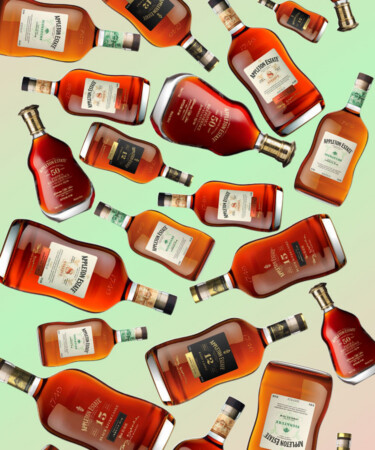
Terroir is a characteristic typically prized in wine, but a few distillers attempt to bring that concept into their spirits. At Appleton Estate Rum, the goal is to taste the warm, lush, and damp environment that surrounds the Jamaican distillery.
After British troops invaded Jamaica in 1655, the Crown granted the soldier Francis Dickinson a piece of land in Nassau Valley that would eventually become Appleton Estate, which he named after his hometown in the U.K. Dickinson probably began distilling soon after acquiring the area, but the first legal documentation of rum distillation there dates to 1749, making it the oldest continuously operated distillery in Jamaica.
From then until the 1900s, a series of mishaps including financial strife and an earthquake caused the ownership of Appleton to pass to a number of Jamaicans with roots in Great Britain. This period saw incremental expansions to Appleton’s property and facilities. In 1916, the distillery became an incorporated entity when Cecil Lindo and his brothers simultaneously purchased Appleton Estate and what is now known as Wray & Nephew — founded in Kingston and now produced at Appleton’s distillery — and placed both beneath the same corporate umbrella.
From its colonial beginnings to modern-day innovations, here are seven things to know about Appleton Estate.
-
All rum from Appleton Estate is made on a single property.
Appleton Estate achieves its distinct terroir by fermenting and distilling all of its rum on-site. Like much of Nassau Valley, its property lies over a limestone bed, and the rock naturally filters the rainfall into clear, hard water that the distillery uses to make its rum. In addition to the local water, Appleton sources its molasses from sugar cane grown and farmed nearby.
-
The distillery allegedly experiences daily rain showers.
According to its website, a rain shower pours down on Appleton Estate each day around 2:30 p.m. Weather forecasts for the near future indicate a frequent mid-afternoon shower, but we can’t quite verify to what extent they happen daily. Given the distillery’s tropical climate, however, a 2:30 p.m. shower each day seems feasible.
-
Its tropical location expedites maturation.
Because Appleton ages its rum in a tropical environment, the heat and humidity cause the liquid to mature around three times faster than a spirit would in a cooler climate. For instance, a 3-year-old rum there would have developed just as much as a 12-year-old Scotch. The more rapid development doesn’t necessarily compromise flavor, as Appleton’s rums offer a smooth, mellow taste that’s still able to drive a complex palate, according to the brand’s tasting notes. However, the speedy aging process increases the angel’s share. According to Forbes, Appleton loses around 10 percent of its liquid due to evaporation each year.
-
Appleton ships its rum to a bottling site via an underground pipeline.
Once the rum has been fermented and distilled, Appleton sends its rums to Kingston, Jamaica, for aging and packaging. Learning a trick from Scotland’s clandestine whiskey trade of the 17th and 18th centuries, Appleton Estate installed an underground pipeline beneath Jamaica’s capital city to transport the rum from its aging site to its bottling facility. The two sites are connected by a subterranean passageway to avoid crossing the major highway that bifurcates the warehouses. After the aged liquid has reached the bottling facility, a vacuum system passes an inflatable ball through the pipeline to ensure nothing is left behind, Forbes reports.
-
Appleton Estate hired the first woman master blender in the spirits industry.
Appleton Estate hired Joy Spence as its master blender in 1997, marking the first time a woman held that title in the entire spirits industry. Spence first joined the distillery in 1981 as chief chemist. In her tenure as master blender, she has spearheaded the release of a number of historic expressions, including the 8 Year Old Reserve Rum made to celebrate the distillery’s 250th anniversary. Spence also helped open Appleton Estate’s visitor center shortly after assuming her leadership role.
-
Appleton has released the world’s oldest tropically aged rums.
Under the direction of Spence, Appleton Estate released a 50-year-old rum in 2012 — at the time, the oldest barrel-aged rum available. The expressions were particularly selected and stored away in 1962 with the intention of releasing them down the line to commemorate the 50th anniversary of Jamaica’s independence from British rule. Thirteen years later, Spence set a new record with The Source 51 Year Old, the oldest tropically aged rum to date.
-
The brand’s insignia is a combination of traditional Jamaican emblems.
In addition to its rums that honor Jamaican history, Appleton celebrates the country with its insignia. A collage of five symbols rooted in Jamaican heritage makes up the crest. A blue mahoe — the country’s national tree — sprouts up at the top of the image. Beneath it is a rendition of the Jamaican flag and a budding ackee, an indigenous fruit. Anchoring it all is a lignum vitae tree, which is commonly found around the Caribbean. Lastly, on each side of the insignia is a doctor bird, a hummingbird native to Jamaica.
Recent Appleton Estate Reviews
Appleton’s Hearts Collection — a series of rare rums created by master blender Joy Spence and rum expert Luca Gargano — might be the ...
This aged rum is made using molasses-based pot and column distillates and aged for a minimum of 21 years in Jamaica’s lush Nassau Valley. ...
