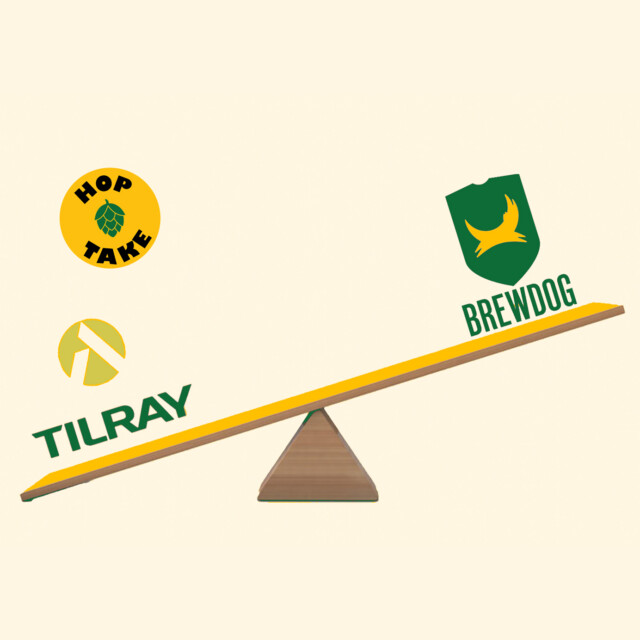
When we last checked in on the Good Ship BrewDog midway through last month, it was in rough seas. Leaking cash and drifting further from a long-promised public listing with each passing year, the Scottish craft brewery’s board hired a restructuring firm in January known for its mop-ups of General Motors, Enron, and the Bernie Madoff scandal. Hundreds of millions of dollars, hundreds of thousands of annual barrels, and 1,400 livelihoods hung in the balance.
“Whatever happens, it will almost certainly be a bad situation for those poor [Equity] Punks,” I wrote just 14 days ago, referring to the eager sods that had pumped a collective $100 million into the United Kingdom’s largest craft brewer via its long-running and deeply dubious equity crowdfunding scheme. “Even if the jig isn’t up for BrewDog, it’s likely up for them.”
In other words, I was not surprised to learn Monday that those ~200,000 retail investors got wiped out in Tilray Brands’ acquisition of BrewDog. That they’d be taken to the cleaners in a liquidity event has been more or less guaranteed for years. And, of course, the announcement came with pink slips, as this sort of fire sale so often does: Around 500 BrewDog employees in the U.K. are to be laid off, per a statement from AlixPartners. For the second time in as many weeks, those workers got the bad news from the press, not their bosses. Given BrewDog’s dismal track record, that snub wasn’t hard to believe, either.
The rest of the deal was full of shocking details, though, and none more so than the purchase price. Over the past half-decade, Tilray has made a name for itself as a corporate clearinghouse for erstwhile craft breweries, but even by its bargain-basement standards, the roughly $44 million it will pay for BrewDog’s global brand, Scottish brewery, and 11 pubs across the U.K. and Ireland is astonishingly low. Brewbound’s Jess Infante reported earlier this week that the latter firm produces around 670,000 barrels annually, putting the per-barrel (bbl) cost — a common industry yardstick for comparing valuations — at just under $66. For contrast, I went back and reviewed the approximate per-barrel pricing for a few pivotal craft brewery sales over the past decade, drawing barrelage data tabulated by the Brewers Association for the year prior to each sale and prices from contemporary news reports and filings. The findings (all approximate and sorted chronologically throughout):
- $305/bbl is what Anheuser-Busch InBev paid for Goose Island in 2011
- $3,600/bbl is what Constellation Brands paid for Ballast Point in 2015
- $1,000/bbl is what Boston Beer Co. paid for Dogfish Head in 2019
- $1,150/bbl is what Tilray paid for SweetWater in 2020
To be clear, nobody is getting these prices anymore. Frankly, nobody ever should have gotten some of them; Constellation’s obscene overpayment for Ballast Point will go down as one of the American beer industry’s all-time biggest boners. But even by more recent benchmarks, Tilray’s get-in on BrewDog is a low-end outlier. Take, for example, its more recent thrift finds:
- $150/bbl is what Tilray paid for Green Flash and Alpine in January 2022
- $745/bbl is what Tilray paid for Montauk in November 2022
- $116/bbl is what Tilray paid Molson Coors for four of its craft breweries in 2024
The barrelage on Tilray’s 2023 fire-sale deal with ABI for eight of the latter’s brands is hard to divine because the Brewers Association did not break out barrelage for all the breweries, and Hi-Ball is a) an energy drink and b) defunct at the time of the sale. (Tilray has since resurrected and added a “hard refresher”-style extension, Hardball.) Assuming an average of 50,000 barrels for the missing breweries — Widmer Brothers, Redhook, and Square Mile — would put the per-barrel price of the ~$84-million purchase at around $130/bbl. That’s still roughly double the valuation BrewDog commanded from Tilray, with almost a dozen brick-and-mortar pubs thrown in.
This is partly a function of the mergers and acquisitions market, which has turned dramatically against craft breweries since the second boom last decade. Not that BrewDog was angling to get acquired, mind you: The £213 million (~$265 million) investment from TSG Consumer Partners in 2017 was meant to provide a runway for BrewDog to go public a few years later. (Another shocker from this deal: Even with its preferred shares, the private equity firm appears to have gotten hosed here, too.) Getting bought would have been contra its “punk” marketing mythos, which it articulated ad nauseam and with great success with stunts like the 2015 amendment to the company’s articles of association to prohibit “any transfer of any Certificated Share to a transferee who is a monolithic purveyor of bland industrial beer.” Forget selling out to, say, Heineken. “This is about outselling Heineken, and that’s always been the aspiration,” James Watt, the company’s co-founder and chief executive for much of its existence, told Fortune magazine in 2021.
Watt and co-founder Martin Dickie were hardly alone in sneering at craft brewing’s so-called sellouts. Nor were they alone in promoting their brewery as a bastion of anti-corporate do-goodery while not, ah, doing good. But BrewDog is bigger than most: At its peak, it claimed around 90 branded outposts (counting franchises) on four continents, breweries on three, and an implied valuation of more than $2.5 billion. The chasm between what it claimed to be and what it was yawned wider than most, too. It was a for-profit business run by self-styled merry pranksters who refused to grow up, and that got a lot less cute as false-advertising penalties, financial obligations, and allegations of workplace harassment began to stack up.
Breakneck expansion — necessary to stay ahead of the souring outlook at home and sustain the world-beating narrative — came with costs, too. In 2021, former employees detailed some of them in an open letter about BrewDog’s toxic work environment and hypocritical behavior; in 2022, a BBC documentary laid bare more testimony on the company’s corporate rot and Watt’s sleaziness. By the end of that year, BrewDog had lost its B Corp certification. By the beginning of 2024, it had abandoned its pledge to pay a living wage. By October 2025, it had sold off the “Lost Forest,” an $11-million greenwashing gambit that was meant to turn BrewDog carbon-negative but never panned out — and probably never could have. (Watt had been gone roughly a year by the time BrewDog sold the forest, one of the last vestiges of the glory days; Dickie had just departed a few months prior.) Some 250,000 of the 500,000 saplings BrewDog planted (with a big chunk of funding from the Scottish government, by the way) died after a particularly brutal winter. As metaphors go, it’s a little loose, but you get the shape of it. The brand, red-hot for so many years, had finally gone cold as the market did likewise.
Which brings us back to Tilray. It is well established that chief executive Irwin Simon absolutely loves a deal. “I’m always someone that bought someone else’s misery and tried to breathe life and excitement into it,” he told Hop Take in late 2024. Whether he can pull that off in the craft brewing industry remains an open question. Buying low has given Tilray runway, but it has struggled to deliver the sort of #synergies it will need to sustain the business in the long term. Shedding SKUs and closing breweries can improve a bottom line, and Simon has done plenty of both; on an October 2025 earnings call, he said Tilray had already generated $25 million in savings, out of a targeted $33 million. But those are one-time cuts, and sales are struggling.
“Like the rest of the beer industry, our business was impacted by softer consumer demand, which we believe is short-term influence,” Simon said on another call with analysts in November 2025. According to scan data for off-premise sales at multi-outlet grocery, mass retail, and convenience stores tracked by market research firm Circana, the company’s brewing portfolio was down 14.9 percent in dollars and 13.9 percent in volume year-over-year for the 12 months through Jan. 25. (Compare that to 2.4 percent and 3.8 percent declines in the overall category’s dollars and volume, respectively.) The market is soft, but right now, Tilray is softer.
In a brief meeting about the sale this past Monday, Simon crowed that “you could not simply build this platform in Europe today for the amount of money we paid.” He envisions using BrewDog’s underutilized Ellon plant to brew American brands like Shock Top and SweetWater for European drinkers. (Somebody should probably warn them.) “We have to double the capacity here,” he said. With what is unclear: Tilray’s total beer volume in 2024 was 783,495 bbls, while BrewDog turned out just 670,000 barrels from a facility that has the capacity to turn out 2 million. Hemp-derived THC and adult-use cannabis are illegal in the U.K., and if Simon is hoping to make up the difference with cannabidiol seltzers or a retooled line for gummies, he’s yet to say.
He also reiterated that Tilray was pursuing separate deals for the Scottish firm’s American and Australian subsidiaries. There’s a logic to the stateside deal, especially: After all, Tilray just inked a partnership to contract volume from Carlsberg starting in 2027, and BrewDog USA’s Canal Winchester 150,000-bbls/year plant only produced a hair over 89,000 bbls in 2024 (the most recent year for which production data is available). But there’s always a logic to these purchases. The question is whether Tilray can execute on it while continuing to digest its previous purchases and addressing the added complexity of a transatlantic business, a damaged brand, and a downtrodden workforce.
As BrewDog’s rise and fall demonstrates, expansion can’t cure a business’s underlying ills — even if it keeps up the illusion of growth for a little longer.
🤯 Hop-ocalypse Now
Has Trump’s reign of terror on Hispanic communities contributed to declines in beer sales? Brewing executives have been extremely reluctant to say so explicitly, but they’ve been glad to imply the regime’s deadly deportation spectacle is to blame for shortfalls when speaking with analysts and investors. Jim Koch, the co-founder and chief executive of Boston Beer Co., tried to have it both ways on the company’s earnings call last week, hypothesizing that an early 2026 uptick in sales may have been partially due to this cohort “adjust[ing] to some of the new realities,” then later attributing Twisted Tea’s struggles in part to “pressure on the Hispanic consumer.” Which is it, man?
📈 Ups…
The Beer Institute has a new federal lobbyist whose previous gig was advising a Washington congressman who owned a hop farm… Congratulations to the 2026 inductees of the American Craft Beer Hall of Fame… Four Loko parent company Phusion Projects is considering a sale of the brand, which is valued around $400 million… RFK, Jr., who this week took aim at the sugar content of Dunkin’s coffee drinks, remains bafflingly disinterested in beverage alcohol… In a new memo, longtime industry hand Bump Williams said the beer industry got “lazy,” and you know what, he’s right and he should say it…
📉 …and downs
Pabst Brewing Co.’s five-year FMB partnership with Brown-Forman is coming to an end… Truly was down 14.4 percent in the last four weeks’ worth of NIQ scans analyzed by Goldman Sachs Equity Research, woof… Constellation Brands’ beer division managed to have a down year in 2025 despite gaining share in 49 states… Constellation is also launching an apple-flavored hard refresher called Good Peels, and no, correctly calling multiple market trends doesn’t make this any less tedious to me…
This story is a part of VP Pro, our free platform and newsletter for drinks industry professionals, covering wine, beer, liquor, and beyond. Sign up for VP Pro now!
