I am not a particularly holiday obsessed person. It is always my mushy husband who reminds me that it’s time to adorn our fake plastic tree and dust off the Menorah. Yet, if a seasonal invite involves both food and drama, then I will don a festive spirit and roll up. This philosophy is what landed me at a marble table in mid December last year, waiting for high tea service at Salt Lake City’s Grand America Hotel.
A server with the verve of a freshly shaken can of Sprite delivered the classic three-tiered structure: berry-laced scones and snappy cookies on the bottom, puddings and miniature cheesecakes in the middle, and an array of unidentifiable sandos on the top. He stepped back from the table and looked at my two friends and I knowingly. Then this walking wink asked us coyly, “Who wants a photo with their tower?”
The truth is that the food was completely unremarkable. But surrounding us in the almost comically elegant dining room — with enough crystal chandeliers, polished silver, and cream-and-gold upholstery to make you feel like you’d accidentally wandered into a Downton Abbey set — fellow customers were behaving identically. Whipping out their phones, squintily aiming them at the tower of dainty bites, and locking in a fleeting moment of opulence.
This specialness is exactly what afternoon tea, ritualized in the 1840s by Anna, Duchess of Bedford, was meant to confer. But the three-tiered stand wasn’t a new invention so much as an evolution. As early as the 1720s, wealthy English households displayed fruit and sweetmeats on ornate silver epergnes that doubled as centerpieces. By the early 19th century, Marie-Antoine Carême was building elaborate architectural pièces montées from sugar, marzipan, and pastry. And later that century, Parisian brasseries popularized plateaux de fruits de mer, ancestors of modern seafood towers.
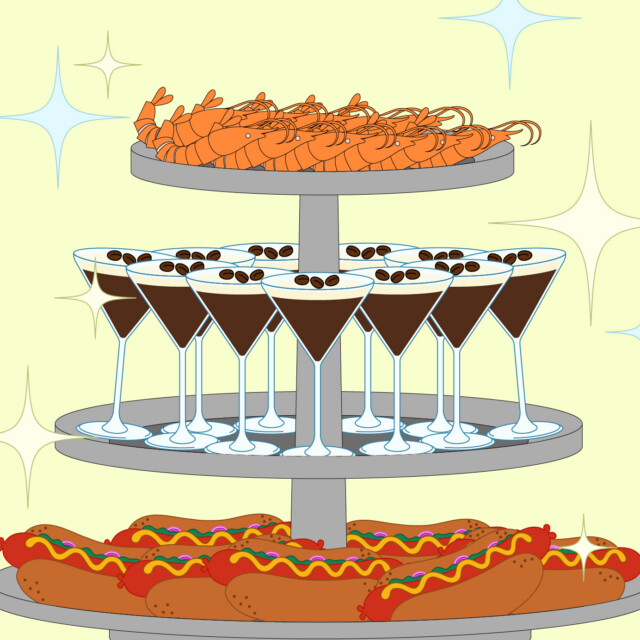
Today, the bacchanalia of vertical presentation has spilled into nearly every corner of modern dining. Across the country, restaurants are nestling pink shrimp, glistening oysters, and honking crab legs into icy layers; balancing waffles and eggs on tiered A-frames; and fashioning donuts into tabletop monuments. Bars are sending out trees laden with Espresso Martinis and blush glasses of rosé. Champagne towers are the nouveau wedding flex. And home cooking enthusiasts are coaxing piles of chips and hunks of salami into improbable, honey-drizzled pyramids.
No matter what it carries, we simply cannot seem to deflect the tower’s spell. So I brought one question to the restaurant designers, chefs, psychologists, neuroscientists, food stylists, and sculptors I interviewed for this story: Why? Their answers pointed to a united consensus. Food and drink towers have seduced us for centuries because they exploit several deeply human instincts at once. While the ingredients changed over time, the intent passed from generation to generation: elevate the food, elevate the occasion.
The Tallness Equation
The first clue in this psychological mystery has surprisingly little to do with food. Colin Ellard, a cognitive neuroscientist and professor emeritus at the University of Waterloo, studies the relationship between humans and built environments. Tallness, he says, has long been a shorthand for importance. “We assume this kind of equation between height, power, success, all the potent things of life,” Ellard tells me, explaining why skyscrapers inspire both awe and a sense of oppression. The association runs so deep that it’s shaped our language. “We make references to elevated experiences,” he says. “We don’t use that word by accident. It refers explicitly to height.”
Consumer research neatly validates the idea that we’re total simps to whatever looms over us. Studies on the marketing of luxury goods found that the higher a product sat on shelf, the more valuable and prestigious it appeared to the aspiring shoppers below.
“Through all the trauma that the world is experiencing, there’s such a need for whimsy.”
Towers may also inspire our reverence because, like a stalagmite rising upward from the floor of a cave, they seem to escape the ordinary condition of things. David Altmejd, a Montreal-born contemporary artist whose sculptures explore transformation and the human form, builds a piece skyward when he wants to transcend its materiality. “The natural state of matter is always as submissive to gravity; it naturally accumulates close to the ground, horizontally,” he tells me. “So the verticality of an object suggests that it’s something more than just material, as if it’s also spirit.”
We’ve always wanted to be seen looking cool. As towers entered the scene, dining rooms were becoming places to display wealth, taste, and social standing. Before the 1830s, hungry New Yorkers gathered in taverns, which doubled as third spaces to question “authority and governmental decisions,” historian Cindy R. Lobel writes in “Urban Appetites.” But as the city’s population boomed, its restaurant sector expanded and stratified. The new establishments, Lobel writes, “served as important spaces of social articulation — stages for acting out status and conspicuous consumption.” In other words, the tower is a natural extension of the very human desire to amass clout via luxury and extravaganza.
Attention Is the Point
Anyone with a propensity to doomscroll knows that we don’t remember everything we experience. Decades of research have shown that those we attend to — and process more deeply — are far more likely to persist in long-term memory. The difference between a meal that lodges itself in the mental filing cabinet upstairs and one that disappears the next day often comes down to how totally it commandeers attention.
Our lizard brains come with factory settings that respond to certain kinds of stimuli. We’re suckers for contrast, says Anna Polonsky, founder and creative director of restaurant design studio Polonsky & Friends, whether achieved “through scale, height, movement, light, color, or sound.” But the most powerful design principle — the one that draws accipiter-like stares from an entire restaurant — is interruption. “Anything that briefly disrupts the visual rhythm of a room invites notice,” she explains. A food tower rises above eye level, punctuates the landscape of a dining room, and, perhaps most importantly, “slows the moment down.”
That pause does a lot of work. Charles Spence, the Oxford experimental psychologist whose research on multisensory perception has informed the theatrical dining experiences at Heston Blumenthal’s Berkshire, England restaurant Fat Duck, argues that much of eating’s pleasure lies not in consumption but in anticipation. Well before the first bite, our brains are already predicting what a meal will taste like and how satisfying it will be. A food tower exploits that process from every angle.
It draws eyes while beelining through the dining room. Its relative height makes the contents seem fancy. And the quantity of food signals abundance without gluttony. As Spence puts it, “A tower offers a way to show a whole lot of food without the implication being that it’s all for one person.” Add movement — fizzy Champagne cascading into waiting glasses, for example — and a tower becomes even harder to ignore. “Dynamic food in motion is more attractive to your brain,” Spence says, citing the sizzling burgers and oozing sauces in fast-food advertisements.
A Touch of Whimsy
Some of today’s towers would likely make Duchess Anna roll in her grave. In Newport, R.I., where seafood stacks are practically part of the natural habitat, Brad Head decided to adapt the format to the hot dogs, burgers, and Espresso Martinis he shills at Wally’s Wieners. The result is deliberately absurdist: a tower of franks feels less like precious luxury and more like adult playtime. “It’s really about the experience that the guest has when they come,” Head says. “The food is kind of complementary to that.”
That sense of occasion is exactly what customers are chasing right now. In January this year, OpenTable reported a 46 percent year-over-year increase in experiential dining and an 11 percent rise in group bookings of six or more people. Over half of respondents said they would willingly pay more for a meal with a distinctive atmosphere. And even the physical space has become part of the performance: 58 percent of those surveyed now consider a restaurant’s “Instagram- or TikTok-worthiness” when deciding where to eat.
Perhaps food towers also satisfy a deeper human yearning. Pearl Jones, a freelance stylist in the business of meticulously arranging food for the camera, points out that art and photography have often become more fanciful during periods of collective anxiety — not as denial, but as a sort of spiritual balm. “Through all the trauma that the world is experiencing,” she says, “there’s such a need for whimsy.” A tower offers permission to delight in something gloriously unnecessary.
That appeal mushrooms outward on social media. Because most food and drink towers are built from a single repeated ingredient — shrimp, Martinis, oysters, frilly tufts of radicchio — “you’re not really asking the viewer to do a lot of filtering or processing,” Jones says. The visual gag is instantly legible and delightful. And an image’s ability to halt scrolling thumbs has obvious benefits for restaurants.
The hot dog tower at Wally’s Wieners has become a siren song for tourists. “We have people travel from New Jersey and Connecticut and New York and Maine,” Head says. “They say, ‘We came to Newport just for Wally’s.’” Of course, he knows perfectly well that a hot dog is just a hot dog. But a lofty cairn of dogs? That becomes something else entirely: a moment that pulls us in, a photo worth sharing, and a memory that has a chance of holding on. “It’s fun,” Head says. “That’s all it is.”
