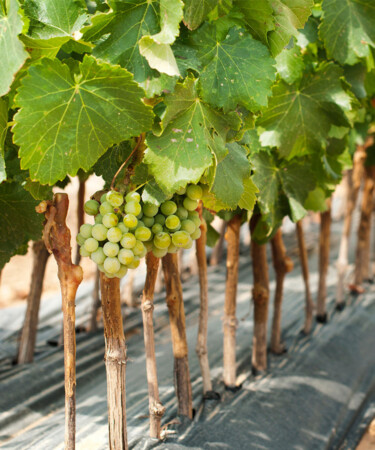
As if learning about winemaking grapes and their characteristics wasn’t arduous enough, here’s something that can throw a wrench into any semblance of progress: grape clones.
The word “clone” carries some discomforting connotations. It can conjure up dystopian images of homogenous armies marching in order, and it can make you realize that grape varieties having several clonal variations convolutes the world of wine all the more — but fret not.
Any wine of a single variety is likely a blend of different clones, says winemaker Brett Stone, co-chief executive officer and winemaker at King Estate Winery in Oregon’s Willamette Valley. In other words, the average wine drinker looking for, say, a Pinot Noir, doesn’t need to worry about discerning which clone(s) they’re drinking. For most drinkers, the Pinot Noir 115 clone isn’t all too different from the Pinot Noir 777.
But for those with their noses attuned to what’s going on inside their glass, grape clones open up a Pandora’s box of opportunities to sink their teeth into, says Stone, who hails from a region that specializes in grape clones and whose winery works with around 20 Pinot Noir clonal varieties. (In Oregon, speaking about “grape clones” is synonymous with talking about “Pinot Noir clones” specifically, Stone says. Experimenting with the grape’s varieties has become a pastime for producers in the region since its 20th-century winemaking boom.)
Variations in genetics can result in variations in yield, ripeness, sugar development, and disease resistance, among other viticultural factors. “When you get to the finished wines, those differences can impact things like flavor profile, aromatics, tannin structure, etc.,” Stone says.
Vintners have been producing grape clones for millennia. Rather than relying on the natural reproduction of two vines, the clonal selection process involves trimming a piece of the crop, called the “mother vine,” and replanting it in the soil for it to grow on its own. The result is a direct genetic copy of the mother vine with the very characteristics the winemakers are hoping to replicate.
“After the phylloxera epidemic in Europe, growers started grafting vines onto root stock that showed the best, most desired traits, and they would use them again and again,” Stone shares.
Grape clones matter most when a vineyard dedicates specific plots to certain clonal variations and when that is explicitly labeled on the bottle. King Estate, for example, produces various single-clone Pinot Noir wines, and its labels denote the specific kinds used, like “375 clone of Pinot Noir” and “Pinot Noir clone 115.” True geekiness emerges when winemakers are interested in the nitty-gritty of each clone and try to transpose those characteristics into the liquid, Stone says. “A clone-specific wine will be exclusively one clone of Pinot Noir that was particularly selected for certain characteristics or nuances to come out in the wine,” he explains.
But caring about clones and dedicating a set of cuvées to them isn’t a requisite for yielding high-quality wines. A blend of different clones from the same plot in a single-variety wine is not a mark of lower quality, Stone adds.
“Clonal selection aside, a grape from one region versus another is still going to produce very different wines, and they can still be great,” he says. “So, a wine certainly doesn’t have to be from a single clone to be great, and you can certainly make great wines from a blend of clones.”
In short, grape clones matter if you want them to matter, and with the abundance of wine idiosyncrasies and specificities to learn, we leave the choice to you. As Stone puts it, clones are just another rabbit hole there for those who want to tumble down it.
