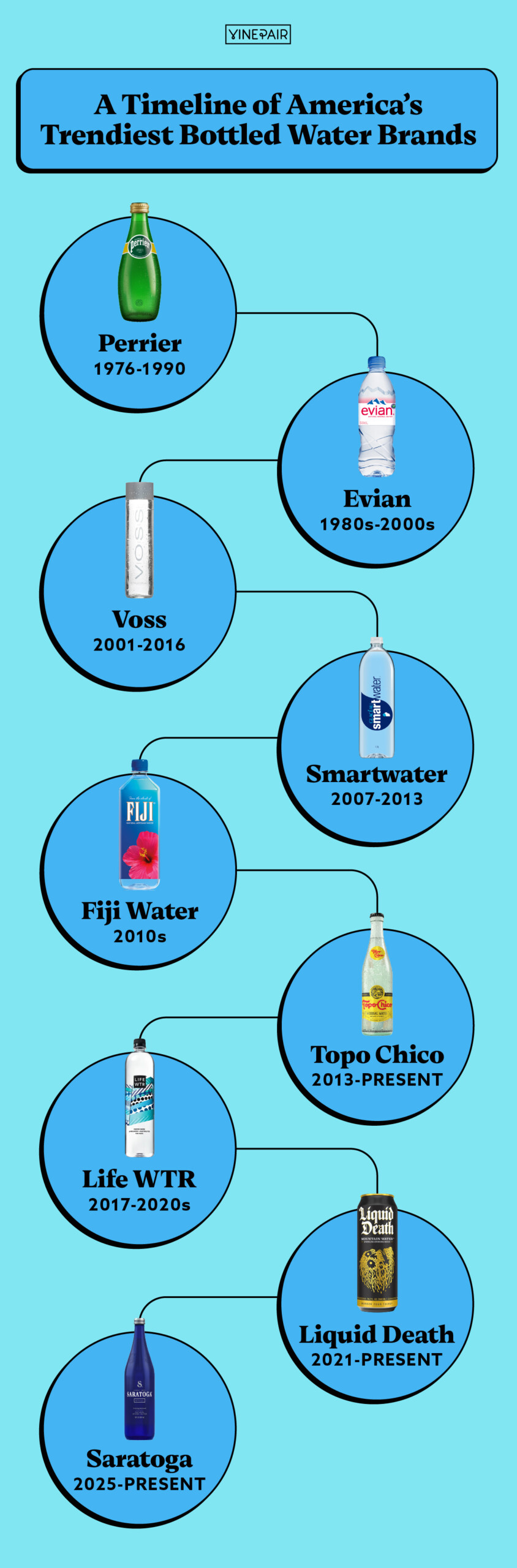
![A Timeline of America’s Trendiest Bottled Water Brands [Infographic]](https://vinepair.com/wp-content/uploads/2026/01/it-water-timeline-card-375x450.jpg "A Timeline of America’s Trendiest Bottled Water Brands [Infographic]")
Americans are obsessed with hydration. We dump electrolyte powder into limited-edition Stanley cups in acts of performative consumption that go viral on social media. And while reusable water bottles have their own cultural cache, it’s bottled water that’s largely responsible for quenching Americans’ literal thirst. According to research and trend analytics firm Beverage Marketing Corporation, U.S. consumers drink approximately 16.4 billion gallons of bottled water annually, amounting to roughly 47.3 gallons per capita.
Humans have been drinking purified water since the dawn of time, but it wasn’t until the late 1800s and early 1900s that major advancements in filtration and chlorination made clean drinking water readily available. But that was water from a tap — not a bottle. As it turns out, demand for bottled water (outside of issues with contaminated supply) didn’t even exist half a century ago. In the late 20th century, Americans were much more inclined to reach for drinks like coffee, tea, and soda, with their water source primarily being the free-of-charge tap. That was until the 1970s when the bottled water industry as we know it took form, and it all points back to one French brand: Perrier. According to a 1985 article in The New York Times, “In the late 1970s, when Perrier was the chic, non-alcoholic, non-caloric drink, it inspired a $500 million market for bottled and sparkling waters.”
But not all bottled water brands are perceived equally by consumers. Some waters are more than just vehicles for hydration — they’re a means of communicating to others that you’re in the know. Others are bona fide status symbols, with high-profile celebrity backers and countless shout-outs in pop culture.
To outline the progression of these trendy bottled water brands, we created this timeline revealing when each “it” water enjoyed its moment in the spotlight. It’s important to note that while brands like Aquafina (PepsiCo), Dasani (Coca-Cola), and Nestlé Pure Life are some of America’s best-selling waters, for the purpose of this article, only brands that have been marketed as more premium, luxury waters were considered.
Keep reading to check out our timeline of America’s trendiest bottled water brands.
Perrier: 1976-1990
Packaged in eye-grabbing, vibrant green glass (and now plastic), Perrier is one of the most recognizable labels on the market. The sparkling water brand dates back to 1899 when Dr. Louis-Eugène Perrier first bottled and sold water from Les Bouillens in Vergèze, France, a historic, Roman-era spring. By the 1970s, Perrier had been sold in some hotels and restaurants around the U.S. for a few decades, but it was not the widely available product it is today. That just wouldn’t do for marketer Bruce S. Nevins.
The adman is widely credited with introducing Perrier to the U.S. in the late ‘70s with a series of campaigns positioning the beverage as a luxurious, European hydration tool. In 1979, the brand launched a seductive television ad in which Perrier was described as a naturally sparkling water from a spring deep below the ground in southern France. “More quenching, more refreshing. A mixer par excellence,” the commercial declared, framing Perrier as a product to both quench thirst and mix into alcoholic drinks.
One year later, the brand partnered with the Olympics as an official sponsor for both the 1980 and 1984 Summer Games. By the end of 1984, Perrier sales were over $50 million per year. “Perrier pioneered the idea that drinking bottled water in small single-serve glass bottles was an affordable way to grasp a bit of European sophistication,” branding expert Douglass Holt told Fast Company in 2023, “which resonated among so-called yuppies.”
Despite practically launching the bottled water market, Perrier had lost some of its cultural cache by the 1990s. In 1990, the brand voluntarily recalled its entire inventory for benzene (a potential carcinogen) contamination in the bottling process. While the FDA stated that there was no significant health risk, the brand was pulled from shelves for four months to remove any potential danger. That same year, the brand was forced to remove the term “Naturally Sparkling” from its label after the FDA declared it to be misleading.
Now owned by Nestlé, Perrier has recovered in the decades since — every year, almost 1 billion bottles are sold worldwide. That said, it has yet to truly re-establish itself as the “it” bottled water brand it was in its heyday.
Evian: 1980s – 2000s
Evian hit the U.S. market in 1978 with the promise to replenish drinkers with natural, mineral spring water from Évian-les-Bains, France. In the 1980s, the brand skyrocketed in popularity following a number of highly suggestive ads featuring scantily dressed 20-somethings drinking Evian after working out at the gym. Evian was able to capitalize on the emerging health fads of the late 20th century and positioned itself as the water to drink if you care about your body and outward appearance. Advertisements exclusively cast gorgeous, fit people that its target demographic — health-conscious, urban-dwelling young people — could only hope to emulate. A 1989 article from the LA Times called Evian “the most intriguing accessory to come out of the ’80s.”
The pink-capped water bottle brand remained popular well into the ’90s, perhaps in large part due to a series of rumors that various celebrities used Evian to wash their hair and body. Cameron Diaz debunked one about herself, telling GQ in 2005 that the rumor she only washes her face with Evian is “ridiculous.” Evian remains a popular water choice to this day, but it’s been a long while since anyone’s claimed that celebrities demand it for their showers.
Voss: 2001 – 2016
Founded in 2001 by Ole Christian Sandberg and Christopher Harlem, Voss has attracted consumers since its inception with its sleek glass packaging, minimalist design, and crisp, Norwegian spring water. In the brand’s early years, distribution was deliberately restricted to high-end bars, restaurants, and hotels, which put forth an air of exclusivity only further emphasized by the ultra-premium price tag. While Voss might be more widely available today, it’s no less expensive — and certainly not perceived as any less elite. In 2019, Dwayne “The Rock” Johnson announced his role with the company as investor and strategic adviser, and in 2022, one TikTokker claimed to spend $2K per month on bottles of the stuff. Apparently it’s “such a luxury.”
Smartwater: 2007 – 2013
Established by J. Darius Bikoff in 1996, Smartwater has been associated with the health-minded crowd since its inception thanks to its vapor distillation technique said to create water that’s “as pure as the first drop of rain.” It wasn’t until 2007 that the brand would firmly embed itself within the cultural cache cannon, though. That year, Coca-Cola purchased Glaceau (the makers of Smartwater), which rapidly expanded the brand’s presence in stores across the U.S. Perhaps even more important for the brand’s image was an investment from Jennifer Aniston, which also saw the actress serve as the spokesperson for the pH-balanced water. The actress has appeared in numerous commercials and print advertisements over the years, pushing the brand’s valuation to over $830 million by 2019. Smartwater remains a trendy bottled water brand to this day, with stars like Pete Davidson and Zendaya posing for ad campaigns in the 2020s.
Fiji Water: 2010s
Fiji Water was founded in 1996 by entrepreneur David Gilmour and has been positioned as a luxury, artesian water ever since. Each bottle comes from an underground aquifer on Fiji’s Viti Levu, a volcanic, mineral-rich island on which Gilmour established a spa years prior.
The water’s pure, untouched-by-man marketing was subtle in some instances — i.e., the blue cap and tropical label. In others, it was impossible to miss. For example, in 2006, the water brand took out a full page magazine ad reading, “The label says Fiji because it’s not bottled in Cleveland.” The ad backfired spectacularly when tests run on both Fiji Water and Cleveland tap water showed the latter to have lower levels of trace arsenic.
Even so, Fiji maintained a powerful celebrity following, beloved by stars like Paris Hilton and Mary J. Blige, who allegedly had a 2006 concert rider calling for 10 bottles of water, but they “absolutely, positively must be Fiji.” Justin Timberlake was apparently a fan, too, making headlines in 2007 when he apparently called for 7,000 bottles of Fiji Water on his rider for five shows in London that year. Today, Fiji is still one of the best-selling bottled water brands in the U.S., and its celebrity associations remain strong.
Topo Chico: 2013 – Present
There’s no mistaking the flashy yellow label of Topo Chico. Established in Monterey, Mexico, in 1895, Topo Chico is bottled using water from the Cerro Topo Chico spring, which has a history dating back to 1440. That year, it’s said that an Aztec princess was struck with an unidentifiable illness for which no one could find a cure. Desperate for a solution, the king’s priests suggested a spring nearby that was rumored to restore health. So the princess went, tasted the water, and was allegedly cured. To celebrate the tale, an image of the princess sipping water from the spring is printed on every bottle of Topo Chico.
Despite being over 130 years old, the sparkling mineral water only developed its cult-like following here in the U.S. about 15 years ago. Well, at least throughout most of the U.S. Given the brand’s Mexican roots, the beverage has been popular in the American southwest for decades, with Texans displaying a particular proclivity for the drink. In 2013, though, the brand shifted its marketing strategy, securing placements at fashion shows, trendy coffee shops, and music festivals like Austin City Limits and Chicago’s Lollapalooza.
Coca-Cola’s acquisition of the brand in 2017 expanded distribution throughout the U.S., making Topo more readily available for the everyday consumer. The acquisition couldn’t have arrived at a better time — just three years later, Ranch Water skyrocketed in popularity, and what’s Ranch Water without Topo Chico?
Life WTR: 2017 – 2020s
PepsiCo launched Life WTR in January 2017 as a premium bottled water brand specifically targeted at Millennials and Gen Z consumers. Packaged in the same, larger-format 700-milliliter and 1-liter bottles as rival Smartwater, Life WTR distinguished itself with an ever-rotating set of labels designed by emerging artists from around the world. Almost immediately, Life WTR was deemed the new “it” water, with approximately 85 million bottles sold between February and December 2017, according to Circana. To firmly establish itself as a premium offering, Life WTR has partnered with a number of high-profile celebrities, including musician Doja Cat, actress and writer Issa Rae, and LeBron James.
Liquid Death: 2021 – Present
Liquid Death looks like it would feel more at home in the craft beer aisle than in the water section, but that’s perhaps what makes this canned water brand so special. Officially launched in 2019, Liquid Death was founded by Mike Cessario, who thought the product would only be popular among punk-rock musicians in need of refreshment during sets. Spoiler alert: It’s caught on with more than just musicians.
In 2021, the brand inked a deal with Live Nation to make it the exclusive water provider at over 120 concert and festival venues across the U.S. Liquid Death has also secured advertising partnerships with dozens (maybe hundreds) of podcasts since its debut, and has collaborated with celebrities like Martha Stewart, Tony Hawk, Kylie Kelce, and more. In 2025, the brand launched into the most mainstream marketing channel available with its first Super Bowl ad.
Saratoga Spring Water: 2025 – Present
Saratoga Spring Water dates all the way back to 1872, but judging by the way the brand spread across social media feeds in March 2025, one would think it was brand new. That’s probably because the water — packaged in vibrant, sapphire glass bottles — was the focal point of what is certainly the world’s most preposterous morning routine.
The video was posted by fitness influencer Ashton Hall, and in it he brushes his teeth with Saratoga, drinks it during a workout and shatters the bottle, and dunks his face in a Saratoga water ice bath. All of this happens between the normal human hours of 3:50 and 5:52 a.m. The video only continues to devolve from there, with Saratoga front and center throughout the entire two-minute runtime.
Ridiculousness aside, the move — which is not believed to have been paid for by Saratoga — did wonders for the brand. That month, Google search results for “Saratoga water” and “Saratoga Spring” spiked for basically the first time ever, and, for the first 11 months of 2025, sales were up 69 percent year-over-year. The brand is heading into 2026 with some strong momentum already, launching a new ad campaign starring WNBA point guard Skylar Diggins and returning for the second year as the official water of the Golden Globes.
*Image retrieved from John via stock.adobe.com
